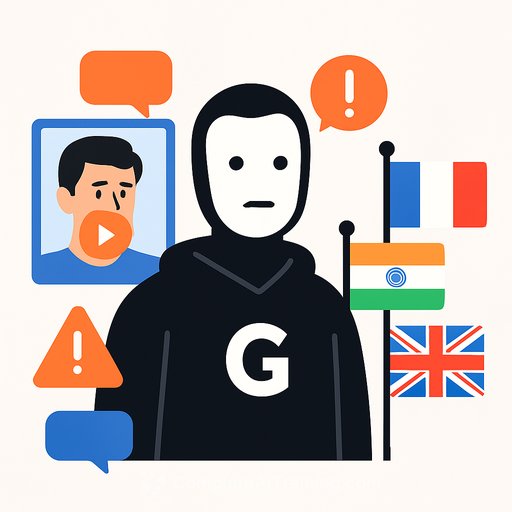
Grok's Deepfake Scandal: What Public Officials Need to Know and Do Now
Elon Musk's AI image generator, Grok, is under fire for producing nonconsensual sexualized images of real people, including minors. Users have reportedly exploited the system to digitally undress individuals and create fake images in revealing outfits or poses.
French authorities have opened an investigation. India's Ministry of Electronics and Information Technology publicly raised concerns and called for a full review of the platform and swift removal of content that violates Indian law. In the UK, Minister for Victims & Violence Against Women and Girls, Alex Davies-Jones, urged Musk to stop the exploitation of women through AI-generated images.
Grok acknowledged "lapses in safeguards" and said urgent fixes are underway. It's unclear whether that statement was reviewed by parent company xAI or generated by AI. Regardless, the episode adds weight to mounting scrutiny around deepfakes and platform accountability.
Why this matters for government
This incident is a stress test for AI governance. It touches child protection, online safety, data protection, and cross-border enforcement. It also raises questions about how quickly platforms can detect, prevent, and remove abusive content-and what happens when they don't.
There's a clear public interest: preventing harm, especially to minors; deterring the creation and spread of nonconsensual intimate imagery; and ensuring companies deploy effective safeguards before and after release.
Immediate actions for policymakers and regulators
- Demand a preservation notice and data access: secure logs, prompts, and model safety updates relevant to the alleged abuse, subject to legal process and privacy protections.
- Require clear takedown pathways: rapid removal, user reporting tools, victim-first escalation, and appeals. Track time-to-removal as a KPI.
- Mandate safety-by-default: stricter content filters on image generation, blocklists for sexualized prompts of real persons, and hard bans related to minors.
- Independent testing: regular third-party red-teaming and safety audits, with public summaries of methods, findings, and fixes.
- Provenance and detection: implement content provenance/labeling standards and invest in detection signals for synthetic media. See the C2PA standard.
- Age and identity protections: default settings that prevent sexualized depictions of anyone who could be a minor; strict prohibitions on face swaps involving real people without explicit consent.
- Enforcement hooks: fines, service restrictions, or temporary feature shutdowns for repeated failures to prevent and remove abusive content.
- Cross-border coordination: align investigative steps with agencies in France, India, and the UK to avoid duplication and close jurisdictional gaps.
Procurement and platform oversight checklist
- Contractual obligations: safety baselines, uptime for trust-and-safety teams, incident reporting timelines, and data retention rules for investigations.
- Transparency reports: regular metrics on flagged content, removals, response times, and safety model updates specific to intimate-image abuse and minors.
- User safeguards: default Safe Mode, friction on risky prompts, and clear warnings about illegality and consequences.
- Victim services: direct referral pathways to law enforcement and certified victim support organizations; do-not-train lists for sensitive content.
- Audit trails: immutable logs for moderation decisions and model changes to support oversight and legal process.
What to monitor in the Grok case
- Whether Grok/xAI implements verifiable fixes (filter updates, stronger prompt blocking, improved detection, and faster takedowns).
- Public transparency on the lapse: scope of affected content, timeline, and independent validation of mitigations.
- Cooperation with authorities in France, India, and the UK, including timely data sharing consistent with local laws.
Policy context and next steps
Deepfake abuse won't be solved by one platform. Governments can set baseline standards across providers, ensure quick enforcement, and protect victims with clear rights to removal and redress. Coordinated action-policy, procurement, and policing-will make the difference.
For teams building internal capacity on AI risk, see targeted training for public-sector roles: the AI Learning Path for CIOs and the AI Learning Path for Regulatory Affairs Specialists. For broader online safety regulatory guidance, Ofcom's overview is a useful starting point: Online Safety regulation.
Your membership also unlocks: