SAHI and BODH: India's new guardrails for healthcare AI
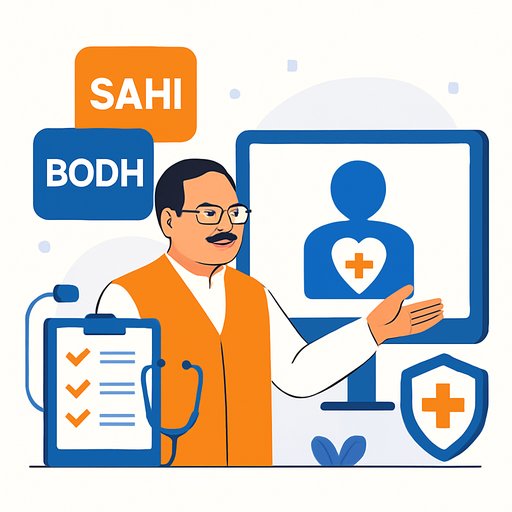
India is moving from pilots to accountability in health AI. At the India AI Summit in Bharat Mandapam, Union Health Minister Jagat Prakash Nadda will launch two national initiatives: SAHI (Strategy for Artificial Intelligence in Healthcare for India) and BODH (Benchmarking Open Data Platform for Health AI).
Together, they set a clear rule: AI should assist clinicians and health workers, not replace them. The focus is safety, reliability, and equity-without slowing down useful innovation.
What SAHI sets in motion
SAHI is the country's first structured framework for integrating AI into hospitals, public health programs, and digital health systems. It centers on transparent governance, strong data stewardship, clear validation standards, and responsible deployment.
In practice, this means every AI tool in care delivery, claims, or surveillance must be explainable where it matters, clinically validated, and accountable to human oversight. Equity-performance across regions, facilities, and patient groups-is not optional.
What BODH brings to the table
BODH is a national evaluation platform built to test and benchmark AI models before they scale. Developed by IIT Kanpur with the National Health Authority under the Ayushman Bharat Digital Mission, it enables model testing on diverse, real-world datasets without exposing patient information.
The goal: consistent performance across hospitals, states, and populations. Think of it as a pre-deployment checkpoint that reduces bias, overfitting to single sites, and surprise failure modes in production.
- Who it serves: diagnostics, clinical decision support, claims management, disease surveillance, and more.
- What it checks: accuracy, generalization across settings, fairness across cohorts, and operational metrics that matter at the bedside and in back offices.
Why this matters for healthcare leaders
This is a shift from ad hoc pilots to structured oversight. If you run a hospital, a public health program, or an insurer, SAHI and BODH give you national guardrails you can plug into procurement, IT, and quality workflows.
For startups and vendors, this sets a higher bar-and a clearer path to scale-by standardizing how models are validated and compared.
Immediate actions for hospitals and health systems
- Set up an AI governance group with clinical, IT, legal, ethics, and quality leads.
- Inventory every AI tool in use or under consideration. Note intended use, data inputs, model owner, validation evidence, and monitoring plan.
- Adopt a model risk tiering approach (low/medium/high) based on clinical impact and autonomy. Tighten controls as risk rises.
- Require vendors to provide performance by site and cohort, calibration plots, error analyses, and plans for drift monitoring.
- Build a feedback loop: clinician override logging, incident reporting, and a clear path to pause/rollback.
- Align consent, audit, and data retention with ABDM and NHA guidance.
Procurement checklist you can use now
- Intended use and clinical workflow fit are explicit and documented.
- Evidence of external validation across at least two independent sites.
- Performance reported by subgroup (age, sex, region, clinical condition) to check equity.
- Explainability where clinically relevant (e.g., feature importance or saliency) without leaking PHI.
- Data handling: no unintended data export, secure logging, and clear deletion process.
- Post-market plan: monitoring frequency, drift detection, retraining triggers, and support SLAs.
- Pathway to BODH benchmarking before scale-up.
What to expect from BODH evaluations
- Standardized datasets representative of Indian care settings and disease burdens.
- Blind benchmarking with privacy-preserving processes so patient data isn't exposed.
- Comparable metrics across vendors and sites to support procurement decisions.
- Focus on generalization, fairness, and stability-not just headline accuracy.
For clinicians
- AI is assistive. You stay in the loop and on the hook for final decisions.
- Expect clearer model labels: intended use, known limitations, and when to override.
- Report mismatches and near-misses-your feedback will shape model updates and approvals.
For public health programs and payers
- Use SAHI guardrails to vet triage, risk scoring, and claims tools before scale.
- Require BODH results for high-impact use cases that drive incentives or coverage decisions.
- Monitor for regional drift and provider behavior changes introduced by AI.
Risks to manage early
- Overreliance: automation bias can creep in-design interfaces that keep clinicians attentive.
- Data gaps: rural or low-volume facilities can be underrepresented; insist on subgroup performance.
- Shadow AI: stop unapproved tools from entering clinical workflows via BYOD or informal pilots.
Where this fits in India's digital health stack
These initiatives build on the Ayushman Bharat Digital Mission's health data and consent rails. Expect tighter alignment between ABDM registries, consent artifacts, and the way AI tools request, process, and log data access.
For context on ABDM, see the National portal and program documentation.
If you're skilling teams for this shift
Clinical, data, and procurement teams will need shared language on AI validation and safety. Curated course paths by role can accelerate that alignment.
- AI Learning Path for CIOs - recommended for procurement, IT, and governance leads.
- AI Learning Path for Regulatory Affairs Specialists - useful for compliance, policy, and ABDM alignment.
Bottom line
SAHI sets the rules. BODH tests the tools. If you're responsible for care quality, claims integrity, or public health outcomes, start aligning your governance, procurement, and monitoring playbooks now.
The payoff is simple: safer deployments, fewer surprises, and AI that actually supports clinicians and patients where it counts.
Your membership also unlocks: