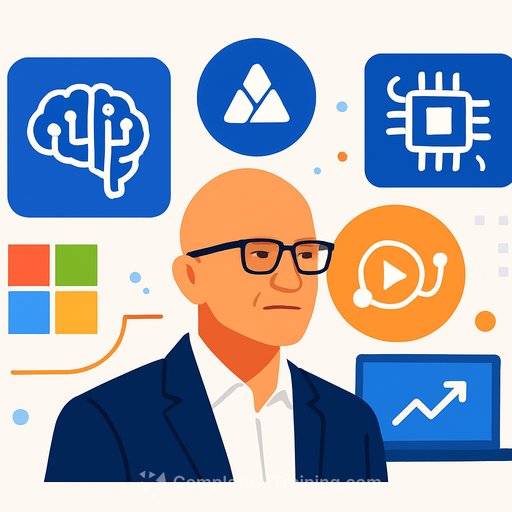
Microsoft Redraws Its AI Org Chart - And Why It Matters for Executives
Microsoft quietly reworked its leadership in December 2025 to move faster on AI decisions. This wasn't routine. It was a signal: AI is now core infrastructure for the company, not a side feature.
Reports suggest Satya Nadella is pulling trusted operators closer to the heart of model development, reducing single-partner risk, and setting up Microsoft to own more of its AI future. The early OpenAI bet paid off with products like Copilot, but the next decade will be decided by control, cost, and speed.
The New AI Playbook: Beyond One Partner
Microsoft's relationship with OpenAI evolved in October 2025 under a new agreement. OpenAI became a public benefit corporation, Microsoft took an estimated 27% equity stake valued near $135B, and retained key rights to AI models through 2032. The partnership stays strong, but the strategy now widens.
Microsoft is building a multi-model ecosystem: integrating partners like Anthropic and Meta while expanding its own model efforts (including internal MAI systems). The logic is simple-diversity of models improves resilience, pricing leverage, and performance coverage across use cases.
- Portability: Route workloads to the best model for the job (cost, latency, accuracy).
- Coverage: Mix reasoning, multimodal, code, and safety-tuned models across business functions.
- Negotiation power: Avoid lock-in and keep unit economics in check as usage scales.
Who's Leading the Charge
Jay Parikh now leads a newly formed Core AI division. His mandate: unify engineering, model infrastructure, and product building blocks to ship the next generation of agentic software-systems that remember context, take actions, and complete multi-step work across apps.
Judson Althoff steps up to lead Microsoft's commercial business, freeing Nadella to focus on technical direction and model strategy. It's a deliberate split: one leader drives invention, another scales it across the enterprise customer base.
What Core AI Will Build
- An AI-first application stack: reusable primitives for memory, planning, tools, and workflow control.
- Agentic applications: copilots that don't just assist-they complete tasks with oversight.
- Model routing and safety: policy guardrails, evaluations, and observability baked into the platform.
- Deep product integration: from Microsoft 365 to Azure, so AI value shows up where work happens.
Inside Microsoft: Culture Turned into Execution
Internally, Microsoft has made AI use non-negotiable. Microsoft 365 Copilot and GitHub Copilot are expected in daily workflows, not treated as optional add-ons. New researcher and analyst agents point to a future where work is delegated, not just assisted.
The pace is creating energy and friction. Teams are being measured on AI adoption and output. Hiring favors people who can ship with AI, not just talk about it. For leaders, the message is clear: change the operating model, not just the toolset.
Microsoft 365 Copilot explains how this shows up in practical workflows across knowledge work.
Market Impact: A More Durable Position Against Google and Amazon
Microsoft's moves aim to improve its position in enterprise AI and cloud. A broader model mix, deeper in-house capability, and a clear distribution channel through Microsoft 365 and Azure give it leverage where it counts-inside enterprise workflows and infrastructure budgets.
The updated OpenAI agreement still matters, but it's now part of a wider system. Microsoft keeps valuable model rights while gaining freedom to partner broadly and build internally. That balance reduces risk as model performance, pricing, and safety standards keep shifting.
What This Means for Your 2026 Roadmap
- Adopt a multi-model strategy: Plan for model routing, evaluation, and swap-ability. Don't bet on one vendor.
- Invest in agentic patterns: Memory, tools, and workflow orchestration beat isolated chat features.
- Own your data layer: Clean pipelines, retrieval, and policy governance are the real moat.
- Build AI FinOps: Track token spend, latency SLAs, and quality metrics. Tie usage to business outcomes.
- Revamp procurement: Contracts should cover data use, indemnity, safety, and portability.
- Upskill line leaders: Push hands-on AI usage across sales, finance, ops, and product.
- Pilot, measure, scale: Start with 2-3 high-leverage workflows, set baseline metrics, then expand.
- Plan for governance: Central policies, local autonomy. Clear audit trails and incident response.
Practical Moves You Can Make This Quarter
- Stand up a lightweight model evaluation rig (quality, bias, cost) and a routing pattern.
- Build one agentic workflow per function (sales proposals, FP&A variance, vendor onboarding).
- Enable enterprise-wide Copilot usage with usage dashboards and team-level goals.
- Define AI data contracts with security, retention, and redaction rules.
FAQs
What AI leadership changes did Satya Nadella make in 2025?
In December 2025, Nadella reorganized leadership to speed AI execution. Jay Parikh leads Core AI to drive product and platform innovation, while Judson Althoff runs the commercial business so Nadella can focus more on technical strategy.
Is Microsoft moving beyond OpenAI for AI development?
Yes. Microsoft continues to partner with OpenAI but is expanding to multiple models and building internal systems. The goal is control, flexibility, and better economics across use cases.
How will Microsoft's AI strategy impact Azure and enterprise services?
Expect tighter integration of multi-model capabilities into Azure, stronger governance and safety tooling, and more capable agentic applications across Microsoft 365 and industry-specific solutions. The result: broader coverage of enterprise workloads with clearer ROI.
For Further Learning
If you're mapping skills to roles for 2026 initiatives, see these curated paths: AI for Executives & Strategy, AI Learning Path for VPs of Strategy, and AI Learning Path for CIOs.
Closing Note
Microsoft's late-2025 moves show a shift from single-partner dependence to a diversified, in-house-strong AI strategy. New leaders focus on shipping agentic software at scale, while commercial operations drive adoption. This sets up Microsoft to compete on speed, cost control, and depth of enterprise integration.
Disclaimer
The content shared by Meyka AI PTY LTD is solely for research and informational purposes. Meyka is not a financial advisory service, and the information provided should not be considered investment or trading advice.
Your membership also unlocks: