UNESCO strengthens Namibia's judiciary on AI and the Rule of Law
25 November 2025
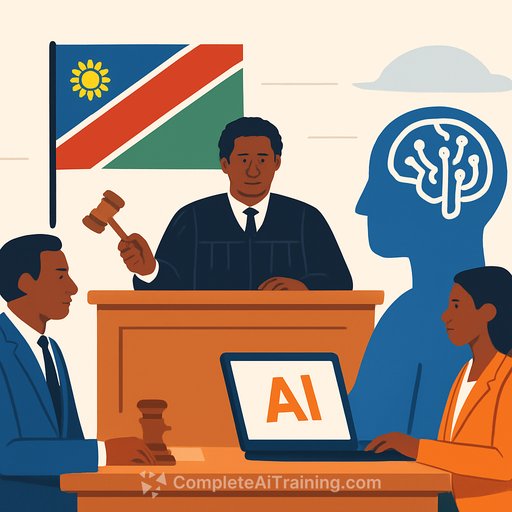
From 3-5 November 2025, 32 judges, magistrates, and justice sector officers met at the United Nations House in Windhoek for UNESCO's Training on Artificial Intelligence and the Rule of Law. Senior members of the bench, including Supreme Court Justice Hosea Angula and High Court Judge Shafimana Ueitele, took part, signaling concrete interest from the judiciary.
The agenda was clear: put AI to work where it adds value, protect judicial independence, and keep rights at the center. Sessions covered adoption policies, ethics and legal risks, and cybersecurity-giving participants practical tools to use AI without compromising due process.
Why this matters for the bench and bar
AI already touches legal research, case management, and data security. If courts and legal offices don't set the rules, the tools will set them by default. This training focused on keeping human judgment in control and building procedures that stand up in court and in public trust.
What the training covered
- Responsible adoption: procurement criteria, testing, documentation, and guardrails for decision-support tools.
- Judicial independence: keeping AI advisory, not determinative; preventing undue influence from opaque models.
- Ethics and human rights: bias, discrimination, explainability, transparency, and due process implications.
- Cybersecurity and data protection: safeguarding case files, sensitive evidence, and court infrastructure.
- Practical use cases: AI-assisted research, e-discovery, docket triage, and case management-with protocols for validation and disclosure.
- Governance and collaboration: rights-based AI policy and interdisciplinary work between legal and technical experts.
Key messages from the sessions
UNESCO's Head of Office and Representative to Namibia, Ms. Eunice Smith, linked the workshop to broader national efforts-recent parliamentary training and a free, certified online course for civil servants on AI and digital transformation. Her point: the judiciary is a central actor in protecting rights as AI enters public institutions.
She noted the programme helps the courts use AI for research, case management, and decision-making support while addressing risks like bias and opacity. The goal is practical competence paired with accountability.
Dr. Kamel El Hilali, AI and the Rule of Law Specialist at UNESCO, underscored the non-negotiable role of the judge: "AI does not, cannot, and must not replace human judges." The tools can assist; they cannot decide.
Speaking virtually, Ms. Anna Hoffmann-Kwanga, Resident Representative of the Konrad Adenauer Stiftung in Namibia and Angola, emphasized shared responsibility among partners to build institutional readiness. As data and algorithms influence legal processes, legal officers need clear methods to uphold the rule of law.
Mr. Silas Shimakeleni, Senior Legal Officer at the Legal Aid Directorate (Ministry of Justice and Labour Relations), highlighted the training's day-to-day value for judicial practice and innovation in service delivery.
Delivering remarks on behalf of Prof. Dr. Anicia Peters, CEO of the National Commission of Research, Science and Technology (NCRST), Mr. Kelvin Mubiana Katukula stressed guardrails: fairness, privacy, and administrative justice. Any AI that weakens these principles should be rejected, with human oversight and accountability staying central.
Practical steps courts and legal offices can adopt now
- Publish an internal policy on acceptable AI use for research, drafting, and case management; require disclosure when AI-assisted content is used.
- Set a procurement checklist: data provenance, bias testing, explainability options, audit logs, and exit strategies.
- Establish validation procedures: pilot on non-sensitive matters, compare outputs to human baselines, and document limitations.
- Create a standing review board (judges, clerks, IT, data protection officers) to oversee tools and incidents.
- Adopt data governance rules: retention, encryption, access control, and protocols for handling confidential materials.
- Prohibit AI tools from making or recommending outcomes in adjudication; keep them strictly advisory.
- Run continuous capacity-building for judges, magistrates, prosecutors, and court staff with scenario-based exercises.
Policy context and next steps
The workshop closed with discussion on sustainable adoption, capacity-building, and legislative frameworks that protect human rights. UNESCO's Global Toolkit on AI and the Rule of Law will continue to guide Namibia's justice sector as it develops procedures that are transparent, fair, and defensible.
For broader reference, the Council of Europe's ethical charter on AI in judicial systems offers useful principles for courts considering AI-assisted tools. Read the charter.
Further learning
Legal professionals looking to deepen practical skills with vetted AI courses can explore options organized by profession. Browse courses by job.
Your membership also unlocks: