DOE Should Fuse AI Foundation Models with Traditional Computing to Shift Scientific Discovery
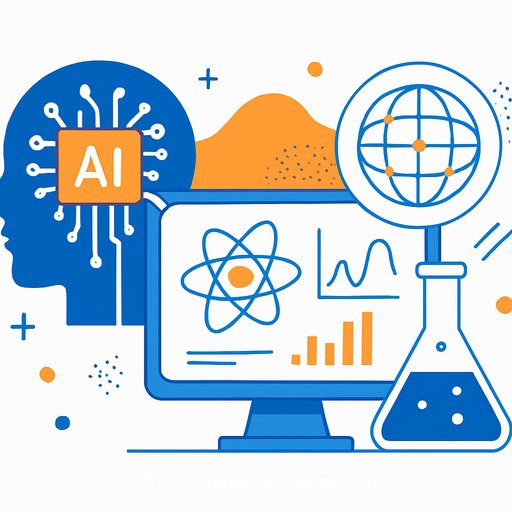
A new report from the National Academies of Sciences, Engineering, and Medicine outlines how the U.S. Department of Energy (DOE) can use foundation models to accelerate research - and why pairing them with physics-based computation is the smart move. The central idea: use AI to scale insight and speed, while relying on proven simulation and theory for trust, verification, and safety.
Why Foundation Models Matter for Science
Foundation models are large neural networks trained on massive, diverse datasets. After fine-tuning, they can learn new tasks, work across modalities, and discover patterns in ways that classic models can't match. For data-rich scientific domains, they can process heterogeneous inputs at volumes that exceed the capacity of many current tools.
That said, assurance, verification, validation, and uncertainty quantification must get stronger before these models can support high-stakes decisions. The report is clear: AI should enhance - not replace - established computational methods.
Keep Physics-Based Models at the Core
Traditional computational models remain the bedrock of predictive science. They are grounded in physical laws, verified and validated, and essential for safety-critical domains like nuclear systems, materials physics, and Earth system science. Hybrid approaches can bridge predictive modeling with interpretive reasoning, giving researchers systems that solve complex problems and explain why the answers make sense.
What the Report Recommends
- Invest in DOE-specific foundation models where the agency has an advantage (extensive scientific datasets, world-class talent, and mission-critical problems).
- Prioritize hybridization of foundation models with established computational methods, while continuing investment in software and infrastructure.
- Establish standardized protocols and benchmarks for training, documentation, reproducibility, and evaluation.
- Strengthen assurance, verification and validation, and methods to quantify uncertainty.
- Leverage autonomous AI systems to help operate scientific labs where appropriate.
- Pursue partnerships with industry and academia to advance national mission goals.
What This Means for Research Teams
- Faster iteration on hypothesis generation, experiment planning, and analysis across large, messy datasets.
- Surrogate modeling to reduce the cost of expensive simulations - with guardrails and uncertainty estimates.
- Improved pattern discovery in materials, climate, and complex systems research, with physics-based checks in the loop.
- Opportunities for autonomous labs to accelerate feedback cycles between simulation, modeling, and experiments.
Practical Steps to Get Started
- Map your data assets and high-value simulations. Identify where a hybrid model could reduce time-to-insight.
- Run a small pilot: fine-tune a foundation model on your domain data, and couple it with an existing physics-based code path.
- Define evaluation from day one: accuracy, calibration, uncertainty reporting, reproducibility, compute cost, and data lineage.
- Adopt documentation standards (datasets, model cards, training recipes) and enforce versioned, repeatable pipelines.
- Coordinate with safety, compliance, and cyber teams before moving pilots into production or mission-critical contexts.
Where DOE Has an Edge
The agency holds extensive physical science datasets to train and test models, has the ability to attract top talent, and runs facilities where autonomous systems can drive real-world impact. With clear protocols and benchmarks, DOE can scale these capabilities across programs without sacrificing trust.
Risk, Assurance, and Trust
Foundation models can fail in surprising ways. To use them responsibly in science, teams need rigorous verification and validation, clear uncertainty estimates, and transparent documentation. The goal is dependable, explainable systems that work hand-in-hand with established computational methods.
Learn More
Your membership also unlocks: