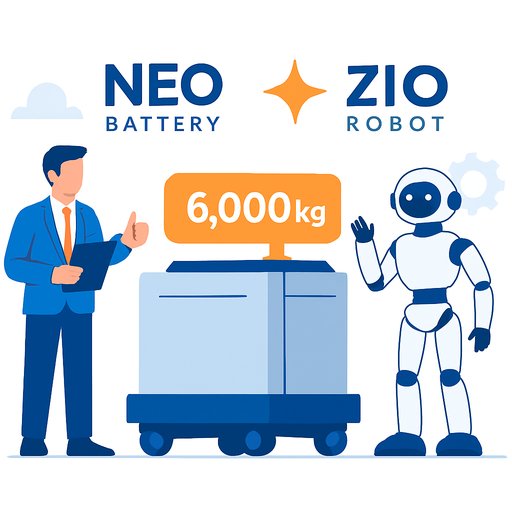
NEO Battery Materials Partners with Zio Robot to Boost AMR Payloads and Uptime
NEO Battery Materials has entered a Strategic Technology Partnership with South Korea's Zio Robot to integrate high-energy lithium-ion cells into Zio's Mobile Worker (MW) autonomous mobile robots. The focus: higher energy density and high-rate discharge versus the Chinese-manufactured batteries currently used. Expected system-level outcomes are longer runtime and higher payload support. Prototyping will be validated with anchor collaborators, including Samsung Electronics, in live industrial and manufacturing environments.
Why this matters for IT and development teams
- Higher energy density extends mission windows and reduces charge interruptions, opening room for tighter SLAs on throughput.
- Improved high-rate discharge supports torque-heavy starts, docking maneuvers, and payloads up to 6,000 kg without brownouts.
- Zio's modular MW architecture lets multiple units link/unlink on demand, so fleet software can dynamically right-size capacity per job.
- Diversifying away from Chinese battery suppliers addresses sourcing constraints and compliance requirements in Western and allied markets.
Technical angles to watch
- Cell chemistry and pack design: silicon-enhanced Li-ion promises higher Wh/kg and Wh/L; confirm pack voltage ranges, max C-rate, internal resistance, and thermal profile under sustained load.
- BMS and telemetry: ensure CAN/RS-485/Ethernet compatibility, SoC/SoH accuracy, coulomb counting, fault codes, and firmware update paths are documented and testable.
- Fast charging and cycle life: target charge strategy (constant current/constant voltage), peak charge rate, cooling needs, and expected cycles at your duty profile (opportunity charging vs. scheduled).
- Safety and certifications: confirm pack-level protections (OVP, UVP, OCP, OTP), enclosure ratings, and export/regulatory needs. Zio holds ISO 9001/14001/45001 and KC & CE certifications for its platforms.
What the prototype phase means for deployment
Field trials with Samsung Electronics and other collaborators will stress-test energy delivery under real payloads, turns, and docking cycles. Expect revisions to pack tuning, thermal management, and firmware before broad release. Use this window to align your data model, charging infrastructure, and maintenance playbooks with the new performance envelope.
Metrics to track during evaluation
- Energy and performance: Wh/kg, Wh/L, peak and sustained C-rate, voltage sag under load, charge time from 20-80%.
- Operations: completed missions per shift, charge events per day, average queue time at chargers, and MTBF/MTTR tied to energy faults.
- Economics: cost per cycle, cost per delivered pallet/kg-km, and battery utilization vs. idle.
- Thermals and health: temperature deltas under heavy payloads, SoH decay rate, and fault-code frequency.
Impact on AMR fleet orchestration
- Longer runtime reduces charge scheduling conflicts; update dispatch logic to favor continuous missions and cut mid-route swaps.
- Linked MW units require SoC parity; add pre-mission SoC checks and smart pairing to avoid de-links mid-haul.
- Rerun route planning with heavier single-haul capacity to consolidate tasks and reduce hallway congestion.
- Revise safety zones if increased torque changes stopping distance under max payload.
Actionable checklist for IT and engineering
- Set up a battery telemetry pipeline and dashboards for SoC/SoH, temps, C-rate, and charger utilization.
- Update your digital twin to simulate 10-25% longer runtime and fewer charge cycles; validate throughput and staffing impacts.
- Audit chargers: power availability, connector standard, cooling/ventilation, and queuing logic for opportunity charging.
- Define acceptance tests: peak payload climbs, rapid direction changes, and emergency stops under low SoC.
- Negotiate SLAs on cycle life, replacement timelines, and spares inventory; document firmware rollback procedures.
Company notes
Zio Robot develops AMR-based logistics systems for warehouses, hospitals, and manufacturing, with omnidirectional drive, intelligent control algorithms, and a modular architecture that lets MW units link/unlink by job. The company was founded by DGIST researchers and is backed by Samsung Electronics via C-Lab Outside. Learn more at Zio Robot.
NEO Battery Materials is a Canadian developer of silicon-enhanced lithium-ion technology for drones, robotics, unmanned systems, electronics, EVs, and energy storage, with a focus on low-cost manufacturing and fast charging. Details are available at NEO Battery Materials.
Related resources
Bottom line: if your AMR fleet is constrained by runtime or torque under heavy loads, this partnership could shift your planning assumptions. Line up data collection, charger capacity, and acceptance tests now so you can move fast once pilot results land.
Your membership also unlocks: