Netflix's AI North Star: Retention at Global Scale
Netflix isn't treating AI as a spectacle. It's treating it like plumbing. With more than 325 million paid memberships and $45.2 billion in 2025 revenue (up 16% year over year), the company has shifted from chasing growth to protecting what matters most: retention.
At this scale, retention isn't a KPI on a dashboard. It is the business. The company is guiding to a 31.5% operating margin in 2026 with continued double-digit revenue growth, and AI is the calm, unsexy engine meant to keep that flywheel steady.
From Growth Machine to Value System
Netflix's audience is approaching a billion people. The challenge: deliver a service that feels personal in every market without splintering the operation. AI solves for this by making the same catalog feel different to different people-without multiplying costs.
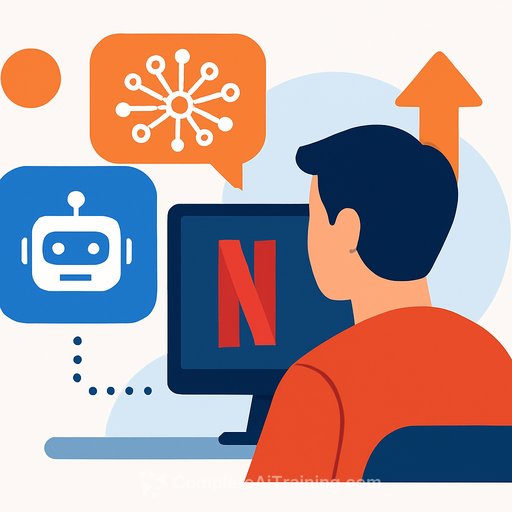
Recommendations adjust to context (time of day, device, recent behavior) instead of leaning only on history. Add AI-driven subtitle localization, merchandising optimization, and real-time discovery, and you reduce the gap between intent and satisfaction. That gap is where churn hides.
Discovery Is a Margin Lever
Executives were blunt: time spent searching is time spent questioning the subscription. That's why AI sits behind the row order, the artwork you see, even the nudge you didn't notice. Less hunting, more watching. Same content budget, better retention curve.
If you want the deeper mechanics, Netflix has long documented the business impact of recommender systems and artwork testing. Worth a read: The Netflix Recommender System (ACM).
Ads That Don't Erode Value
Advertising is the clearest stress test for this philosophy. Ads add friction by default. So instead of stuffing more inventory, Netflix is using machine learning to help advertisers target better, automate planning, and tailor creative to Netflix IP-so the ad experience doesn't trigger the cancel button.
The goal isn't higher ad load. It's preserving perceived value so the ad tier grows without cannibalizing retention. For context on the approach, see Netflix's public notes on its ad plans: Basic with Ads.
All Hours Aren't Equal
Not every minute of viewing carries the same weight. Live events punch above their time share with cultural relevance and sign-ups. Flagship series stabilize churn far more than casual viewing does.
AI helps quantify these asymmetries. Which titles deserve heavier promotion? Which franchises justify expansion? Which formats are worth testing? This is where creative ambition meets financial discipline-and that combination is what compounds retention over time.
Scaling Complexity: The Warner Bros. Question
The proposed acquisition of Warner Bros. would bring a deep library and a premium brand like HBO Max into the fold. It also adds operational complexity. Retention-focused systems are the glue: one platform, many tastes, minimal friction.
At Netflix's size, tiny shifts in churn have outsized effects. A fractional improvement can beat a price hike or another nine-figure content bet. AI lets the company chase those small, durable wins methodically, not by gut feel.
What Executives Should Steal from This Playbook
- Set a single, hard objective for AI: reduce churn. Let every model ladder up to that metric.
- Build personalization as infrastructure: context-aware recommendations, localized UX, creative testing at scale, and robust Design.
- Treat discovery time as a cost center. Shorten it and you lift margin without adding content spend.
- Score content by retention impact, not vanity metrics. Promote and invest accordingly.
- In ad-supported models, optimize for perceived value first; revenue follows when people stay.
- Design for merge scenarios (new brands, libraries, markets). AI should simplify choices, not add menus.
Metrics That Actually Matter
- Time-to-satisfaction: minutes from app open to play.
- Retention impact by title: incremental 30/60/90-day retention lift.
- Search abandonment rate: sessions with no play event.
- Ad-tier net retention vs. ad-free: delta after controlling for tenure and price sensitivity.
- Localization efficiency: title availability to watch-time conversion across languages/regions.
- Churn elasticity: sensitivity to promo/price vs. discovery improvements.
The Bigger Shift
The line between entertainment and software is getting thin. Netflix isn't trying to automate creativity; it's building a system that protects attention, session by session, across markets and formats.
If you run a subscription business, this is the lesson: growth is a phase, retention is a system. Put AI to work on the system.
For Teams Building This Capability
If you're formalizing a roadmap for personalization, ads, or retention analytics, consider curating training by function to speed internal adoption-for example, the AI Learning Path for Sales Managers.
Your membership also unlocks: