The Similarities and Differences Between Neural Networks and Human Brains
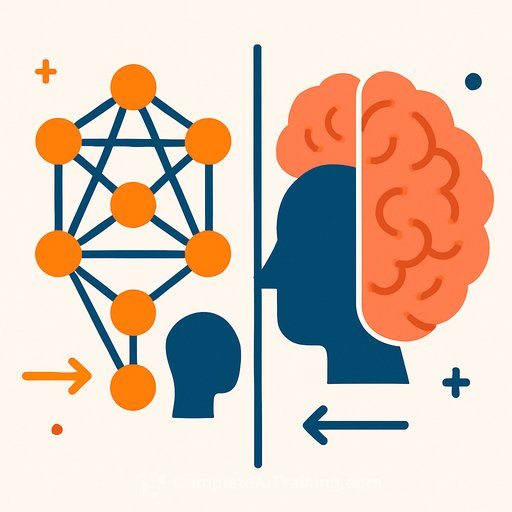
Artificial neural networks and human brains share a name and some structural traits, but their operations and demands differ dramatically. A toddler learns language with minimal energy and social interaction, while training large language models (LLMs) requires vast computational resources and enormous datasets. Despite these differences, both systems consist of millions of interconnected units—biological neurons in humans and artificial neurons in neural networks.
Both brains and neural networks can generate fluid, flexible language, yet scientists still struggle to fully grasp how either system functions internally. This gap in knowledge challenges researchers aiming to improve AI models and deepen insights into human cognition.
Neural Networks as Models of Human Cognition
Recent studies published in Nature highlight the use of neural networks to predict behavior in psychological experiments. One project fine-tuned Meta’s Llama 3.1, an open-source large language model, on data from 160 psychology tasks, creating a model dubbed "Centaur."
Centaur outperformed traditional psychological models, which rely on simple mathematical equations, in predicting human choices and memory tasks. This predictive capability is valuable for researchers, as it allows for virtual experimentation before involving human participants. More intriguingly, the creators suggest Centaur might offer clues about the mechanisms driving human cognition by analyzing how it replicates behavior.
Limitations and Skepticism
Despite Centaur’s predictive success, some psychologists question its explanatory power. The model contains billions of parameters—far more than the relatively simple equations used in conventional psychology. This complexity raises doubts about whether Centaur truly mirrors human mental processes or simply mimics outputs.
Olivia Guest, assistant professor of computational cognitive science at Radboud University, compares it to studying a calculator to understand how people add numbers. The calculator provides correct answers but reveals little about human mental strategies.
Extracting meaningful insights from such a large network remains a major challenge. The "black box" nature of LLMs limits researchers’ ability to interpret their inner workings, making it unclear if these models genuinely reflect underlying cognitive processes.
Small Neural Networks Offer Another Path
Alternatively, some researchers focus on tiny neural networks—sometimes with just a single neuron—that can still predict behavior across species, including mice, monkeys, and humans. Their small size allows scientists to monitor each neuron's activity, offering a clearer view of how predictions arise.
While these small models may not perfectly replicate brain function, they provide testable hypotheses about cognition. Their main drawback is specialization: each network typically addresses just one task, unlike large models trained on a wide array of behaviors.
Marcelo Mattar, assistant professor at New York University and lead on the small-network study, points out the trade-off between network size and understandability. Larger networks handle complex behaviors better but are harder to analyze. Smaller networks are easier to interpret but limited in scope.
Balancing Prediction and Explanation
The tension between creating accurate predictive models and developing explanatory frameworks is central to neural-network research in psychology. Small networks and interpretability studies of LLMs are steps toward closing this gap.
However, the broader challenge remains: our ability to predict complex systems, whether minds, climates, or proteins, often outpaces our capacity to fully explain them.
For professionals interested in advancing AI and cognitive science, exploring courses on neural networks and AI interpretability could be valuable. Resources like Complete AI Training offer targeted learning paths to deepen expertise in these areas.
Your membership also unlocks: