Hybrid AI System Cuts Energy Use by 100x While Improving Accuracy
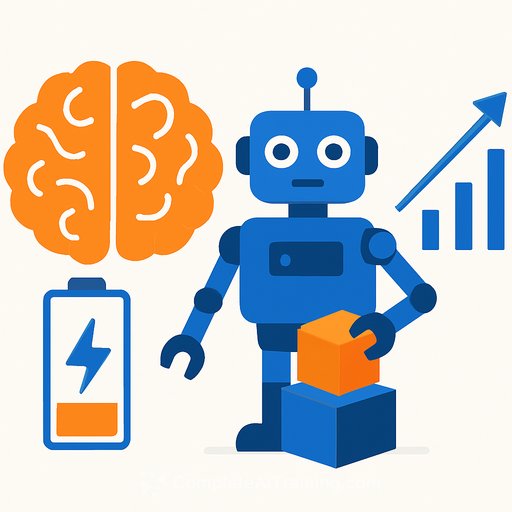
Researchers have developed a proof-of-concept AI system that reduces energy consumption by up to 100 times while outperforming conventional approaches on complex tasks. The work combines neural networks with symbolic reasoning-a method that mirrors how people break problems into logical steps.
AI and data centers consumed about 415 terawatt hours of electricity in the United States in 2024, accounting for more than 10% of total national electricity production. Demand is projected to double by 2030, raising questions about infrastructure capacity and sustainability.
The Neuro-Symbolic Approach
The research, led by Matthias Scheutz at a School of Engineering, focuses on visual-language-action (VLA) models-AI systems used in robotics. Unlike large language models such as ChatGPT, VLA systems process camera input and language instructions to control physical movements: a robot's wheels, arms, or fingers.
Conventional VLA models rely on pattern recognition from training data and trial-and-error learning. A robot asked to stack blocks must analyze the scene, identify each object, and determine placement-a process prone to errors from shadows, misalignment, or incorrect spatial reasoning.
Symbolic reasoning applies rules and abstract concepts like shape and balance instead. This structured approach limits trial-and-error cycles and accelerates problem-solving.
Measurable Performance Gains
Testing on the Tower of Hanoi puzzle showed the difference clearly. The neuro-symbolic system achieved a 95% success rate compared with 34% for standard systems. On a more complex variant the system had never seen, it succeeded 78% of the time. Traditional models failed every attempt.
Training time dropped from more than 36 hours to 34 minutes. Energy consumption during training fell to 1% of what standard systems required. During operation, the hybrid system used just 5% of the energy needed by conventional approaches.
Why This Matters for Infrastructure
Major data centers now consume hundreds of megawatts of electricity-equivalent to the needs of small cities. This expansion has sparked a race to build new facilities, with companies like Microsoft, OpenAI, and others constructing massive server complexes to support AI workloads.
Current generative AI and LLM approaches may not be sustainable long-term. They deliver powerful results but consume disproportionate energy for tasks that don't require that level of computational intensity. A Google AI search summary, for example, uses up to 100 times more energy than generating a list of website links.
Neuro-symbolic AI offers an alternative by combining learning with structured reasoning. The research will be presented at the International Conference of Robotics and Automation in Vienna in May.
Your membership also unlocks: