China's New AI Bureaus: How Local Governments Are Turning Policy Into Execution
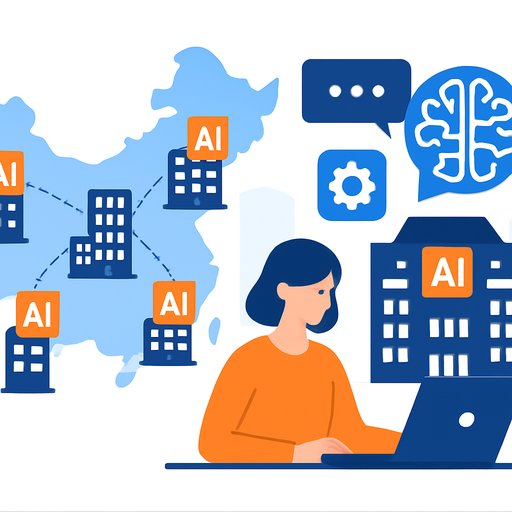
Several Chinese cities and districts have set up dedicated AI development bureaus-specialized government teams to coordinate strategy, resources, and deployment. The goal is simple: compress time from policy to production and speed up new business forms in the intelligent economy.
Haizhu District Sets the Template
Guangzhou's Haizhu District just launched an AI development bureau-the first independently established, district-level government department in China focused solely on AI. The intention is to fix fragmented management, scattered resources, and weak strategic coordination.
According to the bureau, its work will focus on integrating frontier AI technologies, attracting leading firms and specialized innovators with core tech, and opening high-value application scenarios. Initial targets include fashion design (see AI Design Courses), the low-altitude economy, and intelligent connected vehicles.
Haizhu has the base to move fast. Pazhou-one of Guangdong's three planned AI clusters-sits in the district. The area counts nearly 8,000 AI-related companies, more than 200 large-model and algorithm projects, and three years of strong growth in next-gen information services.
Use Cases You Can Measure
ZJTECH, a major textiles and apparel platform in Haizhu, is rolling out AI for supply chain digitization - see the AI Learning Path for Supply Chain Managers for relevant skills and role mappings. Fabric matches across thousands of categories now take about two minutes, and one click generates fashion designs aligned with market demand.
South China Brain-Computer Interface Technology Co. built a brain-computer AI mouse that lets paralyzed patients control a virtual cursor hands-free. It enables basic actions like browsing short videos and operating tablets-practical, human-centered impact.
Compute, Including in Orbit
Haizhu also unveiled the Pazhou space intelligent computing center plan. Phase one aims to stand up a 100-petaflop-scale cluster as a foundation for enterprise R&D and productization.
Space computing pushes compute capacity into orbit-satellites perform data processing and collaborate with onboard intelligent hardware. For cities, this hints at future architectures where terrestrial and orbital compute work as one system.
National Direction and Timelines
China's central policy continues to prioritize AI. In August 2025, the State Council outlined deep implementation of "AI Plus," with plans for AI to be tightly integrated with six key sectors by 2027. By 2030, AI is expected to be fully embedded in high-quality development, with adoption rates for new-generation intelligent terminals and related applications surpassing 90%.
As one expert noted, these local bureaus signal sustained commitment and the push to test new models for ecosystem building and institutional reform. For context on academic-industry collaboration in China, see the Institute for AI Industry Research at Tsinghua University.
Momentum Across Cities
Wenzhou, Zhejiang, established a municipal AI bureau in September 2025 to drive citywide AI planning and coordinate infrastructure for compute, data, and algorithms. Zhuhai, Guangdong, inaugurated its municipal AI development bureau on Dec. 9 to advance its "cloud intelligent city" strategy-opening application scenarios and supporting intelligent upgrades across sectors.
What This Means for Government, IT, and Development Leaders
- Centralize accountability: Create a single AI authority with budget, data-sharing mandates, and the ability to coordinate across agencies and industry.
- Build a scenario pipeline: Prioritize use cases with clear owners and KPIs. Examples: fashion design co-creation, low-altitude traffic management, V2X for connected vehicles.
- Plan your compute stack: Mix on-prem, cloud, and (where relevant) space-based workloads. Size clusters to workload classes, and implement quota systems to avoid resource contention.
- Data governance first: Standardize ontologies, data contracts, access controls, and privacy-by-design. Include policies for synthetic data and model training transparency.
- Procurement that matches AI: Use outcome-based contracts, model risk tiers, and a vendor evaluation rubric covering security, provenance, latency, and total cost to serve.
- Safety and ethics in the loop: Stand up review boards, track incidents, require red-teaming, and run privacy impact assessments for high-risk deployments.
- Talent and upskilling: Recruit specialists with core tech depth and train civil servants who own scenarios. Sponsor certifications that map to priority use cases.
- Measure what matters: Track time-to-deploy, utilization, cost per inference or workflow, scenario activation count, citizen satisfaction, and compliance rates.
What to Watch Next
- Interoperability standards across cities for data, models, and APIs.
- Shared compute marketplaces and cross-jurisdiction cost-sharing.
- Operational frameworks for space-compute workloads and downlink constraints.
- Approvals and safety baselines for low-altitude applications.
- Funding levers that tie incentives to adoption and measurable outcomes.
Local AI bureaus are moving from strategy slides to shipping real systems. If your team is standing up similar programs, targeted training can shorten the ramp. Explore role-based learning paths such as the AI Learning Path for Training & Development Managers.
Your membership also unlocks: