
AI news ·
New AI tools generate hypotheses and design experiments to accelerate scientific discovery
AI generates hypotheses and automates experiments to accelerate scientific discovery. Stanford awarded $2.17 million to 29 research teams to integrate these tools.
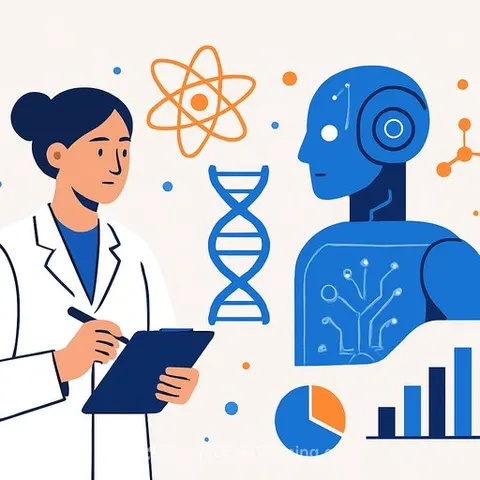
AI systems now generate scientific hypotheses, design experiments, and identify patterns in massive datasets-capabilities that are reshaping discovery across biology, climate science, materials research, and other fields. This shift comes as research teams increasingly adopt machine learning to speed up work that once took years.
A wave of new tools and funding is pushing the trend forward. In April 2026, the Stanford Institute for Human-Centered AI awarded $2.17 million in seed grants to 29 research teams pursuing novel ideas across disciplines. The projects range from collaborative coding environments to health tracking systems, each aiming to integrate AI into the scientific process.
Hypotheses that humans might miss
One of the most striking changes is in hypothesis generation. Instead of relying solely on existing literature and intuition, scientists now use models that comb through vast corpora of published studies and experimental data to propose connections no human would likely notice. These systems do not replace the researcher-they surface possibilities that the researcher then evaluates.
This approach has already led to new drug candidates and materials with specific properties. The AI does not understand the science; it finds statistical regularities that map to meaningful biological or physical mechanisms. Researchers then test those leads in the lab.
Experiment design gets automated
Designing experiments is another area where AI is taking hold. In protein engineering, for instance, models now suggest amino acid sequences likely to fold into stable structures with desired functions. Scientists at several labs have used such tools to design novel antibodies and enzymes, cutting months off the development timeline.
Climate science is seeing a similar impact. One project simulated 1,000 years of climate dynamics in a single day, a task that would have been unthinkable with traditional physics-based models alone. The speed allows researchers to test more scenarios and refine their understanding of long-term trends.
Finding patterns across disciplines
Pattern recognition remains the most widespread use of AI in research. Across genomics, neuroscience, and social science, machine learning models sift through data at scales that exceed human capacity. A recent project called PsychAdapter lets researchers tune language models to reflect specific personality traits, age, and mental health characteristics, generating text that sounds like real individuals. That capability opens new avenues for training simulations and personalized content in behavioral research.
The broader field of AI for Science & Research continues to expand as these tools mature. What ties the efforts together is a clear division of labor: AI handles the scale, and humans decide what questions matter most.
Why this matters for science and research professionals
For working researchers, the takeaway is practical. AI is not a distant promise-it is already changing how hypotheses are formed, experiments are run, and data is interpreted. Ignoring these tools means falling behind peers who use them to work faster and ask more ambitious questions.
Building competence in these methods does not require a computer science degree. Many scientists start with short, focused training that covers experimental design, data modeling, and the specific tools relevant to their domain. For researchers looking to build these skills, an AI Learning Path for Research Scientists offers structured guidance on applying AI to experimental design and data modeling. The goal is not to turn scientists into engineers, but to give them enough fluency to collaborate effectively and choose the right problems for AI to solve.