
AI news ·
New Mexico requires AI reading program in schools, but teachers say scores are unreliable
New Mexico mandates AI reading tool Amira for K-2 students, but teachers say it misreads kids with speech disabilities or accents, causing score swings of 20-30 points. The district admits problems exist while the company defends its accuracy.
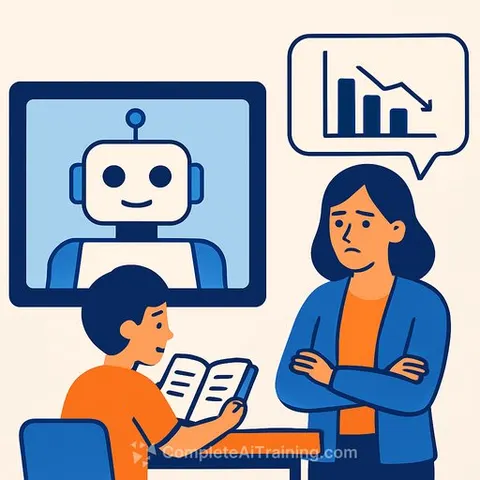
AI Reading Assessment Tool Faces Accuracy Questions in Schools
New Mexico requires all kindergarten through second-grade students at public schools to use Amira, an AI-based reading assessment program, beginning this school year. The software listens as students read aloud, catches pronunciation errors, and grades their progress with a numbered score used to measure school and district performance.
Some schools report success. At Matheson Park Elementary in Albuquerque, reading scores in one second- and third-grade class rose nearly 30% since the school year began, according to Amira data.
But teachers across Albuquerque Public Schools say the program produces inconsistent results that don't match what they observe in their classrooms.
Recognition Problems With Certain Students
Celeste Hernandez teaches kindergarten at Bel-Air Elementary. Her class includes seven students with speech disabilities and eight learning English as a second language. Amira frequently fails to recognize words from these students, she said.
"It's not always great at picking up the language of students, especially when they have trouble with spoken language," Hernandez said.
Students with speech disabilities sometimes must repeat words repeatedly until they become frustrated. "There's a point of frustration where it's like, why are we doing this?" Hernandez said. "You can just see it in kids - they just are defeated."
Background noise in busy classrooms also degrades accuracy. The AI picks up voices of other students and environmental sounds, leading to wrong scores.
Data Fluctuations Concern District Officials
Erik Johns, a teaching and learning coach at APS, tracks student assessment data. He sees month-to-month swings in Amira scores that defy statistical norms.
"If you see a kid fluctuate one to two points, that's normal," Johns said. "Fluctuating 20 or 30 points every month is totally abnormal. And it's primarily because the AI is not working correctly."
These inaccurate readings make it hard to identify which students need help. They also affect how teachers are evaluated.
"I have some really, really excellent teachers here, especially in my lower grade levels, and they're being judged on this data that's completely inaccurate," Johns said.
Special Education Teachers Report Disruption
Ryan Hayes teaches special education at Chaparral Elementary. About half his students handle Amira well. For the rest, the program creates obstacles.
Some students need instructions repeated five to eight times. When Amira asks them to read a sentence once or twice, they don't understand. Hayes said students with social communication deficits, receptive delays, and articulation problems struggle particularly.
One student with a short attention span escalates into screaming during Amira sessions. "When you have her do it a couple of times, she escalates and starts screaming and shouting," Hayes said. "It dysregulates everybody in the classroom."
Amira assessments consume instructional time. Hayes calls Tuesday "Amira day" - students groan and some cry at the prospect of using the program.
Company and State Officials Defend the Tool
Amira Learning says its software performs as accurately as human scorers. The company reports that students using Amira 30 minutes per week show eight additional weeks of reading growth compared to non-users.
Chris Blevins, Amira's senior vice president of strategic partnerships and government relations, said the program works well for students with disabilities. His own daughter has an individualized education program and uses Amira successfully, he said.
The New Mexico Public Education Department acknowledges the program isn't suitable for students with the most significant cognitive disabilities. The department defers to students' IEP teams to determine appropriate assessments for these students.
PED spokesperson Janelle Garcia said the department is working with Amira on training and support for students who speak other languages or have speech disabilities. "A range of protections are built into the program to ensure that Amira's mastery evaluations are not impacted by accent or unusual speech pattern," Garcia said.
Broader Context
Amira is required for assessments in New Mexico and Idaho. It's authorized for state use in Oklahoma, Georgia, California, Texas, Michigan, and Massachusetts.
New Mexico adopted Amira after the state's previous testing software provider, Istation, was acquired by Amira Learning.
Albuquerque Public Schools reports that 31,267 students have used Amira for 2.5 million minutes during the 2025-26 school year. The district maintains that Amira is making a positive difference by providing personalized practice to strengthen early literacy skills.
The district acknowledges issues remain. "We know there are issues with the program that the company is working to fix," APS spokesperson Martin Salazar said.
Teachers who worked with one-on-one reading assessments before computers arrived remember the trade-offs. "Did it take a long time? Absolutely," Hernandez said of the old method. "But I could tell you where every kid was all the time."
For more on how AI is being used in schools, see AI for Education and AI for Teachers.