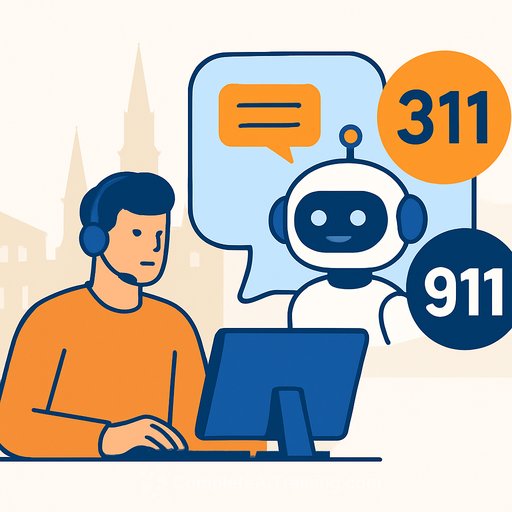
New Orleans to Deploy AI Agents for 311 Calls Within Months
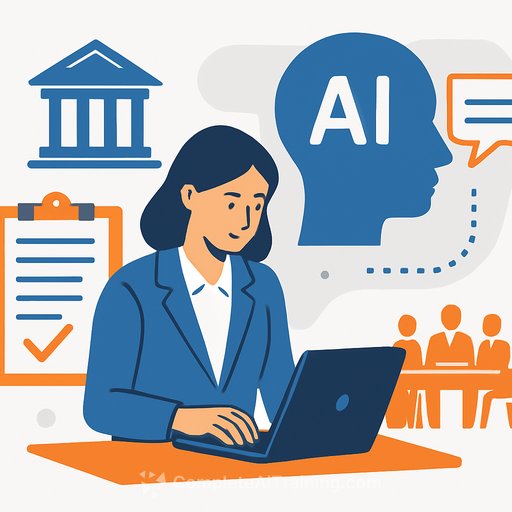
Within months, callers to New Orleans' 311 non-emergency line may reach an artificial intelligence agent instead of a human operator. The AI has been trained on three years of 311 call data and programmed to sound "customer service-centric, polite," according to Karl Fasold, executive director of the Orleans Parish Communications District.
The system won't generate service tickets. Instead, it will provide information-which accounts for roughly 50% of 311 calls, Fasold said.
The move follows an earlier shift in the same agency. Since 2023, AI agents have been answering and triaging certain 911 calls in New Orleans, making the communications district among the first in the nation to adopt AI-assisted emergency call handling.
How the 911 AI System Works
The Orleans Parish Communications District partnered with Carbyne, a software company specializing in emergency call center systems, to address a specific operational problem: call surges during rush hour.
Data analysis revealed a pattern. Every morning and evening, traffic accidents generated hundreds of calls about the same incident. These calls buried critical emergencies in the queue.
"If you're calling about a heart attack, you go to the back of the queue," said Alex Dizengof, chief technology officer and cofounder of Carbyne. "The queue is blind. Call takers aren't able to prioritize the calls."
The AI solution integrates with the computer-aided dispatch system used by first responders. Anyone calling 911 within 200 meters of a live auto accident is now routed to an AI agent, who asks if the caller is reporting the wreck. If yes, the agent confirms help is on the way. If no, the caller reaches a human operator.
The result: Fasold estimates the agency recovers at least two hours of call taker time daily. For an agency running 40% below full staffing, that matters. For 911 callers in life-or-death situations, it matters more.
"We as humans get tired of mundane, repetitive work," Dizengof said. "And if it is repetitive, critical work, this could also be dangerous."
The Transparency Gap
Callers to 911 and 311 in Orleans Parish are not explicitly told when they're speaking to an AI system, though the voice is obviously not human. The communications district does not plan to announce when the 311 AI agents launch.
There is little national policy governing AI use in emergency response, and no city policy that addresses it, according to computer science professors Aron Culotta and Nick Mattei at Tulane University's Center for Community-Engaged Artificial Intelligence.
The stakes became concrete during the Bourbon Street terrorist attack in January 2025. An AI agent answered the first two 911 calls before routing them to a human. For roughly 20 seconds, the incident was classified as a hit-and-run crash, Fasold said.
Culotta said responsibility falls on the public to demand transparency and accountability from government agencies deploying these systems.
The Case for Narrow AI Use
Culotta and Mattei noted that technology reducing human contact is not new. Call centers emerged in the 1980s. Ring cameras and Alexa are now commonplace.
"Squeamishness here might come from the fact that your government is doing this, and not something that you bought and brought into your house," Mattei said. "But for very well-contained applications, I think this can be a powerful way to free up government resources. Just because it's AI doesn't mean it's bad."
Dizengof emphasized the importance of guardrails. "AI can serve our communities in a better way and help save lives," he said. "But it has to come with proper controls, where ultimately a human makes the final decision about when and how AI will act."
Learn more about AI for Government and AI for Customer Support applications.
Your membership also unlocks: