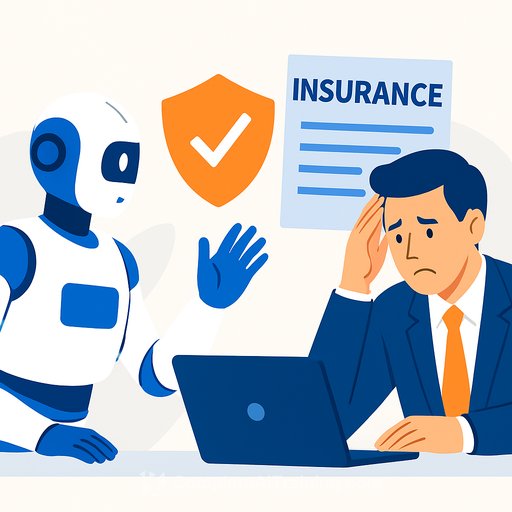
AI Could Address Insurance's Talent Crisis-But the Timeline Remains Uncertain
The American insurance industry faces a decades-old staffing problem that artificial intelligence might solve, worsen, or simply transform in ways no one can yet predict. A major new study of AI's economic effects offers the clearest picture yet of what informed experts actually expect-and reveals significant gaps in their certainty.
The research, conducted by economists and forecasters from the Federal Reserve Bank of Chicago, Yale, Stanford, the University of Pennsylvania and the Forecasting Research Institute, surveyed five groups of experts from October 2025 through February 2026. The findings carry direct operational implications for carriers, brokers and agents struggling to fill positions and retain experienced talent.
The Problem in Numbers
Insurance depends heavily on clerical and administrative work-policy processing, data entry, documentation-that economists ranked near the bottom of expected employment growth. Customer service roles, another major component of insurance operations, ranked similarly. The result: a surplus of routine work that is expensive to staff and increasingly difficult to hire for.
Meanwhile, the occupations economists expect to grow most-personal care workers, health professionals, roles requiring human judgment and trust-resemble the relationship-intensive work of senior underwriters and independent agents more than back-office operations. That gap sits at the heart of the industry's real problem: routine work that nobody wants to do, paired with a scarcity of experienced judgment that regulators and clients still demand.
What the Forecasts Show
The survey asked experts to forecast outcomes under three scenarios for AI progress by 2030: slow, moderate and rapid. Under the moderate scenario-where AI becomes an effective collaborator capable of handling nearly all routine software tasks and most customer service interactions-disruption begins registering in labor markets relevant to insurance.
Under the rapid scenario, the implications are starker. AI systems would surpass human performance on most cognitive tasks by 2030. Economists forecast labor force participation falling from roughly 62% today to 55% by 2050, with approximately half that decline attributable to AI rather than demographics. White-collar employment as a share of the labor force would stagnate or decline.
For insurance, that white-collar stagnation matters because the industry's staffing model depends on a large middle layer of moderately skilled workers-claims processors, policy administrators, junior underwriters, customer service representatives-whose work is precisely what the survey identifies as most exposed to automation.
The Clerical Work Canary
Economists ranked 43 occupation categories by expected employment change through 2030. General and keyboard clerks ranked last-the occupation economists most consistently expected to shrink. Customer service clerks ranked third from the bottom. Numerical and material recording clerks, which encompasses much of the data-intensive work in policy administration and claims, ranked sixth from the bottom.
These findings held even before conditioning on any particular AI for Insurance scenario. In other words, economists' baseline expectations-incorporating demographics, regulatory uncertainty and typical adoption lags-already place these occupations in the job-loss column.
For carriers struggling to hire and retain workers in these roles, the finding cuts two ways. It suggests the talent pipeline problem in back-office operations may eventually solve itself not because hiring improves, but because demand for that labor diminishes. The transition will not be instantaneous, however. The period between now and 2030 is likely to be characterized by exactly the friction the industry already feels: too many open positions, too few qualified applicants, and technology that is promising but not yet fully deployed.
The Underwriter Question
If clerical staffing is the immediate challenge, the underwriting talent shortage is what keeps executives awake. Experienced underwriters-particularly in complex commercial lines, specialty risks, and emerging areas like cyber liability-represent institutional knowledge that is genuinely difficult to transfer and that has been walking out the door as the generation that built modern commercial insurance approaches retirement.
Here the survey's findings are more encouraging. Occupations economists placed at the top of expected-growth rankings were characterized by human judgment, relationship management, in-person interaction and contextual reasoning-precisely what defines senior underwriting and complex risk assessment.
Even in the rapid AI scenario, economists did not forecast elimination of roles that combine technical expertise with client relationship management, regulatory accountability and judgment from years of loss experience. White-collar employment was expected to stagnate rather than collapse, suggesting displacement concentrated in routine tiers of analytical work rather than its most experienced practitioners.
A technology that automates the routine components of underwriting-data gathering, initial risk scoring, policy checking, renewal processing-while freeing experienced underwriters to focus on judgment-intensive work could, in principle, dramatically extend the productive capacity of a shrinking senior workforce. That is effectively the productivity argument for AI Agents & Automation in insurance: not replacement of talent, but amplification of it.
Claims: The Highest Stakes
No area of insurance operations is more labor-intensive, more consequential for customer experience, or more ripe for disruption than claims. The survey did not address insurance claims management directly, but its findings about cognitive task automation map onto the claims function with uncomfortable precision.
Routine claims-straightforward auto, simple property, uncomplicated medical-involve exactly the kind of structured data processing, pattern recognition and rule application that AI systems are already beginning to handle at scale. Under the moderate-progress scenario (which economists assigned roughly 47% probability), AI systems would be capable of handling nearly all customer service interactions and most routine analytical tasks. For claims departments, that implies significant reductions in headcount for processing standard claims-precisely the entry-level and mid-level positions that traditionally develop adjusters who eventually handle complex losses.
If the pipeline narrows, the industry faces a longer-term risk: fewer experienced complex-claims professionals emerging from the ranks a decade from now, even as the routine work that once trained them is automated away.
Distribution Under Pressure
For independent agents and brokers, the survey's findings present distinct implications. Occupations economists expected to hold up best through 2030 were those characterized by personal service, human interaction and trust. That maps reasonably well onto what the best independent agents say distinguishes their work from what a website or chatbot can provide.
But the survey also documents something more complicated: even in occupations that are not themselves displaced, the economic environment surrounding them changes substantially. If 10 million workers leave the labor force by 2050 and wealth becomes significantly more concentrated, the distribution landscape for personal lines, group benefits and retirement products shifts in ways that are difficult to model but impossible to ignore. An economy with a smaller labor force, a diminished middle class and a growing population outside traditional employment is not simply a smaller market for insurance. It is a structurally different one.
The Adoption Gap
One of the survey's most important findings is what might be called the productivity paradox: experts simultaneously expect significant AI progress and only modest near-term economic impact. The most frequently cited explanation was adoption lag. General-purpose technologies-electrification, the personal computer, the internet-routinely took one to three decades to produce measurable aggregate productivity gains, not because the technology was insufficient, but because organizations needed time to redesign workflows, train workers, update regulations and develop complementary systems.
For insurance, that observation is both sobering and practically useful. It suggests that carriers beginning now to redesign workflows around AI capabilities-rather than simply layering new tools onto existing processes-are likely to capture productivity gains substantially earlier than those that wait. It also suggests the staffing crisis will not resolve itself quickly, even if the technology to address parts of it already exists.
Economists expect the share of work hours assisted by generative AI to reach roughly 10% by 2030 under the unconditional scenario, rising to 24% under the rapid-progress scenario. By 2050, those figures reach 40% and 62% respectively. For an industry that remains heavily dependent on manual processes, those numbers imply a substantial and sustained period of transition-one that will unfold while the talent shortage is still acute.
Where the Uncertainty Actually Lies
A popular assumption in AI debates has been that disagreement among experts is primarily about the technology itself-whether truly capable AI will arrive and when. The survey's data challenge that assumption. Using statistical analysis, researchers found that disagreement about long-run economic outcomes is driven primarily not by different beliefs about how fast AI will develop, but by different beliefs about what economic impact a given level of capability will actually produce-how quickly it diffuses, whether new work offsets displaced work, and how institutions respond.
That finding has practical implications for insurance planning. It suggests that scenario analysis focused narrowly on when AI becomes capable is insufficient. The more consequential uncertainties lie in organizational, regulatory and labor-market responses to capability that already exists or is close to existing. For carriers, the relevant planning questions are less about what AI will eventually be able to do and more about how quickly their own organizations, distribution partners, regulators and workforce can adapt.
The Window for Planning
Economists assigned only 14% probability to the rapid-progress scenario-the one in which AI systems broadly surpass human cognitive performance by 2030. But they assigned 61% combined probability to moderate or rapid progress. That asymmetry matters for insurance.
The industry's long policy terms, regulatory capital requirements and dependence on actuarial projections make it less agile than technology companies in responding to rapid environmental change. A carrier that waits for certainty about AI's trajectory before adjusting talent strategy, technology investment or distribution model may find that the window for an orderly transition has closed.
The talent crisis the insurance industry faces today was years in the making. Whether artificial intelligence ultimately saves the industry from it, deepens it, or simply transforms it into something unrecognizable may be the defining operational question of the next decade. What the new survey makes clear is that the experts who have thought hardest about this question are not certain of the answer-and that the range of possible outcomes is wider than most strategic plans currently contemplate.
Your membership also unlocks: