Tesla's New Leasing Options Put AI-Driven EVs Within Reach for Consumers and Fleets
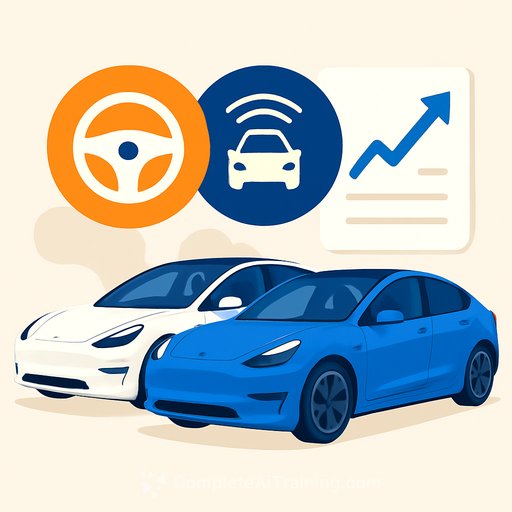
Tesla has rolled out leases for the Model 3 Standard and Model Y Standard in the U.S., making access to advanced driver-assistance features far easier. Pricing starts at $449/month for Model 3 and $479/month for Model Y, with $3,000 down, over 36 months and 10,000 miles per year.
Beyond the payment plan, this is about scale. More cars on the road mean more real-world data to improve Autopilot and Full Self-Driving (FSD), faster software iteration, and a smoother path to broader autonomy.
The offer at a glance
- Monthly: $449 (Model 3 Standard), $479 (Model Y Standard)
- Term: 36 months, 10,000 miles/year
- Down payment: $3,000
- Optional FSD subscription: $99/month (2024 reference)
Why executives should care
Lower monthly costs expand the addressable base for AI-enabled EVs. That feeds Tesla's data engine-over 1 billion miles logged by 2024-accelerating improvements to features like adaptive cruise and automated lane changes.
For companies, this supports EV pilots, green targets, and mobility-as-a-service trials without heavy capex. It also opens the door to over-the-air upgrades that improve capability during the lease, not just at purchase.
Market momentum and money flows
Analysts expect AI-enhanced EVs to approach a 25% global share by 2026, buoyed by lower entry costs and software-driven value. Subscriptions matter here: a $99/month FSD add-on can stack meaningful recurring revenue, with estimates reaching the billion-dollar range by 2025.
Insurance is shifting in parallel. Usage-based policies informed by vehicle telemetry could trim premiums by up to 30%, per recent telematics research from major consultancies. That's a direct lever on total cost of ownership.
For a broader view of AI value at industry scale, this analysis is useful: McKinsey on AI's impact in automotive.
What's under the hood (and in the cloud)
Tesla's stack uses neural networks trained on fleet data and video. As presented at AI Day 2022, the system ingests high-frame-rate inputs from eight cameras, then performs on-vehicle inference with dedicated compute for real-time decisions.
Edge processing handles most tasks; connectivity helps with maps, diagnostics, and updates. Partnerships announced in 2024 bring 5G support to reduce latency in dense urban areas. On the back end, vertical integration-Dojo for training and the HW4 platform-supports faster iteration and scale.
Risk, compliance, and governance
Supply chains remain a watch item, especially for AI chips. Tesla has faced constraints before and responded by diversifying suppliers and investing in in-house hardware.
Regulatory change is moving. U.S. guidance is opening space for Level 3 features, while the EU's AI Act (effective 2024) raises the bar on risk controls, documentation, and auditing. See official materials here: EU AI Act.
Privacy and ethics are central. CCPA updates (2023) and best-practice recommendations from groups like the Partnership on AI call for transparency in training data, strong data governance, and bias testing-especially for automated decision-making on public roads.
Competitive picture
Waymo and Cruise continue to push autonomous ride-hailing. Ford's BlueCruise and GM's Super Cruise are maturing advanced driver-assist features.
Tesla's edge is data density plus integration across hardware, software, and training compute. More leases mean more miles-and faster learning loops.
Mobility-as-a-service implications
Leases fit company car programs, employee benefits, and early-stage robotaxi planning. As AI for Operations improves fleet routing and predictive maintenance, utilization rises and downtime falls.
Over-the-air updates turn vehicles into software products. That shifts planning from fixed features at purchase to ongoing capability growth across a contract term.
Action plan for managers
- Run a 90-day pilot with 5-25 vehicles; track safety events, charging patterns, driver satisfaction, and software update cadence.
- Model TCO with and without FSD/ADAS subscriptions; include insurance quotes for telematics-based policies.
- Set data and safety governance: event logging, human-in-the-loop policies, driver training, and incident response procedures.
- Legal/compliance check: CCPA/CPRA, EU AI Act exposure, vendor data agreements, and audit readiness.
- Mitigate supply risk: flexible specs on chips/compute, multi-vendor service options, and clear SLA terms.
- Upskill teams on AI-in-operations and EV data workflows; consider role-based learning paths such as the AI Learning Path for Data Scientists.
Looking ahead
Tesla is targeting Level 4 capability later this decade, with robotaxi services on the roadmap and a ride-sharing market worth hundreds of billions. Expect further gains in battery optimization from machine learning, with credible studies pointing to meaningful range and efficiency improvements.
The bottom line: lower monthly costs accelerate adoption, data compounds performance, and software drives margin. If you're planning your 2026 mobility strategy, this is a practical on-ramp to test, learn, and scale-without locking up capital.
Your membership also unlocks: