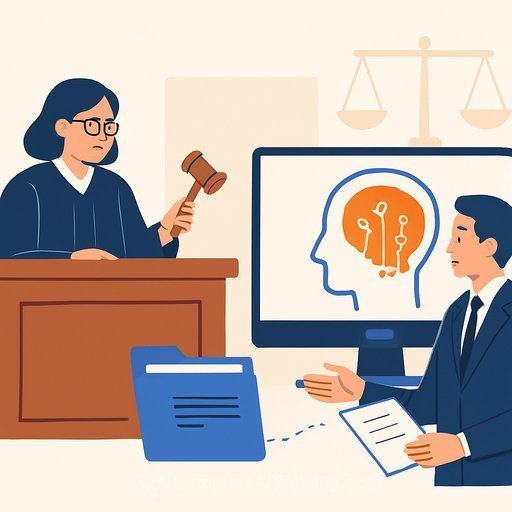
AI In Court Filings: New York Panel Signals "Use It, But With Guardrails"
A New York court system advisory committee indicated that lawyers should not be barred outright from using AI tools to prepare court documents. That's not a free pass. It's a call for competence, disclosure where required, and real supervision.
What this means for your practice
Courts are moving toward a simple standard: use AI if you want, but you're accountable for the results. That includes facts, citations, confidentiality, and candor. Treat AI like a junior colleague-helpful and fast, but capable of serious mistakes if unsupervised.
The legal baseline you still owe the court
- Rule 11 duties remain yours-no frivolous filings, and you must verify factual contentions and legal citations. See FRCP 11.
- Competence now includes tech competence. The ABA has said as much for years. See Model Rule 1.1, Comment 8.
- Confidentiality and supervision still apply (think Model Rules 1.6 and 5.3). Vendors and prompts can expose client data if you're careless.
Practical policy checklist for AI use
- Approval: Define which AI tools are allowed and for what tasks (research, outlining, editing, citation formatting-but not final cites without verification).
- Disclosure: Track local and individual judge orders that require AI-use certifications or disclosures. If a court requires it, comply in writing.
- Verification: Require human review of every AI-generated sentence, with a mandatory cite-check (KeyCite/Shepardize) and source pull for each authority.
- Data security: Block uploading client or proprietary data to public models unless the vendor contract guarantees no training on your inputs and strong confidentiality.
- Prompt hygiene: Keep prompts neutral, precise, and free of client identifiers when possible. Use anonymization and hypotheticals for sensitive facts.
- Logging: Save prompts and outputs used in drafting. If questioned, you can show your supervision and verification steps.
- Billing ethics: Disclose AI use in engagement letters where appropriate, avoid double-charging (AI + full associate hours), and bill for judgment, not copy-paste.
A simple, defensible drafting workflow
- Scoping: Define the issue, jurisdiction, and desired authorities before you touch a tool.
- Research first: Pull primary sources from trusted databases. Use AI to summarize or compare, not to originate controlling law.
- Structure: Use AI to propose an outline and counterarguments. Edit aggressively.
- Drafting: Let AI help with clarity and tone, but you write the core analysis and fact application.
- Citation pass: Independently verify every case, quote, and pincite. No exceptions.
- Confidentiality pass: Remove sensitive details not required for the filing. Apply redaction rules (e.g., FRCP 5.2 in federal court).
- Final review: One partner-level read for accuracy, fairness, and candor to the tribunal.
When and how to disclose AI use
If a judge or local rule requires disclosure or certification, follow it exactly. If not required, disclose only when doing so is necessary to correct the record, explain a workflow material to the court, or comply with client agreements.
Never let an AI tool be the "source." The filing should stand on primary law, the record, and your analysis. If an output influenced your work, you still own the result.
Vendor due diligence questions
- Does the vendor train on your inputs? If yes, don't use it for client-confidential content.
- Where is data stored and for how long? Can you delete it on demand?
- What audit logs and admin controls are available?
- Is there an enterprise or on-prem option for sensitive matters?
Training your team
Set baseline expectations: what AI can do well (summaries, structure, style edits), and where it fails (invented citations, confident errors, subtle misstatements). Pair that with clear escalation and final sign-off.
If you need structured upskilling for associates, paralegals, and KM teams, see AI Research Courses.
Bottom line
The signal is clear: courts aren't banning AI outright, but they expect lawyers to stay in control. Use the tools, keep your standards, and document your process. If your filing is accurate, candid, and secure, the court won't care how you got there-only that you got it right.
Your membership also unlocks: