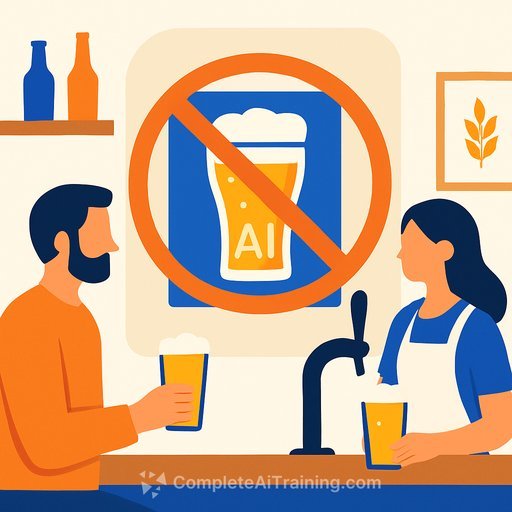
AI on tap? Newcastle pubs ban machine-made art to back local creatives
Two Newcastle venues - The Mean Eyed Cat and the Free Trade Inn - have drawn a line: no AI-generated artwork on bottles, cans, or pump clips. The move is simple: protect paid work for local artists and raise the bar on what gets shown to customers.
For freelancers, this isn't a tech debate. It's about briefs, invoices, and the long-term value of original work.
The line in the sand
Simon Hubbard at The Mean Eyed Cat says he's seen "a spate of breweries who are just coming out with this absolutely dreadful AI slop," mostly from bigger, established names. "You can just tell, it looks overly polished, overly perfect. Hands always look really weird on it."
After talking with the Free Trade Inn, both pubs announced a ban on AI art. Their post became one of their most-viewed. As Hubbard put it: "Who are you going to offend? The robots?" The point: people are going to be put out of work if venues don't take a stand.
"Call it what it is - stolen artwork"
Illustrator Drew Millward, who's designed for breweries worldwide and worked with Northern Monk for years, says the impact is real: training data scrapes millions of human-made images, then spits out lookalikes. He hasn't personally seen his own work cloned back at him yet, but friends have had to defend their styles from AI knockoffs.
For context on how training sets are built, see the public description of the LAION-5B dataset, which aggregates images from across the web via automated scraping. LAION's post explains scale and sources.
Craft over shortcuts
Lettering artist Ashley Willerton has spent about 12 years working with pubs across the North East. He sees more AI around, but believes independent businesses will still choose original work. "It doesn't matter how good AI gets, that's not the point. The point is it will always lack a human touch."
On the brewery side, Donzoko's founder, Reece Hugill, is direct: paying local artists keeps money - and meaning - in the community. "If I was to use ChatGPT for my designs rather than our designer Sean, that's taking money out of the local area into the hands of a multibillionaire." He also links design choices to company standards: "If you're cutting corners in how things are presented, where else are you cutting corners?"
What this means for working creatives
The takeaway: your edge is trust, taste, and proof. Make them visible and easy to buy.
- Add a no-AI clause to briefs and contracts when clients expect hand-made or original-only results. Spell out what tools are acceptable, what isn't, and how rights are cleared.
- Publish a short ethics statement on your site or Instagram. Make it easy for venues to align with you.
- Show your process: WIPs, timelapses, sketches, color studies. Build a "proof-of-human-work" folder for pitches and disputes.
- Offer tiered packages (e.g., sketch pack, full label system, ongoing retainer) so budget pressure doesn't default clients to prompts.
- Partner with venues on "artist-on-tap" rotations, launch nights, and label exhibitions. Make the art an event, not a file.
- Send clients a one-pager on why AI art can backfire: licensing risk, brand sameness, uncanny details, and zero community impact.
- Spot-check guide for venues: deformed hands, warped typography, nonsense text, impossible reflections, mangled logos, and that eerie, uniform "perfection."
What venues and breweries can do now
- Publish an AI-art policy. State what you accept on pump clips, bottles, cans, and posters.
- Commission local. Credit artists on labels and menus. Budget for art like you budget for hops.
- Run open calls with fair pay and clear briefs. Build a roster of regional artists.
- Ask suppliers to attest non-AI artwork or prove rights. If in doubt, don't print it.
- Tie design quality to brand quality: if you wouldn't skimp on ingredients, don't skimp on art.
The momentum
Since the joint post, outreach has been strong. If a handful of breweries rethink their approach, that's progress. Millward wants more businesses to set their stance publicly - consumers shouldn't have to interrogate every image they see.
And there's real optimism. The sentiment from multiple artists is clear: good art will prevail - because people can feel the difference.
Skill up, keep your edge
You don't have to use AI to benefit from understanding it. Learn enough to advise clients, protect your work, and position your craft with confidence.
Useful starting point: AI for Creatives
Your membership also unlocks: