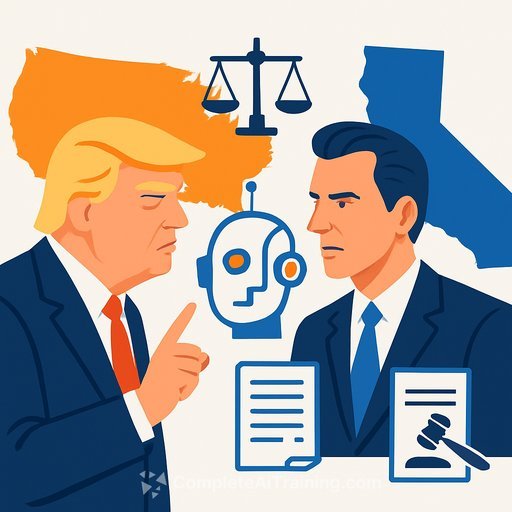
Newsom vs. Trump's AI Order: What Legal Teams Need to Know Now
Within hours of the White House releasing an executive order aimed at preempting state AI laws, California Governor Gavin Newsom fired back, calling it "grift and corruption" dressed up as innovation. The order would steer federal power against state AI rulemaking and create an AI litigation taskforce to review state statutes that don't "enhance the United States' global AI dominance." Enforcement could include litigation and threats to withhold federal broadband funding.
The response was immediate and broad. California officials, unions, and child safety groups denounced the move; even some conservative voices questioned the preemption strategy. Expect litigation-and soon.
Why this matters for counsel
- If your organization relies on state AI compliance frameworks, the playing field could shift fast.
- The order raises core federalism issues: preemption, anti-commandeering, and limits on conditional federal funding.
- Agencies may test new theories to neutralize state AI laws, especially California's frontier model transparency and incident reporting regime.
Quick recap of the flashpoints
- California's AI law (September): Requires transparency reports for "frontier models" and prompt safety incident reporting, with fines up to $1m.
- Executive order: Directs an AI litigation taskforce to target state laws seen as hindering "global AI dominance," with potential lawsuits and funding leverage.
- Political and civil backlash: California leaders call it an attack on state authority; labor leaders say it hands unchecked power to tech; child protection groups warn it sacrifices safety.
- Unusual critics: Even some Trump allies dispute the legal basis for broad preemption through an executive order.
Key legal questions
1) Can an executive order preempt state AI laws?
Preemption is a constitutional function of federal law, typically through Congress or valid agency rulemaking under a clear statutory mandate. An executive order alone doesn't supplant state law. The administration would need an existing statute that conflicts with or occupies the field to make preemption stick. Without that, expect courts to treat any "blanket preemption" posture as overreach.
Useful primer: Cornell LII: Preemption.
2) Can the administration withhold broadband funding to coerce state compliance?
Under the Spending Clause, conditions on federal funds must be unambiguous, related to the program's purpose, and not coercive. Tying broadband funding to state AI policy could be challenged as too attenuated-or as economic coercion. The NFIB v. Sebelius doctrine is squarely in play.
Useful primer: Cornell LII: Spending Clause.
3) Anti-commandeering and state police powers
The Tenth Amendment limits federal attempts to direct state legislative agendas. A policy that effectively bars states from regulating AI-without a superseding federal statute-invites anti-commandeering arguments. If the order seeks to "freeze" state innovation in safety, privacy, and labor, courts will scrutinize it closely.
4) Administrative law posture
The real action will come when agencies implement the order. That's where the Administrative Procedure Act (APA) becomes the tool of choice. Expect challenges on statutory authority, arbitrariness, and procedural defects. If agencies stretch vague statutes to displace targeted state AI rules, major questions rhetoric will surface quickly.
What California's law tests
California's frontier model statute aims for transparency and rapid incident reporting. It doesn't ban development; it demands accountability. If the administration attacks it, the fight will clarify whether AI governance falls within classic state police powers-consumer protection, safety, and labor-or whether the federal government can claim a dominant interest without a comprehensive federal framework to replace it.
How this likely unfolds
- Immediate filings: States (led by California) seek declaratory and injunctive relief. Child-safety and labor groups may support with amicus briefs highlighting concrete harms.
- Agency moves: Watch for DOJ or specific agencies invoking the EO to threaten suit or funding penalties. That's your APA trigger.
- Venue strategy: States pursue favorable circuits; the administration may look for quick wins via funding programs and grant conditions.
- Preliminary injunctions: Expect courts to weigh irreparable harm to state sovereignty and public safety against speculative national competitiveness claims.
Action items for in-house and public sector counsel
- Map exposure: Inventory every product, deployment, or contract that assumes compliance with specific state AI laws (especially California's frontier model statute).
- Preserve optionality: Add change-in-law clauses and step-in rights for audits, incident reporting, and model governance where vendors rely on state frameworks.
- Funding risk memo: If your entity touches federal broadband dollars, assess Spending Clause risk and contingency plans if conditions shift.
- Litigation readiness: Draft a PI/ TRO playbook. Identify fact witnesses on safety, consumer harms, and reliance interests. Line up declarations now.
- Regulatory watch: Track DOJ and relevant agencies for any guidance, rulemaking notices, or threat letters invoking the EO. Treat those as APA moments.
- Multi-state strategy: Coordinate with AGs and trade associations to avoid fragmented defenses and inconsistent commitments.
- Workforce impact: Prepare talking points on worker protections if the EO is framed as pro-innovation but strips state-level safeguards affecting jobs and bargaining.
- Safety governance: Maintain incident reporting, red-teaming, and transparency protocols even if state mandates are challenged; abandoning them increases litigation and reputational risk.
Signals to watch
- Whether the taskforce cites specific statutes as a basis for preemption, or relies on broad policy claims.
- Any move to make broadband funding conditional on AI policy alignment-how explicit, how related, how coercive.
- Early district court rulings on state sovereignty and interim relief.
- Private sector alignment: whether major AI firms pause compliance with state regimes or continue to honor them contractually.
Bottom line
This order sets up a federalism fight over AI governance without offering a clear federal replacement. For legal teams, the safest course is to keep your compliance scaffolding intact, prepare to litigate (or support litigation), and stress-test funding dependencies. The first agency action under this EO is the real red line-be ready the same day it drops.
If your team needs structured upskilling on AI risk and compliance, see our program catalog by role: Complete AI Training: Courses by Job.
Your membership also unlocks: