
AI news ·
Newsrooms, Classrooms, and the GenAI Fault Line: Promise, peril, and the Global North-South gap
GenAI speeds drafts, translation, and visuals but can amplify bias, errors, and bland prose. Leaders should add verification, disclosure, and fair access across North and South.
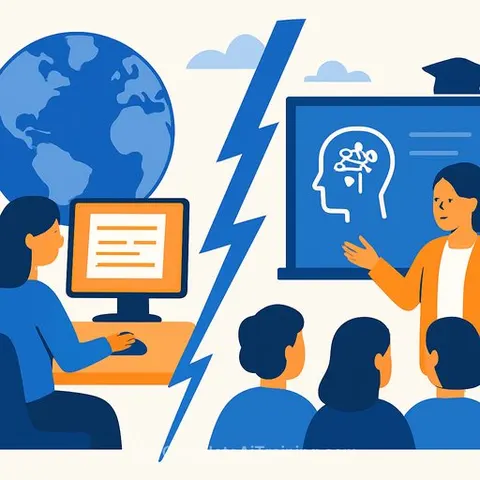
Generative AI in Journalism and Journalism Education: Promise, Peril, and the Global North-South Divide
Generative AI is changing how stories are made and how future journalists are trained. The gains are real: faster output, new formats, multilingual reach. The trade-offs are just as real: weaker critical thinking, more bias, and widening gaps between Global North and South.
If you lead a newsroom or a classroom, your job is to extract value without sacrificing trust. The rest is noise.
What GenAI is doing in practice
- Drafting, editing, summaries, and AI Translation Courses.
- Data Analysis Courses, visualisation, and research support.
- Design assets, formatting, style clean-up, and versioning.
Where it helps
- Speed: first drafts in minutes; more story variations with the same headcount.
- Access: translation and plain-language rewrites widen reach.
- Workflow: templated prompts standardise routine tasks without draining senior talent.
Where it breaks
- Hallucinations, weak sourcing, and quiet plagiarism risk legal and reputational damage.
- Bias and stereotypes can slip in, then scale fast.
- Formulaic writing and over-reliance. A 2025 MIT study linked AI use to poorer memory, reduced creativity, and more generic prose.
The Global North-South gap
Adoption isn't equal. A Thomson Reuters Foundation survey points out that access, cost, and context differ widely across regions, and so do the problems journalists face. Western-centric narratives often miss that reality.
In newsrooms across Zimbabwe, Uganda, Bangladesh, Eswatini, and South Africa, limited budgets, training, and infrastructure slow down meaningful adoption. Talent wants to learn; the pipeline isn't there.
Thomson Reuters Foundation: Journalism in the AI era
Voices from the field
On audience focus: "Too much attention is paid to how AI will affect producers, and not how it will affect consumers. If we don't deliver what people want, when they want it, at a price they'll pay, we'll be replaced-and deserve it."
On critical thinking and integrity: "GenAI can personalise learning and free up academic time, but it can also threaten academic integrity, engender biases, and undermine critical thinking."
On quality control: "AI-generated stories often miss the human element and context. Errors slip through. Trust suffers-even if production is faster."
On adoption with caution: "Learn the tools. Prompt well. Output improves. But used poorly, AI pushes repetition and copycat journalism. Times change; keep pace without losing standards."
On infrastructure and policy: "AI is necessary, but resources and training are scarce. Some broadcasters test AI presenters; most rely on conventional practice. Investment is needed so journalists aren't left behind."
On bans in education: "In many universities, AI is forbidden in academic work. Students don't learn how to use it responsibly, then get penalised for trying."
Implications for educators
Well-used, GenAI expands creative production and supports feedback-at-scale. Poorly used, it shortcuts cognition. Critical thinking remains the non-negotiable core.
Teach both capability and constraint: bias, disinformation, intellectual property, privacy, and disclosure. Give students hands-on practice with rigorous critique, not blanket bans.
UNESCO IBE: Critical thinking and Generative AI
Practical guardrails for newsrooms and classrooms
- Human-in-the-loop: editors sign off on facts, tone, and legal risk. No auto-publish.
- Source-first workflow: require citations, links, and evidence in every AI-assisted draft.
- Bias checks: run sensitive pieces through a structured checklist before approval.
- Disclosure: state when AI assisted. Use clear language your audience understands.
- Red teams: test prompts and outputs for disinformation, stereotype propagation, and privacy leaks.
- Data locality: prefer tools that support on-prem or regional hosting when dealing with sensitive sources.
- Style and voice: fine-tune prompts and examples on your own style guide to reduce generic output.
- Training cadence: short, recurring workshops beat one-off seminars. Track skill adoption by role.
- Student assessment: emphasise process artifacts (notes, outlines, drafts) and oral defences to protect integrity.
Minimum viable AI stack for constrained teams
- Research: one general LLM plus a retrieval tool for your archives and public documents.
- Translation and plain language: pre-approved prompts with tone and glossary controls.
- Verification: a checklist plus a second model (or human) for cross-checks on names, numbers, dates.
- Data visuals: templated charts with locked styles; store sources alongside outputs.
- Privacy: default to local redaction of sensitive info before any AI use.
Assignment patterns that keep thinking alive
- AI-allowed drafts, human-only revisions. Students must submit both and explain changes.
- Counterfactual critiques: have students identify model errors and propose fixes with sources.
- Blind peer review: swap AI-assisted pieces for human edit rounds to surface cliché and bias.
Metrics that matter
- Quality: correction rates, legal flags, and reader trust signals (time on page, subscriptions, referrals).
- Diversity: source diversity and representation in AI-assisted stories.
- Efficiency: cycle time from pitch to publish without uptick in errors.
- Learning: pre/post tests on critical thinking and fact-checking accuracy.
90-day plan for leaders
- Weeks 1-2: define use cases, red lines, disclosure policy, and approval flow.
- Weeks 3-6: run pilot on 2-3 desk routines (summaries, translations, briefs). Track errors and time saved.
- Weeks 7-10: expand to data visuals and longform outlines. Start red-team tests.
- Weeks 11-13: formalise training, publish playbooks, and review metrics with the whole team.
Bottom line
GenAI can scale journalistic output and education outcomes. Without discipline-verification, transparency, and critical thinking-it scales problems faster than progress. Choose the former.
Further reading
- Thomson Reuters Foundation: AI and journalists in the Global South
- UNESCO IBE on critical thinking and AI
Want structured training?
If you're building team capability, explore focused programs for roles in media and education and prompt practice here: Prompt Engineering.