New Hampshire high school students compete on AI regulation policy
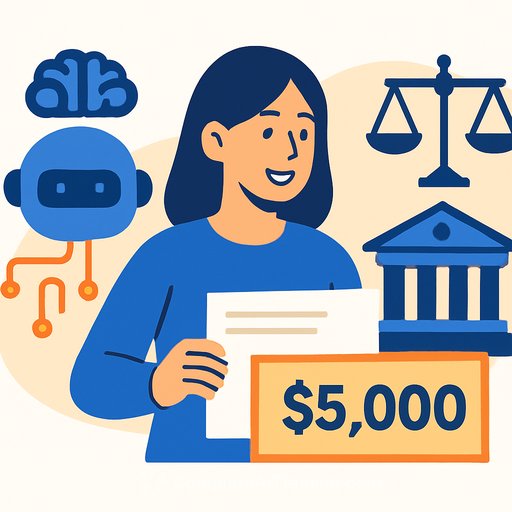
Vaibhav Rastogi, a senior at Bishop Brady High School, won first place in the New Hampshire Bar Foundation's High School Civics Essay Contest for his analysis of how constitutional principles should guide artificial intelligence regulation. He received a $5,000 award.
Rastogi and two runners-up were honored Monday at Merrimack Superior Court in Concord. Leah McFarland of Newfound Regional High School placed second, and Lauren Damota of Londonderry High School placed third. Each runner-up received $2,500.
The assignment
The contest asked New Hampshire students in grades 11 and 12 to write 750 to 1,000 words addressing a specific question: How should freedoms and rights identified in the Declaration of Independence and the U.S. Constitution shape AI regulation? Should AI companies be required by law to pay authors whose work they use?
Forty-nine students submitted essays. A panel of attorneys and judges evaluated each submission on understanding of constitutional principles, originality, clarity of analysis, and writing quality.
Rastogi's approach
Rastogi spent three days researching cases and constitutional law before writing. He initially focused on music rights as a model but shifted his essay toward broader constitutional principles.
His winning essay argued that AI companies like ChatGPT, Google, Anthropic, and Microsoft promise innovation and efficiency but challenge constitutional commitments to free speech, property rights, and personal liberty.
"AI regulation must reflect these commitments by ensuring that innovation does not come at the expense of the very freedoms the Constitution exists to protect," Rastogi wrote.
State Supreme Court Chief Justice Gordon MacDonald praised the essay's structure. "The winning essay is so very well constructed - crisp, disciplined writing, and excellent uses of topic sentences," MacDonald said.
MacDonald highlighted a closing line from Rastogi's work: "As America approaches its 250th birthday, the question is not whether the Constitution can accommodate artificial intelligence, but whether we will honor the values it enshrines."
Damota's argument on copyright
Damota's third-place essay focused on compensation for authors. She argued that AI companies have used millions of authors' works without credit or payment.
"While AI is a promising and transformative technology, the rapid growth of AI companies rests upon the backs of countless human creators who deserve recognition for all their labor," Damota wrote.
She called for legal requirements that AI companies compensate authors whose copyrighted work is used in training and development.
Damota said her civics teachers helped her explore the ethics and legalities of AI policy. The hardest part, she noted, was connecting AI regulation to specific constitutional cases and civics principles.
For educators
These essays demonstrate how students engage with policy questions at the intersection of technology and law. AI for Teachers offers educators structured resources to discuss AI tools and their implications with students.
Your membership also unlocks: