AI helps hospitals tackle A&E bottlenecks as NHS rolls out demand-forecasting technology
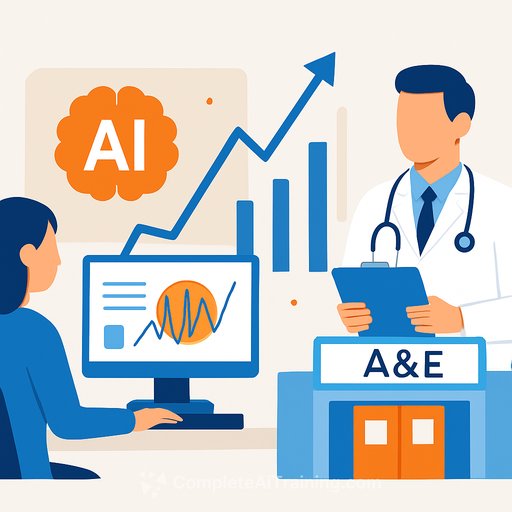
Hospitals across England are deploying an AI forecasting tool to anticipate A&E pressure days and weeks ahead. It's already in use across 50 NHS organisations and available to all trusts.
The goal is simple: see the surge early, plan the rota, protect flow. For frontline teams, that means fewer last-minute scrambles and a clearer line of sight on staffing and bed capacity.
How the forecasting works
The system analyses multiple signals to predict attendances and admissions with enough lead time to act. It blends:
- Historic admissions, day-of-week patterns, and school/holiday effects
- Seasonal illness trends and vaccination uptake
- Local factors such as cold weather injuries and flu activity
- Temperature forecasts from sources like the Met Office
As new seasonal data comes in, the model updates and adjusts. That helps trusts keep pace with winter volatility and changing local demand.
What this means for operations
- Staffing: Align e-rostering with forecast peaks; preload bank/agency requirements 7-14 days out.
- Beds and flow: Set bed conversion plans, open/close escalation areas, tune SDEC, and optimize discharge rounds.
- Diagnostics: Extend hours or add lists when upstream demand spikes are signaled.
- Ambulance handovers: Use predicted arrival profiles to protect bays and reduce delays.
For patients, the expected impact is shorter waits and smoother journeys through emergency care during the busiest weeks.
Winter context
Emergency departments are facing heavier winter demand driven by record flu cases, cold weather injuries, and seasonal illness. More than 18 million flu vaccines have been delivered this autumn, and uptake patterns are factored into the forecasts.
The tool's early warnings give managers options before pressure hits: flex staffing, adjust elective activity, and coordinate with community and virtual ward capacity.
Policy backing and early feedback
The initiative sits within the Prime Minister's AI Exemplars programme spanning health, education, justice, tax, and planning. Technology Secretary Liz Kendall has framed demand forecasting as a practical step to get patients treated faster and support staff during peak months.
Health Innovation Minister Dr Zubir Ahmed has highlighted its role in managing winter pressures more effectively as flu cases rise. Early feedback from trusts and integrated care boards points to better decisions on staffing and capacity, including in Coventry and Warwickshire, and Bedfordshire, Luton and Milton Keynes.
How to implement well
- Own the data: Clean feeds from EPR/PAS, 111/999, and bed boards; validate daily cut-offs.
- Define triggers: Agree clear actions for forecast thresholds (e.g., open 8 beds if >12% surge predicted).
- Integrate systems: Plug outputs into e-rostering, bed management, and site command dashboards.
- Run playbooks: Pre-approve winter escalation steps; rehearse handover and discharge protocols.
- Communicate early: Share 7-14 day outlooks with ED, wards, diagnostics, ambulance, and community partners.
- Measure impact: Track time-to-be-seen, 4-hour performance, ambulance delays, and staff overtime.
Safeguards and limits
- Clinical oversight: Forecasts inform decisions; they don't replace judgment.
- Equity checks: Watch for bias tied to historical under-served groups or data gaps.
- Data governance: Maintain privacy, access controls, and clear audit trails.
- Reality checks: Validate predictions daily against live flow and adjust plans fast.
Part of a broader AI push
Demand forecasting is one of several AI projects being rolled out under the Exemplars programme. Others include AI-assisted diagnostics to speed lung cancer detection, automated discharge summaries to improve patient flow, and the GOV.UK chatbot that provides quick answers using official information.
For programme updates and operational guidance, see NHS England resources: NHS England.
For teams building capability
If your trust is scaling AI literacy around forecasting, operations, or clinical workflow, explore role-based options such as AI Learning Path for Production Planners, the AI Learning Path for Supply Chain Analysts, or the AI Learning Path for Supply Chain Managers.
Bottom line
Forecasting demand isn't about fancy dashboards. It's about giving staff a fair run-up, protecting patient flow, and making winter more manageable across urgent and emergency care.
Your membership also unlocks: