AI forecasting helps NHS prepare for A&E winter demand
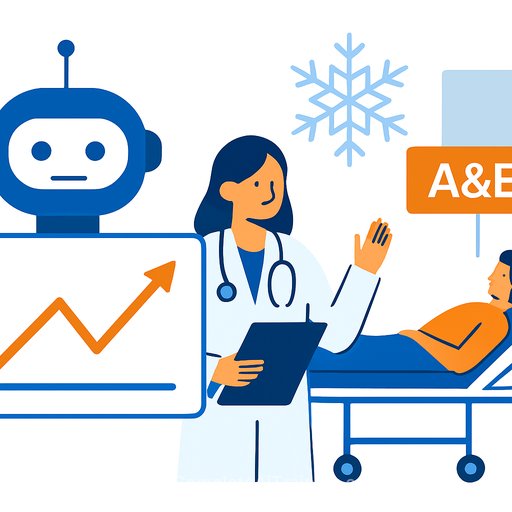
NHS hospitals are using an AI forecasting tool to anticipate when A&E departments will be busiest this winter. The system, already live in 50 NHS organisations, predicts daily demand for emergency care and helps teams plan staff, beds, and patient flow.
Ministers say the goal is simple: spot bottlenecks earlier and shorten waits during the toughest months. For operational leaders, that means clearer staffing decisions, stronger escalation plans, and fewer surprises.
How the tool works
The model is trained on historic data, including Met Office weather trends, to estimate attendances and likely admissions each day. Forecasts can be used to shape rotas, open additional capacity, and adjust same-day emergency care and diagnostic resources ahead of spikes.
When paired with bed management and ambulance handover data, teams can plan discharge pathways earlier and reduce corridor care. The biggest operational win comes from treating demand like a known schedule, not a daily emergency.
What ministers and experts are saying
Technology Secretary Liz Kendall said: "AI is already improving healthcare by speeding up diagnosis and unlocking new treatments. Now we are going a step further. By helping to predict demand, this AI forecasting tool is getting patients the care they need faster while supporting our incredible NHS staff."
Ian Murray, Minister for Digital Government and Data, described A&E as the "front door" of the NHS and said the tool helps hospitals predict busier periods, such as Saturday nights and winter months, so they can plan ahead.
Flu remains a factor. Dr Jamie Lopez-Bernal, UKHSA consultant epidemiologist, warned: "Flu is always unpredictable, is still circulating and could bounce back even further in the new year as we have seen in past years." He urged eligible people to get vaccinated while appointments are available.
Met Office weather patterns are part of the data mix. For vaccination guidance and updates, see the UKHSA annual flu programme.
What this means for NHS and government leaders
- Turn forecasts into action: tie predicted peaks to specific triggers (e.g., open 8-12 SDEC chairs, call in extra flow coordinators, extend imaging hours).
- Lock in rotas early: align staffing, junior doctor cover, and specialist review capacity to the forecast window, not the calendar.
- Protect ambulance flow: pre-book offload bays during expected spikes and flex same-day capacity to reduce boarding.
- Move discharge earlier: pull-forward TTOs, transport, and community handover during predicted high-admission days.
- Coordinate at ICS level: share forecasts across trusts, 111/999, community, and social care so the whole system flexes together.
Data, governance, and assurance
- Inputs: historic A&E attendances, admissions, weather trends, local events, school terms, bank holidays.
- Validation: compare daily forecasts to actuals; track error rates and adjust thresholds for escalation.
- Safety and privacy: complete DPIA, clinical safety case (DCB0129/0160 as applicable), and ensure audit trails for decisions linked to forecasts.
- Bias and drift: monitor performance across sites and seasons; re-check accuracy after unusual weather or service changes.
- Fallbacks: define manual plans if feeds fail or accuracy dips below agreed thresholds.
Metrics to watch
- 4-hour performance and 95th percentile time to initial assessment.
- Ambulance handover delays and time to offload.
- Boarding hours and bed occupancy at noon and midnight.
- SDEC conversion rate and time to decision to admit.
- Same-day diagnostics turnaround during forecast peaks.
Risks and how to manage them
- Overreliance: forecasts support judgement, they don't replace it. Keep clinical and operational sign-off for escalations.
- Data quality: missing feeds or late updates can skew outputs. Automate checks and alert on anomalies.
- Weather anomalies: extreme cold or heat can shift patterns. Stress-test scenarios and keep capacity buffers.
- Adoption: brief site leaders and matrons on what the forecast means today and tomorrow. Make it part of the safety huddle.
Getting started
Fifty NHS organisations already use the tool. If you're not yet live, run a 4-6 week shadow period: compare daily forecasts to actual demand, set local triggers, and refine your escalation playbook before go-live.
Keep the interface simple for frontline teams: a clear daily signal (low/medium/high), time-banded peaks, and a short list of pre-agreed actions. Measure impact weekly and feed back into staffing and bed plans.
Flu remains a moving target
Recent data suggested a dip in flu admissions over the festive period, but experts warn it could rebound in the New Year. Vaccination for eligible groups still matters-especially with pressure already high.
Upskilling teams on AI in operations
If you're building capability around AI-driven planning and analytics, consider role-based learning such as the AI Learning Path for Supply Chain Managers for forecasting and operational optimisation, or the AI Learning Path for CFOs for executive-level governance and cross-system planning.
The aim this winter is practical: forecast earlier, act sooner, and keep patients flowing safely through the system.
Your membership also unlocks: