'Tell Stories Otherwise Not Told': How Nigeria's Creatives Use AI To Boost Film Production
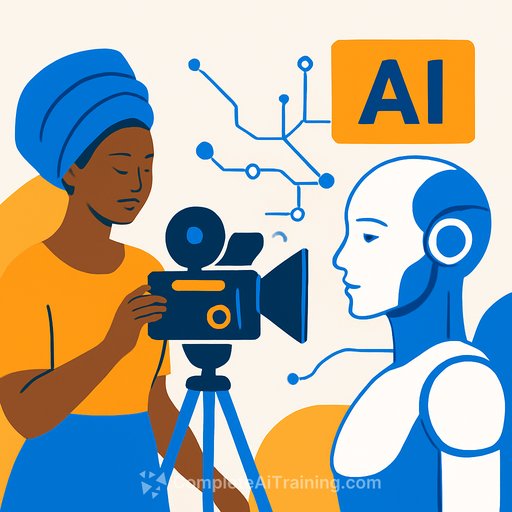
Nigeria's filmmakers and digital creators are moving fast on AI. It trims costs, opens up scenes that were once out of reach and helps local stories play on a global stage. Ignoring it now looks like a career risk.
Why AI is on set now
Actor and producer Omoni Oboli puts it plainly: "Whether you ignore it, it's not going to go away. If you want to truly play in the global space, you're going to have to learn AI."
She's already using it to spark story ideas, animate short videos and make promo assets. At a recent Lagos workshop, she fed her channel logo and a film title into a generative tool and got a 30-second trailer-complete with smoke and sound-in half a minute. "I didn't have to pay anybody to do that. Just having that tool at my fingertip is powerful."
Beyond marketing, she sees AI helping in post: set extensions, complex shots and mood-heavy inserts that would be tough or pricey to capture on location.
Prompts are the new camera language
Director-producer Biodun Stephen walked away from the same workshop with one clear takeaway: better prompts, better results. "One of the key things for me today was learning how to feed the machine properly with the right prompts so that you can get the best result," she says.
She's used AI to animate posters for campaigns and believes the tech will help teams tell stories that budgets or locations would have blocked. Her stance: treat AI as a collaborator, not a threat.
Filling the gaps: history, footage and budget
Travel and lifestyle creator Tayo Aina uses generative tools to recreate historical moments when footage doesn't exist. "If we're talking about where something was signed historically and we don't have the footage, we can use AI to illustrate it and add it into our videos."
He's blunt about the trade-offs. Some roles will shrink. Workflows will get leaner. And the people who adapt will keep moving. "You can never stop technology… if you don't start to implement it into your project, you're going to get left behind."
Platforms are pushing support
YouTube's EMEA Partnerships lead, Miebaka Anga, frames AI as complementary. "AI can help creators and filmmakers augment their creativity, their efficiency and their production capability… At the end of the day, it's still a tool." The goal of workshops like Lagos: introduce practical tools, back creators with ongoing support and boost the visibility of African content worldwide.
For an overview of platform features, see YouTube's AI tools for creators.
Practical ways to plug AI into your workflow
- Ideation and scripts: draft synopses, character sheets and B-story options. Iterate quickly, then rewrite in your voice.
- Trailers and teasers: generate motion logos, stylized title cards and rough animatics to test tone and pacing. Explore tools in Generative Video.
- Post-production lifts: concept style frames, set extensions, sky replacements and background plates for inserts you couldn't shoot.
- Marketing assets: poster variants, social cutdowns and captions in multiple languages to stretch limited budgets.
- Historical gaps: responsibly recreate scenes you can't source, and label them clearly as illustrative.
Prompting tips that actually help
- Be specific: subject, action, setting, era, camera style (e.g., "35mm, handheld, dusk, Lagos marina, moody backlight").
- Lock tone: reference 2-3 visual styles or films you own or can cite for mood-don't copy; aim for direction.
- State constraints: duration, aspect ratio, color palette, motion intensity, VFX level.
- Iterate in layers: get a rough pass, then refine details (props, wardrobe, lighting cues) across versions.
Keep it ethical and clear
- Credit collaborators. Get consent for likenesses and voices. Avoid training on material you don't have rights to.
- Label synthetic shots in documentaries and factual work. Don't blur the line where accuracy matters.
- Use AI to extend teams, not erase them. Bring specialists in when quality or safety is on the line.
A simple way to start this week
- Day 1-2: Define a scene you couldn't shoot before. Write a one-paragraph brief with clear constraints.
- Day 3-4: Generate three visual directions (style frames or short motion tests). Share with a trusted peer for feedback.
- Day 5-6: Build a 20-30 second proof-of-concept trailer or animatic from the best direction.
- Day 7: Cut a social teaser and a poster variant. Measure response. Roll what works into your pitch deck.
The shift isn't about replacing filmmakers. It's about filmmakers who use new tools to tell stories they couldn't tell yesterday-and shipping those stories faster, cleaner and at a price that keeps the lights on.
Your membership also unlocks: