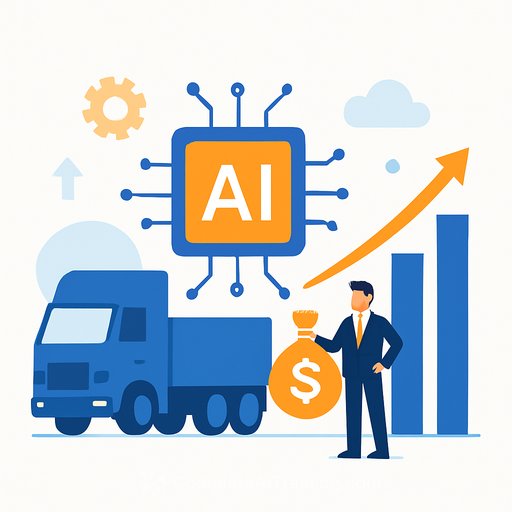
Nirvana Tech raises $100M to scale its AI-native insurance platform beyond trucking
Nirvana Tech has secured a $100 million Series D to widen its footprint beyond commercial trucking. The company built an AI-native operating system for insurance that fuses telematics with Generative AI and LLM to score risk, deliver driver-level safety insights, and smooth out claims workflows. For insurers and brokers, this signals a clear shift: pricing and loss control are moving closer to real-time operations.
The round was led by Valor Equity Partners, with participation from Lightspeed Venture Partners and General Catalyst. Valor's Vivek Pattipati said the firm sees a chance to back a company addressing a fundamental pain point in a data-rich but process-heavy industry. He noted this is about more than underwriting-there's room to apply the same stack to a broader set of customer problems across insurance.
How the platform works
Nirvana ingests telematics across fleets-harsh braking, acceleration, cornering-and pairs that with safety guidance from the Federal Motor Carrier Safety Administration (FMCSA). Its safety intelligence turns daily driving patterns into actionable feedback and a more accurate view of fleet performance. The result: premium optimization tied to demonstrated behavior and reported average savings of up to 20% for safe fleets. On the claims side, access to sensor and video data helps speed triage and reduce downtime after an incident.
Chief executive Rushil Goel put it bluntly: insurance is math meeting messy, dynamic data. "We're building insurance the way it needs to exist in the AI era, with data at the center and models trained on billions of real-world miles," he said.
Why this matters to insurers and brokers
- Pricing and selection: Telematics provides continuous risk signals that outperform static proxies like MVRs alone. Better segmentation, cleaner books, tighter retention.
- Loss control with measurable ROI: Driver-level coaching tied to premiums motivates behavior change and lowers frequency. You can quantify results within a policy term.
- Faster, cleaner claims: Sensor timelines and video reduce disputes, accelerate liability decisions, and improve subrogation recovery.
- Distribution advantage: Brokers who bring safety programs plus data-backed credits win more competitive accounts and keep them longer.
- Line expansion: Once the pipes are in place, the same approach can inform auto liability, physical damage, cargo, and even support workers' comp insights for fleet injuries.
What to do now
- Assess data readiness: Confirm access to ELDs, dashcams, and telematics vendors. Clarify ownership, retention, and rights to use data in underwriting and claims.
- Pilot a behavior-based factor: Start with a simple, filed score for fleets (e.g., harsh events per 100 miles with decay). Limit to a few segments and monitor stability.
- Modernize FNOL and triage: Ingest telematics and video at first notice. Use LLM summarization for adjuster notes, and fast-track clear liability cases.
- Tighten governance: Document model purpose, variables, and monitoring. Check state filing requirements, privacy (GLBA/CCPA), and fairness reviews.
- Prepare your reinsurance story: Share telemetry-driven lifts on frequency, cycle time, and severity. Align treaties with improved data transparency.
- Vendor diligence checklist: Data lineage and transparency, model drift monitoring, API maturity, security posture, uptime SLAs, and indemnities.
What to watch next
- Regulatory acceptance: More filings that incorporate continuous telemetry into rating, with clear consumer disclosures and opt-in frameworks.
- Distribution partnerships: OEMs and telematics providers bundling insurance or offering preferred data-sharing agreements.
- Cross-industry expansion: Last-mile delivery, construction fleets, agriculture, energy services-any segment with high-frequency driving and safety variability.
- Claims outcomes: Shorter cycle times, cleaner liability splits, better subrogation yields, fewer litigated claims-tracked publicly or via broker feedback.
Nirvana's pitch lands at a tough moment for trucking. Many carriers have closed in recent years under pressure from fuel and insurance costs. If behavior-linked pricing and faster claims become standard, fleets that invest in safety tech and coaching should see pricing relief and less downtime.
As Valor's Pattipati noted, the bigger story is applying this data-and-ML playbook to a legacy industry weighed down by manual steps. The teams that move first on data rights, filings, and workflow integration will set the bar others have to match - and executives evaluating that shift can find frameworks in AI for Executives & Strategy.
Further resources
- FMCSA safety programs and guidance: https://www.fmcsa.dot.gov/
- Upskill teams on AI for underwriting and claims: AI for Insurance
Your membership also unlocks: