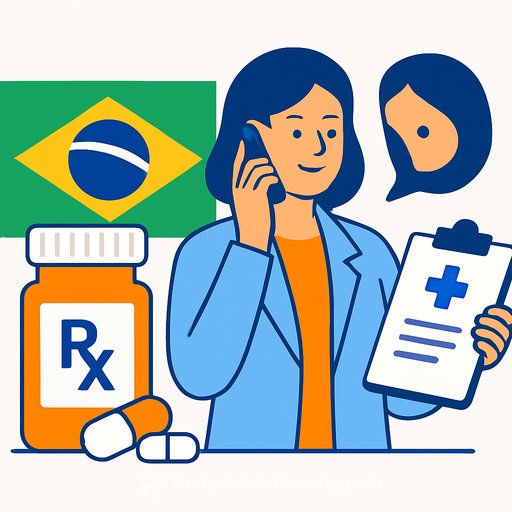
Brazil puts AI prescription review into SUS with NoHarm
Brazil has entered the global AI map with NoHarm, an AI system built to evaluate medical prescriptions and made available free of charge across the public healthcare system (SUS). The tool was co-founded by pharmacist Ana Helena Ulbrich, recently named by Time as one of the most influential people in AI, appearing alongside figures like Elon Musk, Mark Zuckerberg, and Sam Altman.
For clinicians and pharmacists working under resource pressure, this matters. A national-scale safety net for prescriptions can reduce preventable harm while keeping workflows moving.
Why this matters for care teams
Medication-related harm remains a major patient safety issue worldwide, especially in high-volume settings. The focus is simple: fewer errors, faster verification, and consistent checks across facilities of different sizes.
For context, see the WHO's global effort on medication safety: Medication Without Harm.
What an AI prescription evaluator typically does
- Flags potential risks in orders (e.g., interactions, dosing anomalies, contraindication signals) in real time.
- Surfaces concise, clinically relevant alerts to reduce noise and alert fatigue.
- Aligns checks with local formularies, protocols, and stewardship rules.
- Logs decisions and overrides for audit and quality improvement.
The final call stays with the prescriber and pharmacist. The goal is to add a fast second set of eyes-without slowing the line.
How SUS units can put this to work
- Start where risk concentrates: high-alert meds, polypharmacy, and transitions of care.
- Embed checks at order entry and pharmacy verification to catch issues early and late.
- Pilot with a small service line, measure impact, then roll out in stages.
- Set governance: track alert rates, acceptance, overrides, and near-misses; review monthly.
- Protect data: comply with Brazil's LGPD, use least-necessary PHI, and monitor access logs.
- Train with real cases and quick refreshers. Build a feedback loop so clinicians can flag false positives and gaps.
- Communicate expectations clearly: support clinical judgment, avoid over-reliance, document reasoning.
Equity upside for SUS
Because NoHarm is available free to SUS, smaller municipalities and clinics can access the same safety layer as major hospitals. That helps standardize checks, reduce variability, and extend pharmacist oversight where staffing is thin.
What this signals globally
Ana Helena Ulbrich's recognition marks a straightforward point: practical, clinician-led AI can reach national scale when it solves a daily pain point. For broader context, see Time's coverage of the most influential people in AI.
Level up your team's AI literacy
If you're planning adoption or oversight, training managers can upskill staff with the AI Learning Path for Training & Development Managers. Short, focused training makes change management easier and keeps safety front and center.
Your membership also unlocks: