AI Training Belongs in Nursing Education: What to Teach, How to Start, and How to Measure It
A recent study highlights a clear message for nursing schools and hospital educators: AI training is now a baseline skill set for future-ready nurses. Clinical tools, documentation systems, and patient communication are already influenced by AI. Waiting puts students behind the curve and risks care quality.
The takeaway is simple. Build AI literacy directly into nursing curricula and ongoing professional development. Focus on skills that improve safety, efficiency, and decision-making at the bedside.
What this means for educators and clinical leaders
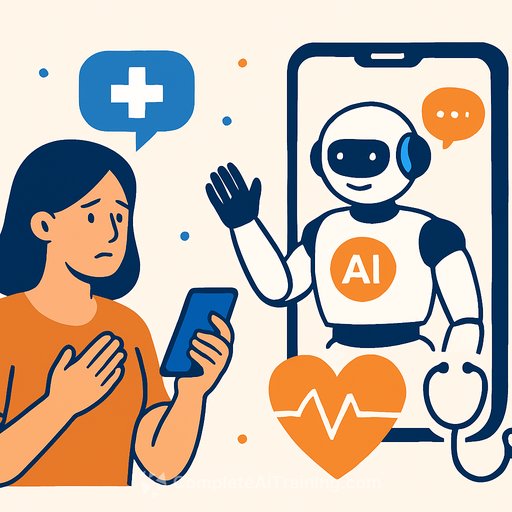
AI is entering triage, clinical decision support, care coordination, documentation, and patient education. Nurses need to understand what these tools do, how they assist, and where they can go wrong. The goal is confident, ethical use-never blind trust.
Core competencies nurses need
- AI literacy: What AI can and cannot do; common terms; limits and risks.
- Data basics: Data quality, bias, and how inputs influence outputs.
- Clinical decision support: How to interpret AI recommendations and validate them against clinical judgment.
- Documentation and admin: Using AI for notes, summaries, patient instructions, and scheduling without losing accuracy.
- Patient communication: Explaining AI-assisted care in clear, respectful language.
- Privacy and security: HIPAA-minded workflows, PHI handling, and tool vetting.
- Ethics and safety: Bias, transparency, accountability, and escalation protocols.
Practical curriculum blueprint
- Level 1: Awareness (Weeks 1-2) - Concepts, examples in nursing, guardrails, and case studies showing both value and failure modes.
- Level 2: Hands-on (Weeks 3-6) - Guided labs with AI note assistants, summarization tools, and decision support simulations; strict PHI-safe practice.
- Level 3: Clinical integration (Weeks 7-12) - Scenario-based training in med-surg, ED, and primary care contexts; team-based exercises with nurses, faculty, and IT.
Implementation playbook
- Start with policy: Define acceptable use, PHI protocols, and documentation standards. Align with compliance and clinical governance.
- Pick approved tools: Work with IT and risk to shortlist safe, supported platforms. Provide sandbox access for training.
- Train faculty first: Short workshops for educators so they can model best practices.
- Build simulation: Use realistic patient cases and EHR-like environments to test decisions and communication.
- Close the loop: Create feedback channels for faculty and students to report issues and improvements.
Guardrails that keep patients safe
- AI is advisory: Final clinical decisions stay with licensed professionals.
- Document the human: Record the nurse's reasoning when AI suggestions influence care.
- Bias checks: Teach students to question outputs that may disadvantage specific populations.
- Privacy first: No PHI in unapproved tools; use de-identified data in training environments.
How to measure outcomes
- Skill assessments: Short practical exams on safe AI use, documentation quality, and decision validation.
- Time studies: Track changes in documentation time and handoff quality.
- Safety signals: Monitor near-miss reporting related to AI recommendations.
- Student confidence: Survey comfort with AI tools before and after training.
Useful references
- WHO guidance on ethics and governance of AI for health
- American Nurses Association: Augmented Intelligence in Nursing
Get practical training support
If you're building AI modules for nursing cohorts or clinician upskilling, you can pull ready-made course lists by role and skill. It saves development time and keeps content current.
- Courses by job - curate programs for nursing students, clinical educators, and administrators.
- Latest AI courses - keep your curriculum fresh with new tools and policy updates.
- AI Learning Path for Training & Development Managers - a sample curriculum and implementation guidance tailored to educators and clinical trainers.
Bottom line
AI training belongs in nursing education now. Teach the fundamentals, practice with guardrails, and measure real outcomes. Nurses don't need to be data scientists-they need clear, safe, repeatable workflows that improve care.
Your membership also unlocks: