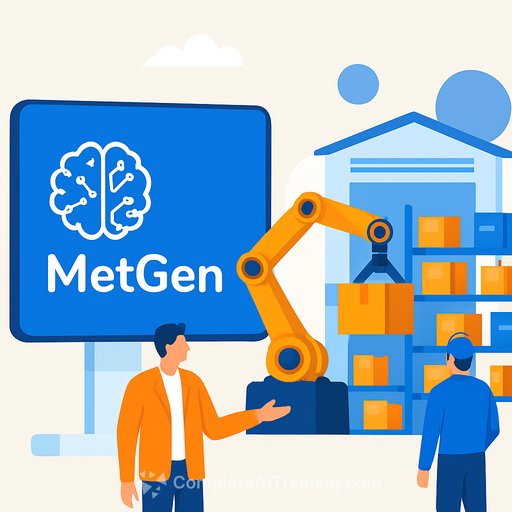
MetAI to debut MetGen at CES 2026, targeting the US market
News highlights - Monday, December 29, 2025
Digital twin adoption is moving from pilot to production. With AI, 3D simulation, and big data maturing, teams can stand up high-fidelity virtual environments to test, iterate, and de-risk before anything hits the floor. MetAI, invited by Taiwan Tech Arena (TTA) to exhibit at CES 2026, will showcase MetGen - an AI- and 3D-driven digital twin platform built to help US smart warehousing and advanced manufacturing teams move faster with fewer surprises.
Why product development teams should care
Most digital twins still take months to build and rarely match real-world behavior on the first try. MetGen aims to compress that timeline to minutes by converting 2D files into SimReady 3D environments and wiring in physics and control logic from the start.
That means you can validate layouts, stress-test logic, and run what-if scenarios before committing budget and time on-site. Less rework, tighter feedback loops, and a cleaner path from design to deployment.
What MetGen does
- AI-native, domain-specific generative platform for real-to-sim and sim-to-real workflows
- Automatically converts CAD/BIM/2D blueprints into SimReady 3D twins with structure consistency
- Integrates AI, 3D simulation, physics modeling, and executable automation control logic
- Generates large-scale, high-fidelity synthetic datasets inside the twin for model training
- Built on NVIDIA Omniverse integration to assemble complex environments in minutes Learn more
Initial focus: smart warehousing, semiconductors, and data centers.
Time-to-value and accuracy
Traditional digital twins lean on manual data wrangling and hand-built models - think hundreds to thousands of hours and multiple revision cycles. Even newer tools often struggle with fidelity, forcing costly rework.
According to MetAI, MetGen interprets CAD or BIM directly and constructs complete 3D twins in minutes, with high consistency and no structural mismatch. Teams can plan production lines, create sandboxes for robot training, and pressure-test logistics flows before touching hardware.
Go-to-market and traction
MetAI will present MetGen at CES 2026, backed by support from TTA across prep, matchmaking, and presentation. "We are honored to receive TTA's invitation to exhibit at CES 2026," said co-founder and CEO Daniel Yu, noting that US warehousing demand - driven by retailers like Amazon, Walmart, and Costco - makes the US the company's primary expansion target.
The company closed a US$4 million seed round in 2025 with investors including Kenmec Mechanical and NVIDIA, making it one of the few Taiwan startups to receive a direct strategic investment from NVIDIA. Partnerships include work with TSMC and a project with Kenmec to reconstruct Chief Global Logistics' smart logistics center as a physics-accurate, control-ready digital twin with AI-driven optimization.
US expansion plans
MetAI is preparing to establish a US headquarters with a local team, customer support, and a technical service center. The goal: sit closer to key customers in North America and tighten execution across pilots, rollouts, and ongoing optimization.
How to pilot MetGen inside your org
Operations teams looking to scale digital twins and closed-loop automation should review the AI Learning Path for Operations Managers for role-focused guidance.
- Baseline assets: collect CAD/BIM drawings, equipment specs, and PLC/control logic
- Pick a focused use case: AMR routing, picking/packing cells, tool install validation, or data center layout
- Start small: model a single line or cell and benchmark build time vs. your current approach
- Leverage synthetic data: pre-train perception or planning models inside the twin; add staged sim-to-real tests
- Integrate systems: connect to WMS/MES/PLC via APIs for closed-loop simulation-to-execution
- Track the right KPIs: time-to-model, throughput deltas, error rates, and change-order reductions
What to watch next
- Measurable real-to-sim fidelity and sim-to-real transfer rates in production settings
- Hardware ecosystem coverage: robots, PLCs, sensors, and conveyors
- Deployment options, pricing, and licensing for multi-site rollouts
- Live demos and customer references coming out of CES 2026
Upskill your team
If you're building internal capability around AI-driven simulation and automation, explore role-based AI learning paths to shorten onboarding and pilot timelines: AI Learning Path for Training & Development Managers.
Your membership also unlocks: