NVIDIA's Israel Expansion: What Product Teams Should Do Next
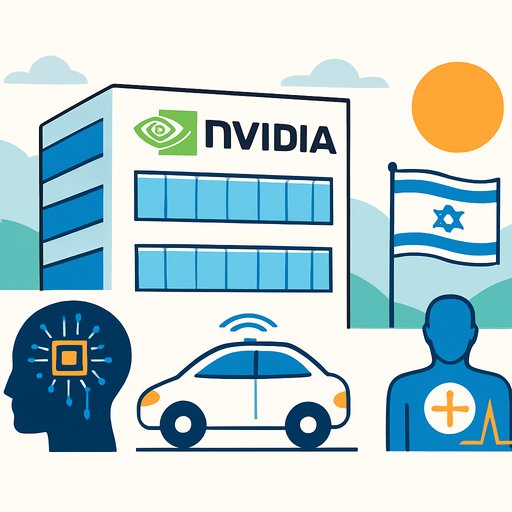
NVIDIA is opening a new employment campus in Kiryat Tivon. Beyond the headline, this move signals deeper investment in the core stack that fuels autonomous vehicles, AI infrastructure, and medical computing.
If you build products, this isn't about GPUs as a component. It's about a platform that compresses your timelines from idea to deployment.
Why Kiryat Tivon matters for product development
- Access to talent: proximity to Israel's northern tech hubs and an established R&D base accelerates hiring across systems, AI, and networking.
- Stronger supply chain and partner ecosystem: easier collaboration with chipset, networking, and simulation vendors.
- Faster enterprise adoption: local presence reduces procurement friction and boosts co-development opportunities.
The stack NVIDIA is pushing forward
- Compute and networking: GPUs plus high-speed interconnects (Infiniband-class) enable training, inference, and digital twins at scale.
- AI software: CUDA, cuDNN, TensorRT, Triton Inference Server, and microservices that package models for production.
- Simulation and 3D: Omniverse for synthetic data, digital twins, and multi-domain testing before you touch the real world.
Impact by sector: where to build
Autonomous vehicles: Lower-latency inference, high-fidelity simulation, and safety tooling tighten your release cycles. If you're planning L2+ features, you'll want repeatable pipelines across data collection, labeling, training, and validation. Learn more on the official DRIVE platform page here: NVIDIA DRIVE.
AI products: Expect better throughput per watt and lower cost per token/frame with optimized runtimes. This is where Triton + TensorRT and model-specific microservices help you ship features that meet strict latency SLOs.
Medicine: Imaging, drug discovery, and clinical AI require traceability and performance. Tooling around federated learning and reference workflows shorten validation. For context, see NVIDIA's healthcare platform: NVIDIA Clara.
Practical moves for your roadmap
- Set performance baselines: define target latency, throughput, and memory ceilings for inference before choosing architectures.
- Lock down your toolchain: standardize on ONNX export, TensorRT engines, Triton deployment, and CI that bakes performance tests into PRs.
- Simulation-first development: use digital twins to test corner cases for AV, robotics, or clinical workflows before field trials.
- Optimize the data loop: instrument data feedback from production, prioritize failure modes, and retrain on curated batches-weekly, not quarterly.
- Right-size models: prefer distilled or quantized variants that meet user-level metrics instead of chasing benchmark wins.
Compliance and safety from day one
- AV: design to ISO 26262 and ASPICE, log everything, and maintain replayable scenarios for audits.
- Healthcare: align with IEC 62304, HIPAA/GDPR, and clear data lineage from acquisition to inference.
- Security: isolate workloads, scan containers, and monitor GPU telemetry for anomalies.
Hiring priorities
- Inference performance engineer: owns TensorRT ops, batching, and memory profiling.
- Data operations lead: guarantees reproducible datasets, versioning, and active-learning loops.
- Simulation engineer: builds scenarios, sensors, and validators tied to acceptance criteria.
- Product-minded TPM: aligns model updates with regulatory and customer rollout plans.
De-risk vendor concentration and cost
- Abstract the runtime: keep ONNX export paths and validate fallbacks to alternative accelerators where feasible.
- Track unit economics: measure cost per inference, per mile (AV), or per study (medical). Kill features that can't beat targets.
- Capacity planning: secure shared clusters and prioritize batch windows for model refreshes to avoid starving user-facing services.
30-60-90 day action plan
- 30 days: Benchmark your top 3 workloads on Triton + TensorRT, define SLOs, and identify the biggest latency bottleneck.
- 60 days: Stand up a simulation environment or synthetic data pipeline. Integrate performance tests into CI/CD. Ship a pilot.
- 90 days: Productionize the winning architecture. Add automated data curation and weekly retrains. Start formal compliance documentation.
Why this expansion matters
Local investment means tighter feedback loops between product teams and the platform vendor. Expect quicker access to reference designs, better support, and more joint programs.
If you align your roadmap with this stack now, you'll ship faster, reduce technical debt, and meet stricter safety and cost constraints without slowing delivery.
Level up your team's AI execution
If you need structured learning tracks for PMs, engineers, and IT leaders, consider these role-focused paths: AI Learning Path for Technology Managers, AI Learning Path for Software Engineers, and AI Learning Path for CIOs.
Your membership also unlocks: