
AI news ·
Nvidia CEO Jensen Huang declines Warren's request to testify at Senate AI hearing
Nvidia CEO Jensen Huang declined a Senate invitation to testify about the company's China operations and export controls, offering a headquarters visit instead. Sen. Warren fired back, noting his recent Mar-a-Lago and Beijing trips.
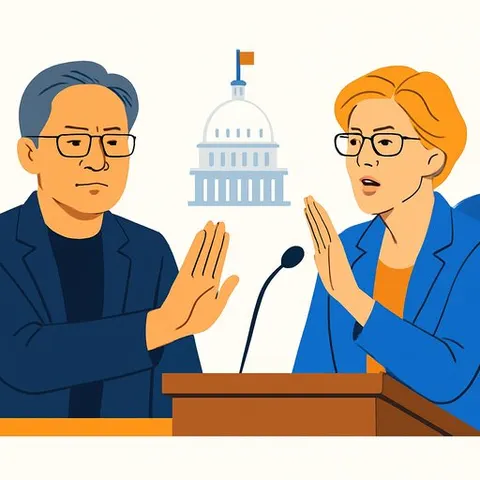
Nvidia CEO declines Senate testimony on China business, export controls
Nvidia CEO Jensen Huang will not testify at a Senate Banking Committee hearing Thursday about American AI development, despite an invitation from Sen. Elizabeth Warren to discuss the company's operations in China and approach to export controls.
Huang said in a letter to Warren that he was "unable to attend," but offered to host committee members at Nvidia's Santa Clara headquarters instead. The company, now the world's most valuable at over $5 trillion in market capitalization, designs the advanced chips that power most AI systems globally.
Warren responded sharply. "If Mr. Huang has time to attend a $1 million-a-head dinner at Mar-a-Lago and fly across the world to meet with President Xi Jinping of China, he should be able to find time to answer questions from Congress," she said in a statement.
What the hearing will cover
Thursday's hearing will examine AI's role in American innovation, affordability, and technological dominance. The committee will hear from four panelists: Mike Flynn of the Information Technology Industry Council, David Feith of the Hudson Institute, Will Rinehart of the American Enterprise Institute, and Sarah Myers West of the AI Now Institute.
Export controls on AI chips have become a central policy debate. The Commerce Department last week moved to close a loophole that may have allowed companies to export powerful AI chips to countries otherwise banned from obtaining advanced American technology.
The export control divide
Huang has repeatedly urged lawmakers to allow broader chip sales globally. In December, he told reporters that American companies should "offer the most competitive chips we can to the Chinese market," while maintaining American technological leadership.
Warren has opposed this approach. She said Huang's lobbying "could turbocharge China's military and undercut American technological leadership."
Congress is considering several bills that would further restrict chip and chipmaking equipment sales to China and other U.S. rivals. Some argue that selling American chips abroad is critical for American competitiveness. Others contend that AI chips are powerful enough to warrant strict export controls, given their potential military applications.
Huang sits on President Donald Trump's Council of Advisors on Science and Technology. NBC News could not locate any record of him previously testifying before Congress.
For IT and development professionals, these export control decisions will shape which AI tools and hardware are available in different markets and how global development teams can collaborate.