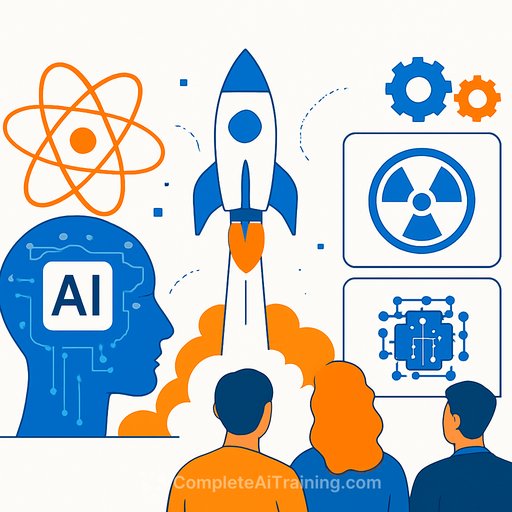
Big Tech joins U.S. "Genesis Mission" AI to accelerate nuclear and quantum research
Twenty-four companies and institutions-including Nvidia, Google and OpenAI-have signed an MOU with the U.S. Department of Energy (DOE) to apply AI to high-impact scientific work. The program, called the "Genesis Mission," is aimed at boosting U.S. energy and national security while cutting reliance on foreign technologies.
The lineup spans Microsoft, Amazon Web Services (AWS), AMD, IBM, Intel, Oracle, Anthropic, Palantir and xAI. Project Prometheus, an AI startup founded by Jeff Bezos, is also participating.
President Donald Trump signed an executive order last month to formally launch the initiative. "Genesis Mission will accelerate innovation across a wide range of fields, including energy, manufacturing and drug development," said Michael Kratsios, director of the White House Office of Science and Technology Policy.
What the collaboration covers
- Joint research between participating companies and DOE-affiliated national laboratories.
- Application of AI and large-scale computing to nuclear energy, quantum computing and robotics.
- Focus on scientific productivity, energy resilience and national security use cases.
Why this matters for science and research teams
Expect deeper access to advanced compute and models alongside domain experts in federal labs. The effort is set to tighten links between fundamental research and field deployment in energy and security contexts.
- Potential for shared datasets, high-throughput experimentation and standardized evaluation across labs.
- Opportunities to co-develop methods that translate from simulation to physical systems in nuclear and robotics.
- Closer coordination on safety, reliability and auditability for AI systems used in sensitive environments.
How to prepare your group
- Map your research to priority tracks: nuclear modeling, quantum algorithms, robotics autonomy and controls.
- Audit compute and storage: quantify GPU/CPU needs, interconnect, and data ingress/egress requirements.
- Harden your data: provenance, versioning, PII controls and export-compliance checks.
- Build reproducibility into your workflow: containerized pipelines, evaluation suites and model cards.
- Line up collaborators at DOE labs and universities; clarify IP, data-sharing and publication plans early.
- Prepare concise proposals: problem statement, expected impact, evaluation metrics, milestones and risks.
Program context
The initiative is framed as a national effort to boost scientific throughput and reduce exposure to foreign tech dependencies. The Manhattan Project analogy underscores the scale and urgency attached to AI for strategic domains.
For updates on partnerships and lab programs, track DOE communications and opportunities from national laboratories. A starting point: DOE National Laboratories.
Related resources
Bottom line: if your work touches nuclear, quantum or robotics, set up the infrastructure and partnerships now. When calls and project windows open, speed and clarity will decide who moves first.
Your membership also unlocks: