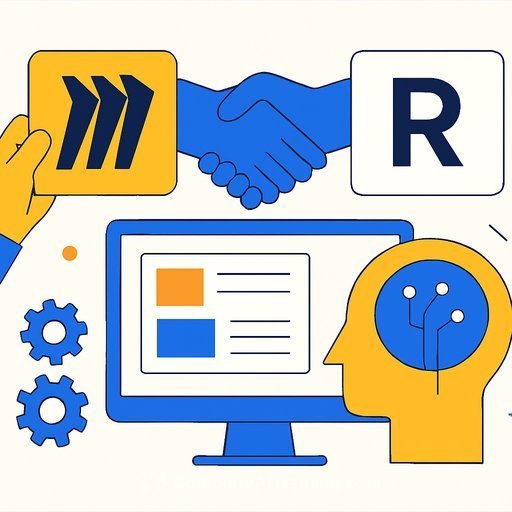
Nvidia-OpenAI partnership: What executive teams need to know in 2026
San Francisco, January 31, 2026 - The Nvidia OpenAI partnership is one of the most watched alliances in technology. It shows how AI progress now depends on tight cooperation between hardware makers and research-led organizations. As adoption spreads across sectors, this relationship influences investment, infrastructure, and policy decisions. It also raises questions around market concentration and long-term viability.
AI infrastructure moved from experiment to core utility
Over the past decade, AI shifted from lab projects to a core layer of products and operations. That shift required gains in compute, energy efficiency, and data throughput. The partnership grew as demand for specialized processors surged. Nvidia's accelerated platforms became essential for training and serving large-scale models. Technology leaders can find practical guidance on infrastructure strategy and roadmap planning in the AI Learning Path for CTOs.
More than a supplier agreement
Industry analysts describe this as strategic coordination, not a simple vendor contract. Both sides benefit from shared planning, early access to new tech, and feedback loops that refine future products. Research goals influence hardware design, while new compute enables more ambitious experiments. The result is a cycle that reinforces progress.
Why it matters for Nvidia
AI is a core pillar of Nvidia's long-term strategy. Investments span data center systems, networking, and software built for AI workloads. Working closely with OpenAI provides real-world signals on efficiency and scale requirements. That input informs product roadmaps and strengthens Nvidia's position as a foundational provider.
Why it matters for OpenAI
OpenAI's mission requires dependable, high-performance compute to support fast iteration and large training runs. The partnership ensures access to reliable infrastructure. That frees researchers to focus on capability development, safety research, and evaluations at scale without constant hardware constraints.
Investor read: reduced uncertainty
Markets respond to clarity on critical supply chains. Ongoing confirmation of cooperation between the two companies has helped steady sentiment during volatile periods. Analysts note that dependable AI infrastructure is increasingly tied to economic competitiveness.
Ripple effects across the ecosystem
This partnership influences startups, cloud providers, and enterprise buyers that build on the associated tools and platforms. Decisions on standards, pricing, and research focus can spread far beyond the two organizations. For large buyers, procurement and architecture choices often follow where the leaders commit.
Energy use and sustainability
As models grow, power and cooling needs increase. Efficiency improvements-smarter chip architectures and better resource allocation-are now a priority. Executives should track energy metrics, location strategy, and vendor roadmaps that target lower total cost of ownership. For broader context, see the IEA analysis on data center energy use.
Regulatory and policy pressure
Governments are scrutinizing competition, data governance, and national security in large-scale AI collaborations. This partnership operates within evolving rules and standards. Policy engagement and transparent practices are becoming table stakes. Frameworks like the NIST AI Risk Management Framework are shaping internal controls and reporting expectations. Teams responsible for compliance and policy engagement may benefit from the AI Learning Path for Regulatory Affairs Specialists.
Global competition and national priorities
Nations are investing to secure leadership in advanced AI. Private-sector alliances are a key lever for progress. The Nvidia OpenAI partnership shows how cooperation can accelerate advances while keeping a close eye on oversight and resilience.
Roadmap: more parallelism and specialized accelerators
The next decade points to increased parallel processing and domain-specific accelerators. This partnership offers a testbed at scale, helping turn theory into deployable systems faster. Expect faster iteration cycles between research findings and hardware releases.
Industry sentiment
As one senior analyst put it: the future of AI will be driven less by isolated breakthroughs and more by sustained cooperation between those who build systems and those who train them. Few partnerships demonstrate that principle at this scale.
Economic impact across sectors
From healthcare and finance to manufacturing and education, AI-related infrastructure choices today set productivity trajectories for years. Economists view this alliance as a driver of AI-enabled growth that reaches far beyond the tech sector. For leaders, the question is how to participate without overexposing the organization to single-vendor risk.
Public expectations and transparency
As AI becomes more visible, expectations around clarity and accountability are rising. Partnerships at the center of development face pressure to communicate goals, safeguards, and measurement. Trust will be a competitive advantage.
Safety, testing, and responsibility
Reliable behavior in advanced systems requires rigorous testing and independent evaluation. Access to large-scale compute enables safety research, simulations, and audits at the pace of model development. This will remain a shared priority for research teams and infrastructure providers.
Talent and workforce effects
Demand for skilled engineers and researchers keeps climbing. Partnerships attract talent by offering ambitious problems and access to the best tools. That advantage compounds over time as teams learn faster and ship better systems.
What CEOs and boards should do now
- Set a clear AI infrastructure strategy: mix of on-prem, cloud, and colocation to manage cost and control.
- Stress-test vendor concentration: define thresholds, exit ramps, and second-source options.
- Tie AI growth to efficiency targets: PUE, GPU utilization, and cost-per-inference KPIs.
- Create a formal AI safety and evaluation program: red-teaming, monitoring, and incident response.
- Integrate policy into planning: assign ownership for compliance with emerging standards.
- Build a talent pipeline: fund training, internal academies, and research partnerships.
- Negotiate for roadmap visibility: early-access pilots, co-development clauses, and support SLAs.
- Adopt FinOps for AI: track unit economics per workload, retraining, and inference at scale.
Signals to watch over the next 12 months
- GPU and accelerator supply timelines; new product launches and lead times.
- Cloud AI pricing, reservation models, and priority access programs.
- Efficiency benchmarks: model performance per watt and per dollar.
- Regulatory actions on competition, data flows, and export controls.
- M&A that consolidates model providers, chipmakers, or cloud capacity.
- Open standards for model interoperability and serving.
Long-term outlook
The cost and complexity of frontier AI make solo efforts less practical. Expect deeper cooperation between hardware providers and model developers. In 2026, the Nvidia OpenAI partnership stands out as a defining relationship, with decisions from this collaboration influencing markets, policy debates, and the next wave of applications.
Level up your org's AI capability
If you're building an executive learning plan, explore role-based programs here: AI Learning Path for CIOs. Focus your team on the skills that convert strategy into shipped systems.
Your membership also unlocks: