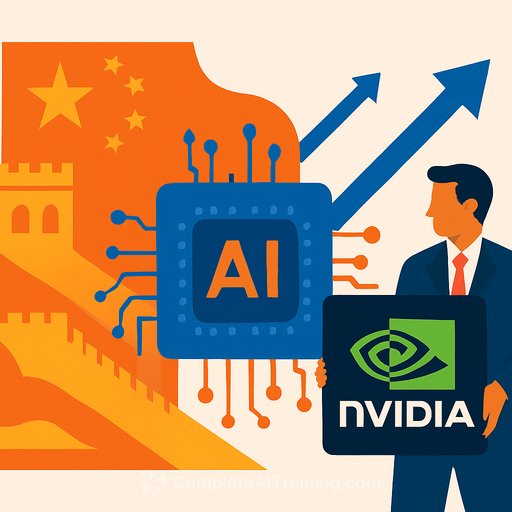
Unlocking a $20 Billion Opportunity: How Regulatory Clarity and Strategic Product Design Are Reshaping Nvidia's China Valuation
In 2025, Nvidia made a strategic move by re-entering China, the world’s second-largest economy. This isn’t just a comeback—it’s a carefully planned approach combining clear regulatory changes, smart product development, and geopolitical insight. For product developers, this shift signals a major opportunity: a potential $20 billion revenue increase that could reshape Nvidia’s market value.
Regulatory Clarity: The Door to China’s Market
In April 2025, the U.S. government lifted export restrictions on Nvidia’s H20 chip. This change came after persistent efforts by Nvidia’s leadership and diplomatic talks between the U.S. and China. The result? An $18 billion inventory backlog cleared and access to a previously restricted market.
The H20 chip’s return is projected to add $12 billion in revenue by 2027. Alongside this, Nvidia introduced the RTX Pro 6000D—a $6,500 chip that meets U.S. compliance and targets China’s growing industrial AI sector. These regulatory adjustments are part of a broader trade truce: China resumed rare earth exports, and the U.S. eased controls on chip design software. This new framework balances security concerns with commercial needs, creating a more stable revenue outlook from China, which currently makes up 13% of Nvidia’s total revenue but holds much untapped potential.
Product Design: Meeting Compliance and Market Needs
Nvidia’s success in China depends on adapting its products to fit regulations and local demand. The RTX Pro 6000D and RTX PRO GPU are crafted to comply with U.S. export rules while addressing China’s industrial AI applications.
For example, the RTX Pro uses a simplified Blackwell architecture tailored for digital twin applications in smart factories and logistics. By cutting manufacturing complexity and costs, Nvidia offers a product that competes well against state-backed projects and big players like Alibaba and Tencent.
This two-tier product strategy—high-end H20 for AI training and mid-range RTX Pro for automation—positions Nvidia to capture 20% of China’s $1 trillion “New Infrastructure” initiative. Analysts from Truist and Bernstein forecast that China revenues could reach $19.5 billion by 2026, with the RTX Pro 6000D alone expected to improve margins by 20%.
Valuation Impact: From $17 Billion to $20 Billion
The financial market has responded positively to these developments. Nvidia’s stock climbed 5% after the H20 license renewal announcement. The forward earnings multiple sits at 40x, reflecting a 55% revenue growth expectation for 2025.
Stifel analyst Ruben Roy raised his price target to $202, citing the potential $19.5 billion China revenue by 2026. If Nvidia maintains a 73% gross margin and 80% AI accelerator market share, its valuation could rise further. The combined $18.5 billion revenue boost from H20 and RTX Pro could make China 15-20% of Nvidia’s total revenue by 2027.
Considering the AI industry’s projected compound annual growth rate (CAGR) of 40% and Nvidia’s strong CUDA ecosystem, the 40x multiple seems justified—even cautious.
Risks to Consider
- A resurgence of U.S.-China tensions could cause a 10% revenue drop.
- Huawei’s aggressive AI chip development poses competitive risks.
- Demand may shift from training to inference workloads, reducing high-end GPU needs.
- Nvidia’s premium stock price ($172 per share) trades above peers like AMD and Intel, though its AI dominance and recurring software revenue add some security.
The Bottom Line for Product Developers
Nvidia’s China strategy highlights the importance of aligning product design with regulatory landscapes and local market demands. Their approach shows how adjusting product specs and pricing can open new revenue streams without compromising compliance.
For those involved in product development, this case underscores the value of flexible design and strategic planning in complex markets. Nvidia’s ability to offer compliant, cost-effective solutions tailored for China’s industrial AI needs is a blueprint worth noting.
As AI continues to grow, staying aware of geopolitical shifts and their impact on product strategies will be crucial. For deeper insights into AI trends and skill development, explore Complete AI Training’s latest AI courses.
Your membership also unlocks: