Nvidia's $20B Groq Deal: A Focused Bet on AI Inference
- Nvidia will license Groq's AI inference technology and hire key executives, while Groq remains independent.
- The deal excludes Groq's cloud business, which will be led by new CEO Simon Edwards.
- CNBC reported a $20B valuation; the companies did not confirm financial terms.
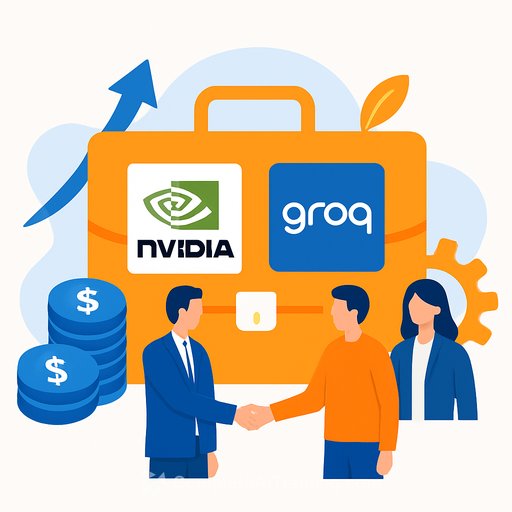
Nvidia just executed its largest deal yet-without buying the company. It's licensing Groq's inference IP and hiring founder Jonathan Ross and president Sunny Madra, while Groq continues to operate separately.
This is a targeted strike: acquire the tech and the talent that matter, skip the operational baggage. It mirrors a rising pattern in Big Tech-license IP, hire leaders, keep the startup structure intact.
What Nvidia Is Actually Getting
Groq's Language Processing Unit runs large language models with significantly lower latency and energy use versus traditional GPUs. That matters for real-time workloads where speed and cost per query define margins and customer experience.
Jensen Huang confirmed plans to integrate Groq's low-latency processors into Nvidia's AI factory architecture. Translation: more complete inference options under the Nvidia umbrella, from model training to real-time inferencing at scale.
Why Inference, Why Now
Training built Nvidia's dominance; inference will pressure it. As models hit production, spend shifts to serving-where throughput, latency, and energy efficiency drive unit economics.
Groq's hardware targets these exact bottlenecks. Add Ross-who helped build Google's TPU-and Nvidia deepens its bench across the full AI stack.
Deal Structure Signals
- Licensing over ownership: Faster integration, fewer regulatory risks, and flexibility to keep options open.
- Talent-first: Hiring top leadership accelerates internal roadmap without a full merger.
- Focused scope: Groq's cloud business stays independent under Simon Edwards, reducing channel conflict.
Context and Competitive Angle
This eclipses Nvidia's $6.9B Mellanox purchase. It also follows Groq's $750M raise at a $6.9B valuation with backers like BlackRock, Samsung, and Cisco.
Rivals are pursuing similar paths-IP access plus acqui-hire-without full takeovers. Expect Google, Amazon, and Microsoft to counter with their own inference-optimized plays.
Integration: What to Watch
- Product roadmap: How quickly Groq's low-latency stack shows up in Nvidia's enterprise offerings and reference architectures.
- Software layer: Support inside CUDA/Triton/TensorRT for Groq-style execution, or adjacent pathways that minimize developer friction.
- Pricing mechanics: Clear TCO advantages for real-time inference-especially at scale and under strict latency SLAs.
Risks and Open Questions
- Ecosystem complexity: Can Nvidia blend heterogeneous hardware without confusing customers or fragmenting its software stack?
- Channel overlap: How cleanly Nvidia's licensing model coexists with Groq's independent cloud business.
- Vendor lock-in concerns: Enterprise buyers may push for portability across inference targets.
- Regulatory optics: Less pressure than a full acquisition, but talent concentration will draw attention.
Executive Takeaways
- Reassess your inference economics. Build a per-request cost model factoring latency targets, energy, and peak loads.
- Pilot heterogeneous inference. Benchmark GPUs vs. specialized accelerators across your top 3 production workloads.
- Prioritize low-latency paths for revenue-critical experiences (search, chat, personalization, trading, safety systems).
- Negotiate for portability. Push vendors on model format support, runtime flexibility, and migration assurances.
- Align teams now. Platform, data science, and infra leaders need a unified plan for training-to-inference handoffs.
Why This Matters for Strategy
AI spend is shifting from building models to serving them efficiently. The winners will blend performance with predictable unit economics and simple deployment paths.
Nvidia is ensuring it owns that conversation-not just with GPUs, but with a broader inference toolkit. For buyers, optionality increases, but so does the need for clear architecture choices.
Further Reading
Next Steps for Your Team
- Stand up a 60-day inference benchmarking sprint across core use cases with clear latency and cost KPIs.
- Refresh your vendor roadmap and lock in volume pricing tied to real-time workloads.
- Upskill engineering on inference-optimized architectures and model serving best practices. If helpful, explore curated options by leading providers here: AI courses by leading AI companies.
Bottom line: this is a surgical move to defend and extend Nvidia's lead where the revenue shifts next-production inference. Treat your inference strategy as a P&L problem, not just an engineering problem.
Your membership also unlocks: