Nvidia's $20B Pact With Groq: A Defensive Offense That Locks In Inference
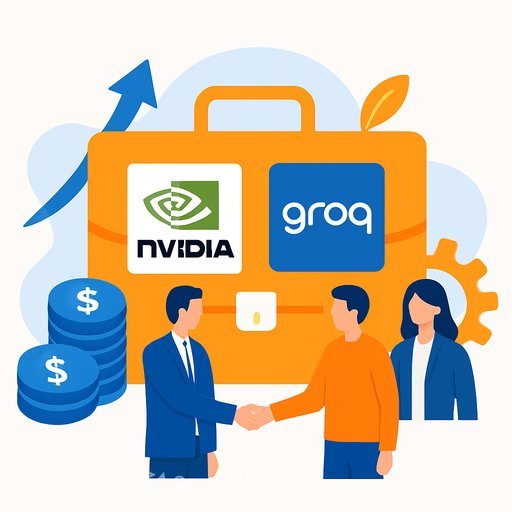
Nvidia just wrote a $20 billion check to license Groq's inference tech and hire its leadership-without buying the company outright. It's the biggest commitment in Nvidia's history and a clear signal: inference is the next profit center, and they want to own the stack end to end.
The structure is intentional. Nvidia licenses Groq's IP, acquires select assets, and brings in CEO Jonathan Ross and key execs-while GroqCloud keeps running independently. That keeps regulators calm, protects Nvidia's moat, and quietly folds LPU advantages into Nvidia's ecosystem.
Why This Move, Why Now
Nvidia's dominance in training chips is safe for now. Inference is where margins and volume are shifting as real-time AI becomes a standard feature, not a demo.
Groq's LPUs shine in low-latency inference and deterministic execution-exactly where general-purpose GPUs can feel heavy. Nvidia licenses the tech, absorbs the talent, and plugs the gaps in Hopper and Blackwell roadmaps without the risk of a blocked acquisition.
Deal Structure: Acquire the Advantage, Not the Company
This is a licensing-first play with talent integration. Groq remains a "competitor" on paper, which reduces antitrust heat while Nvidia gets non-exclusive access to IP that matters.
Bringing in Ross-who helped build Google's TPU program-gives Nvidia a direct line into ASIC-style thinking, compiler expertise, and SRAM-focused design for low-power inference at scale.
The Strategic Read
- Neutralize a credible niche threat: LPUs set the pace on latency-sensitive workloads.
- Defend against hyperscalers' custom silicon: TPU, Trainium, and homegrown inference chips are real risks.
- Sidestep merger scrutiny: Keep Groq independent, secure the IP and people, and avoid a headline-grabbing takeover.
- Tighten the platform loop: Training plus inference inside one vendor's stack is sticky for enterprises.
Money, Sentiment, and Optics
$20 billion for a startup last valued at $6.9 billion sounds steep-until you price in Nvidia's cash position and the cost of being late to inference. Markets seem to agree: modest stock lift, bullish notes from analysts, and a consistent message from investors-this makes beating guidance easier.
Call it what it is: an expensive hedge that also expands the product surface. If inference spend hits hundreds of billions this decade, the premium pays for itself.
What This Means for Enterprise Buyers
- Latency SLAs can tighten: Expect lower, more predictable response times for real-time models.
- Hybrid architectures: GPU training with LPU-style inference could become standard in 2026 RFPs.
- Ecosystem consolidation: More value bundled into Nvidia's software stack, more leverage in pricing and support.
- Procurement dynamics: "Nominal competition" remains, but the feature gap will narrow inside Nvidia's orbit.
Technology Edge: Determinism Meets Scale
Groq's bet is determinism-consistent execution times that don't jitter under load. For production LLMs, recsys, and edge AI, that matters more than theoretical throughput.
Integrating this into Nvidia's toolchain could mean predictable inference at lower cost per token, plus better energy profiles. Expect compiler improvements, scheduler smarts, and memory-optimized paths to show up in Nvidia's software releases.
Talent Is the Tell
Deals like this are about people as much as IP. Ross and team bring hardened experience in ASIC acceleration, compilers, and SRAM tuning.
That shortens Nvidia's learning curve and speeds time-to-market on inference-first parts and features. Watch for a faster cadence on inference-specific SKUs and reference designs by late 2026.
Risks to Track
- Regulatory scrutiny: Even without an acquisition, "influence without ownership" can draw attention if rivals complain.
- Integration drag: Translating LPU advantages into Nvidia's stack is a non-trivial engineering problem.
- Customer confusion: With GroqCloud continuing independently, messaging around roadmaps and support will need clarity.
Executive Playbook: What To Do This Quarter
- Revisit inference TCO: Model token-level costs and latency SLAs across GPU-only vs hybrid deployments.
- Pilot real-time use cases: Prioritize chat, agents, and recommendation flows where deterministic latency drives revenue.
- Negotiate flexibility: In upcoming GPU contracts, secure terms for inference-optimized SKUs and software features.
- Upgrade observability: Instrument per-request latency, variance, and energy to justify architecture choices.
- Hedge vendor risk: Keep a second-source path (TPU, Trainium, or specialized ASICs) alive in your playbook.
What to Measure
- p50/p90/p99 latency and variance under peak load
- Cost per 1K tokens and per inference at target quality
- Throughput per watt for production workloads
- Time-to-deploy for new model versions and A/Bs
- Gross margin impact by workload after architecture changes
Outlook
This deal closes the loop for Nvidia: they keep training leadership and close the gap in inference where money changes hands daily. The message to boards and operators is simple-production AI will favor vendors who reduce latency variance and deployment friction.
Expect more licensing-plus-acquihire moves across AI silicon. For buyers, the upside is better performance and tighter integrations. The tradeoff is less negotiating leverage unless you plan for it.
Next Step
If you're updating your AI roadmap, line up a focused skills push for your infra, data, product, and Design teams. For curated, role-based programs that keep strategy grounded in real deployment constraints, explore AI courses by job function.
Your membership also unlocks: