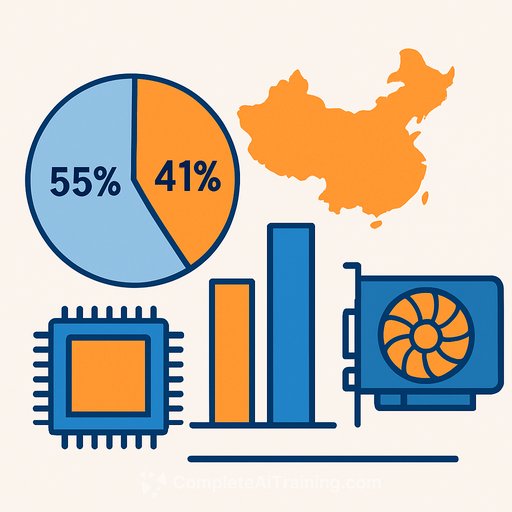
Chinese Chipmakers Claim 41% of Domestic AI Market as Nvidia's Share Falls Below 60%
Chinese semiconductor firms delivered 1.65 million AI GPUs in 2025, capturing 41% of the local AI server market. Nvidia's share fell to 55% with 2.2 million units shipped, down sharply from its 95% dominance before U.S. sanctions took effect.
Huawei leads Chinese competitors with 812,000 chips sold, or nearly 20% of the market. The company launched its Atlas 350 AI accelerator last week, claiming performance nearly three times that of Nvidia's H20 chips. Alibaba's T-Head subsidiary shipped 256,000 units, while AMD holds 4% with 160,000 units.
Baidu's Kunlunxin and chipmaker Cambricon each delivered 116,000 cards, rounding out the top five vendors.
Policy Shifts Reshape Supply Chains
U.S. export restrictions triggered the market realignment. A complete ban on AI GPU exports in April 2025 forced Chinese companies to source from domestic suppliers. Trump reversed course in July 2025, then again in December, finally allowing Nvidia to ship H200 chips to China-but only to specific institutions and applications after months of delays.
Commerce Secretary Howard Lutnick's public comments during 2025 discouraged Chinese companies from ordering Nvidia chips despite the official policy shift, creating uncertainty in the market.
Beijing Balances Domestic Industry With Global Competitiveness
The Chinese government faces competing priorities. It wants to support local chipmakers while keeping its AI companies competitive internationally. Chinese chip designers still lag five to ten years behind Nvidia and AMD in data center performance.
Government efforts appear to be working. Chinese firms' growing market share suggests Beijing's strategy to redirect demand toward domestic semiconductors is gaining traction. Even if Chinese companies can now purchase Nvidia chips more freely, policy pressure to buy domestic will likely prevent Nvidia from recovering its pre-sanctions dominance.
For government officials managing AI infrastructure and chip procurement policy, this shift illustrates how supply restrictions reshape markets and accelerate domestic alternatives-regardless of technical performance gaps. The question for 2026 is whether policy support alone sustains Chinese chipmakers' gains as access to advanced foreign technology expands.
Learn more about AI for Government and how policy decisions affect technology adoption and AI strategy at the institutional level.
Your membership also unlocks: