Nvidia's H20 Chip Sales to China: What It Means for AI and Tech
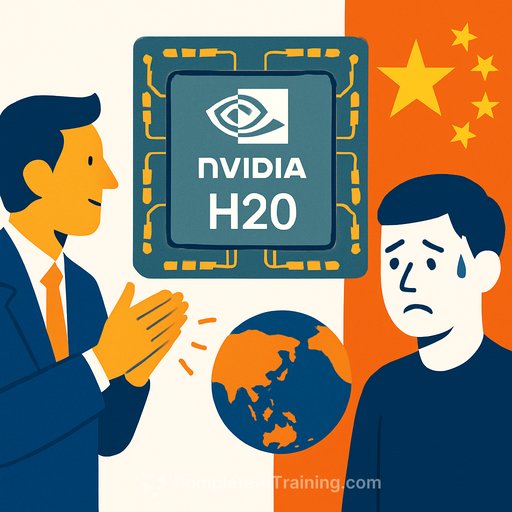
The US has eased export controls on Nvidia's H20 AI chips, allowing sales to China after a pause. Nvidia CEO Jensen Huang confirmed this during his China visit on July 15, noting that the US government will soon issue export licenses. He also hinted at future shipments of even more advanced chips beyond the H20.
While this move brought some positive reactions in China, experts remain cautious. Concerns center on whether Chinese companies might lean too heavily on foreign AI chips instead of developing their own technologies.
Technical Limitations of the H20 Chip
Chinese analysts point out that the H20 chip is intentionally limited compared to Nvidia's high-end H100 chip. For example, its FP16 computing power is just 15% of the H100's, and its NVLink bandwidth is nearly halved from 900GB/s to 400GB/s. Also, critical features like the transformer engine (TE) are removed.
These restrictions mean the H20 is better suited for AI inference tasks rather than the heavy AI training needed for large language models (LLMs) like ChatGPT. This aligns with a US strategy to block China's access to top-tier AI training hardware while allowing mid-level chips.
Short-Term Benefits, Long-Term Risks
The analogy of a "poisoned wine" is used to describe the H20 chips: they provide immediate benefits but may hinder China’s long-term AI ecosystem growth. Chinese firms can boost their AI capabilities now, but dependence on limited foreign technology might slow their own innovation.
Training large LLMs requires thousands of high-end chips such as Nvidia’s A100 or H100. The H20’s reduced interconnect bandwidth and training power make it unsuitable for these models. An industry expert compared it to a Ferrari with a downgraded fuel line and gearbox – it can run but underperforms in demanding conditions.
Market Dynamics and Industry Responses
Despite Huawei’s Ascend 910B chip having advantages in AI training, Nvidia’s CUDA platform remains dominant in China. This is partly because many companies prefer to stick with Nvidia's mature software ecosystem rather than switching to alternatives like Huawei’s MindSpore.
For example, Alibaba tends to use Nvidia chips for migrating existing AI workloads, while Huawei chips may see more use in state-owned enterprises. Experts predict Nvidia’s CUDA will maintain roughly 80% market share in China due to switching costs and software maturity.
Trade and Regulatory Context
The export control relaxation follows diplomatic talks between the US and China in London on June 9, which led to de-escalation measures in trade tensions. China eased export controls on niche metals, while the US agreed to let Chinese firms use certain chip-making software and export parts for C919 flight engines. Now, Nvidia can export H20 chips to China.
However, tensions remain. The US continues efforts to block China’s access to high-end AI chips. For instance, Malaysia recently announced that exporting or transshipping high-performance US-origin AI chips requires permits, aiming to prevent indirect shipments to China.
Official Chinese Response
China’s Ministry of Commerce criticized US trade restrictions, calling for the US to drop what it terms a “zero-sum mentality.” The ministry highlighted recent US export controls aimed at Huawei and other Chinese companies as unfair market interventions. It urged bilateral consultations to resolve these issues.
What This Means for AI Development
- Chinese firms gain short-term access to capable but limited AI chips, enabling ongoing AI projects and inference tasks.
- Long-term innovation may be constrained by reliance on mid-tier foreign technology instead of developing homegrown high-end chips.
- Software ecosystems matter: Nvidia’s CUDA platform keeps its stronghold, affecting chip adoption beyond raw performance.
- Geopolitical dynamics continue to shape AI hardware availability and trade policies.
For IT professionals and developers interested in AI hardware and software, monitoring these developments is crucial. The balance between access to advanced AI chips and fostering domestic technology will influence future AI capabilities in China and beyond.
To learn more about AI training and hardware, check out comprehensive resources on Complete AI Training.
Your membership also unlocks: