Nvidia's H200 Gets a Green Light for China. Will Beijing Bite?
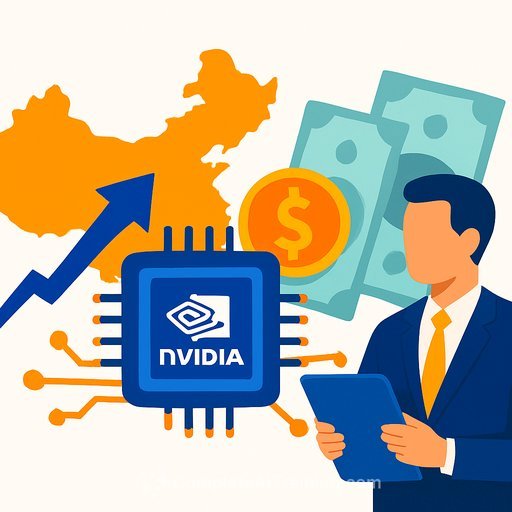
The U.S. has approved Nvidia to sell its H200 AI chips to "approved customers" in China. One condition: a 25% cut of those sales goes to the U.S. government. Earlier this year, Nvidia's broader China sales were effectively halted, and a detuned H20 variant struggled to gain traction. Now the door is cracked open again-but it's unclear how far Beijing will let companies walk through it.
Why China might push back
Beijing's priority is self-sufficiency. China's tech leaders-Huawei, Alibaba, Baidu, Tencent-have been investing heavily in domestic silicon and full-stack AI capability. Nvidia's CEO Jensen Huang has said Huawei's AI chips are "probably comparable" to the H200 in some workloads, and Chinese firms have been training advanced models using a mix of stockpiled Nvidia GPUs and local accelerators.
There's also a strategic risk: dependency on a U.S. supplier under shifting political rules. As one analyst put it, getting "locked in" to Nvidia is a liability when policy can flip with little notice. For Beijing, local control remains the long-term path, even if it's less efficient in the short run.
Why China may still buy H200 now
The H200 is significantly more capable than the H20 and remains ahead on performance and power efficiency versus most domestic options. China's chip supply is constrained, and the country faces ongoing limits on advanced chipmaking tools, keeping bleeding-edge manufacturing out of reach. For companies racing to train large models or support AI services at scale, time-to-compute matters more than ideology.
Executives and researchers point to a practical gap: despite progress from Huawei and others, matching Nvidia and AMD at scale is still difficult. In the near term, H200 can fill production shortfalls, reduce training time, and help firms hit product milestones while local alternatives mature.
Policy and procurement implications for government and public-sector leaders
- Short-term access vs. long-term autonomy: Expect a "buy now, build local later" approach. Purchases could be selective and tightly managed.
- License conditions and oversight: The 25% revenue share and "approved customer" filter create levers for monitoring and enforcement.
- End-use risk: Watch for gray-channel reselling, joint ventures, and cloud access models that obscure buyers or use cases.
- Allied coordination: Divergent export policies among U.S. partners can weaken controls and shift demand routes.
- Industrial policy feedback loop: China will likely double down on domestic accelerators, software stacks, and data-center buildouts regardless of near-term H200 purchases.
Three plausible scenarios
- Limited adoption: Beijing signals restraint; only a small set of state-favored or strategically important firms receive H200s.
- Selective hybrid: Major platforms use H200 for top-tier training while ramping Huawei/other domestic chips for inference and internal workloads.
- Aggressive near-term buys: Companies acquire as much as approvals allow to bridge a 12-24 month gap, then pivot hard to local supply.
What to watch next
- Official guidance from Beijing to large internet and cloud firms.
- Any public list of "approved customers" or reported shipments.
- Domestic accelerator benchmarks from Huawei and emerging startups.
- New rules or clarifications from the U.S. Bureau of Industry and Security.
- Data-center construction and import patterns pointing to capacity shifts.
Practical steps for agencies and state buyers
- Update risk assessments for AI infrastructure procured or operated with Chinese partners or supply chains.
- Incorporate end-use monitoring and data residency safeguards into contracts with cloud or AI service providers.
- Diversify compute sources where possible; evaluate swap plans if export settings change again.
- Track total cost of ownership: performance per watt, time-to-train, and software ecosystem support often decide value more than list price.
- Coordinate with compliance teams on evolving export guidance and reporting requirements.
For reference on current U.S. export guidance, see the Bureau of Industry and Security. For technical context on the GPU in question, Nvidia's H200 overview is here: H200 product page.
Bottom line
H200 sales to China are now possible, but not guaranteed. Beijing will balance immediate compute needs against the strategic goal of self-reliance. Expect a measured, tactical approach: limited buys to hit near-term AI milestones, paired with sustained investment in domestic chips and software.
If you're building internal AI capacity or advising leadership on workforce upskilling, you can browse role-specific programs here: AI courses by job.
Your membership also unlocks: