Nvidia's "ChatGPT moment for physical AI" - what executives should do now
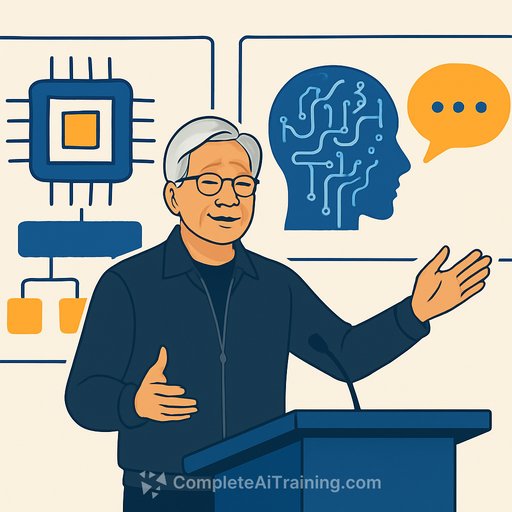
At CES 2026, Nvidia CEO Jensen Huang announced new AI models and chips and framed it as a "ChatGPT moment for physical AI." The message is clear: the next wave won't live only in software. It will run factories, warehouses, stores, vehicles, and devices.
If you own throughput, cost per unit, and safety metrics, this shift lands on your desk. Here's how to translate the hype into an operating plan.
What happened
Nvidia introduced new AI models and hardware aimed at real-world automation and robotics. The positioning signals a push beyond text and images into perception, action, and control. Think computer vision plus decision-making, deployed at the edge and in the data center.
Why this matters for strategy
- Automation moves from scripted to learning-based, raising ceilings on what tasks can be handled without constant reprogramming.
- Value shifts to those who control proprietary sensor data and can iterate models against real operations.
- Edge computing becomes a first-class citizen; latency and reliability beat raw scale in many use cases.
- Simulation and digital twins speed training, testing, and safety validation before anything touches the floor.
Near-term use cases to pilot
- Automated visual inspection and quality checks on production lines.
- Robotic picking, packing, and kitting with vision-language-action models.
- Autonomous mobile robots for intralogistics and inventory moves.
- Predictive maintenance with multimodal sensors (video, audio, vibration).
- Field service assistants that combine procedures, vision, and step-by-step guidance.
- Retail shelf monitoring with automated restocking triggers.
Key metrics (treat these as non-negotiable)
- Cycle time, throughput per shift, and OEE delta.
- Cost per pick/inspection and defects per million.
- Mean time to repair, safety incidents, and near-miss reports.
- Energy per unit and compute cost per successful task.
- Model iteration speed: time from data capture to improved deployment.
Risks and constraints to manage
- Supply constraints for accelerators and edge modules; plan buffers and alternatives.
- Physical safety and regulatory compliance; require simulation plus staged rollouts.
- Cyber-physical security and data governance for video and sensor logs.
- Vendor lock-in across chips, SDKs, and toolchains; insist on exportable models and open interfaces.
- Facilities limits: power, cooling, and network at the edge; forecast early.
90-day action plan
- Stand up a cross-functional squad (ops, IT/OT, safety, finance, legal) with a single executive sponsor.
- Inventory repeatable, high-volume physical tasks with measurable pain (cost, error rate, delays).
- Run a data audit: where do you have video/sensor coverage, what's the label strategy, what's the retention policy.
- Select two pilots with clear baselines, target KPIs, and exit criteria (pass/fail gates every 30 days).
- Issue a focused RFP: edge compute, accelerators, simulation tools, and a systems integrator; negotiate portability.
- Prepare the floor: power, cooling, network, and safe zones for trial deployments.
- Define safety protocols, incident reporting, and a rollback plan before go-live.
- Upskill core teams so they can own iteration cycles, not just consume vendor demos.
Budget framing
- Allocate across five buckets: hardware (data center + edge), integration/controls, data/simulation, change management, and support.
- Treat compute as a lever, not a sunk cost: tie spend to unit economics (cost per successful task).
- Aim for payback based on labor reallocation, defect reduction, and throughput gains within a few quarters.
Signals to watch
- New benchmark results and reference designs for robotics and edge inference.
- SDK and toolchain updates that simplify sim-to-real transfer.
- Systems integrator playbooks and prebuilt cells for common workflows.
- Lead times on accelerators and edge modules; lock supply early.
- Regulatory guidance on safety, audit trails, and data retention for video.
Bottom line
Treat "physical AI" as a staged capability build. Start with narrow wins, wire them into your metrics, then compound the learnings across sites. The companies that move first on data, simulation, and edge operations will set the bar on cost and quality.
Further reading
Upskill your org
Your pilots will stall without people who can iterate models, tune workflows, and measure impact. If you need structured paths for leaders and operators, explore:
Your membership also unlocks: