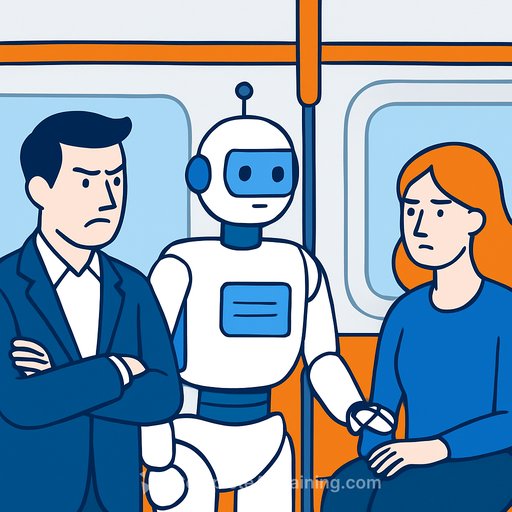
Does Google's subway gallery point to a useful third way for AI sceptics?
For four weeks before Christmas, New York's subway turned into a live test: can creatives find a middle ground between full-on AI hype and outright refusal? The "Imagine If" campaign spanned 4,000 screens across the MTA. Riders scanned a QR code, submitted "Imagine if…" prompts, got instant AI mockups, and then saw selected ideas turned into finished video artworks across all five boroughs.
The result wasn't a conversion story. It was curiosity with guardrails. A practical test of whether AI can sit inside a real brief without swallowing the creative voice.
How it worked
Five artists, one per borough - Lauren Camara, Ariana Cimino, Molly Goldfarb, Subway Doodle, and Jeff Wave - were recruited not as prompt jockeys but as editors and interpreters. They sifted through local submissions, chose what felt right for their audiences, and used tools like Gemini, Veo, Flow, and Nano Banana to shape the final pieces.
The campaign closed with a takeover of OUTFRONT's Two Times Square digital spectacular. OUTFRONT's Chad Shackelford framed it as a citywide act of imagination. Google DeepMind's Matthieu Lorrain called it a human-AI partnership. The most telling line came from Subway Doodle: "As an artist, I was initially hesitant to use AI… but I accepted that AI is here to stay… I was curious to explore how to use Google's generative AI as a tool for my art."
Why this matters
That arc - hesitant, accept, explore - captures where many working creatives are today. Not sold. Not boycotting. Just willing to test tools against a brief and keep what works.
Crucially, this wasn't a grassroots experiment. The tools were specified up front. The choice wasn't "should we use AI?" It was "how do we use it well without losing our point of view?" That distinction is the third way in practice.
The cynic's view (and why it still matters)
Yes, you could call it participation theater. Scan a code, feel involved, while the heavy lifting happens elsewhere. And yes, it marketed Veo and Gemini with glossy language about "co-creation."
But this is how AI will land in most workflows: as a requirement inside a brief, not a philosophical debate. Budgets will specify tools. Deadlines will assume acceleration. The question shifts from "should we?" to "how do we keep taste, context, and standards intact?"
What creatives can actually use from this
- Your value shifts to selection and interpretation. The artists didn't "generate art." They chose ideas with resonance, set direction, and refined outputs. Taste is leverage.
- Use AI to solve parts, not the whole. Treat tools like Veo or Gemini as accelerators for visualization and iteration - then apply craft, pacing, and story on top.
- Hesitation is fine. Avoidance is expensive. Four weeks on a real project taught five artists what dozens of tutorials can't: limits, quirks, and workable workflows. That experience compounds.
- Keep authorship clear. Document what's AI-assisted, what's hand-built, and where your voice shows up. Credit choices, not just outputs.
- Codify your "AI line" in the brief. Define acceptable use, review steps, and quality bars before production. Put human checkpoints at concept, style lock, and final.
The tools (and where to look)
If you're curious about the tech referenced, here's a useful starting point for Generative Video. For specific platforms, see Google DeepMind Veo. OUTFRONT's platform is also worth a look for context on citywide digital placements: OUTFRONT Media.
The bottom line
For working creatives, a third way looks like this: get comfortable using tools you don't fully trust, from companies you don't fully love, producing work you can't fully claim alone. Not ideal. But real.
It's a compromise that pays the bills without giving up your voice. Pragmatic scepticism beats sitting out briefs that already specify AI.
Next step if you want to skill up without the hype
If you want focused upskilling that maps to real roles and briefs, explore curated options here: AI courses by job. Start small, ship work, and refine your own "AI line" as you go.
Your membership also unlocks: