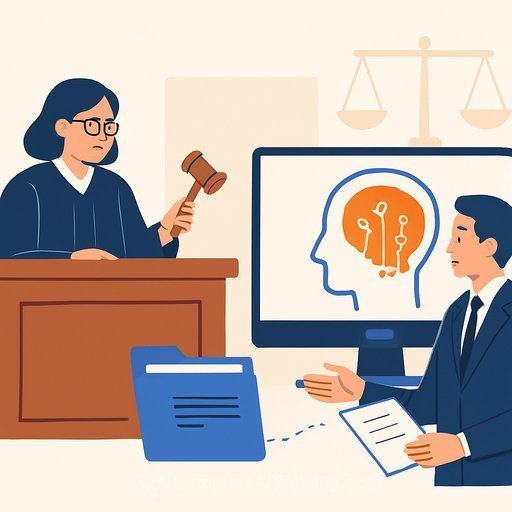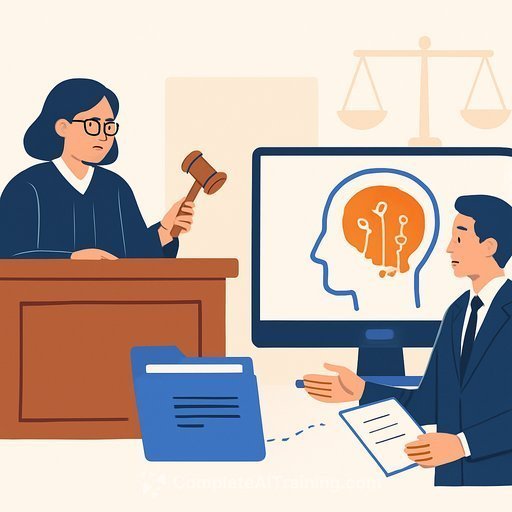
Advancing Legal Practice: NYSBA's Commitment to AI-Driven Professional Development
The New York State Bar Association marks 150 years with a clear signal: AI competency is becoming core to legal practice. Across Jan. 13-16, 2026, conversations centered on how lawyers adopt AI with discipline, ethics, and measurable impact.
Here's a practical, no-fluff brief on what this means for firms, in-house teams, and the courts-and how to put it to work.
Why this matters now
- Clients expect speed, precision, and transparency. AI can deliver each-if governed well.
- Technology competence is part of professional responsibility. See Model Rule 1.1.
- Courts and agencies are issuing guidance. Your policies and training need to keep pace.
What "AI-driven professional development" should include
- Clear standards: Firm-wide policy on approved tools, data handling, attribution, and human review.
- Structured training: Tiered learning by role-baseline for all, advanced tracks for litigators, transactional lawyers, and operations.
- Sandbox and guardrails: Test environments, vetted prompts, and sample datasets to practice without risk.
- Ethics at the center: Confidentiality, privilege, bias controls, and audit trails built into workflows.
- Measurement: Time saved, write-offs reduced, brief quality, client satisfaction-tracked monthly.
High-value use cases you can deploy this quarter
- Research acceleration: First-pass case summaries with citations, followed by manual verification.
- Drafting assistance: Clause comparisons, issue spotting in agreements, and alternative language generation.
- Litigation support: Deposition prep outlines, fact chronologies, exhibit lists, and motion scaffolds.
- eDiscovery triage: Technology-assisted review with targeted prompts for themes and anomalies.
- Client intake and KM: Matter intake triage and knowledge capture from prior work product.
Risk controls that satisfy both ethics and operations
- Data minimization: Remove PII/PHI, use matter codes, and avoid sharing client secrets with public models.
- Human-in-the-loop: Require sign-off for any client-facing output; log reviewers and changes.
- Source transparency: Demand citations and show your work; no citations, no client delivery.
- Bias checks: Use dual prompts and counterfactual reviews for fairness on sensitive decisions.
- Vendor diligence: Security posture, retention policies, model provenance, and SOC 2/ISO evidence.
- Framework alignment: Map controls to the NIST AI Risk Management Framework.
Training tracks that actually stick
- Baseline (all staff): Prompts that work, confidentiality rules, verification, and acceptable use.
- Practice-specific: Litigators (briefing, discovery, testimony prep). Transactional (clause banks, redlines, DSARs).
- Leaders/Partners: Pricing, matter scoping with AI, quality controls, and client communication.
- Ops/IT/KM: Model selection, integrations (DMS, CLM, eDiscovery), and monitoring.
Metrics that prove value
- Efficiency: Drafting and research cycle times, review throughput, and turnaround predictability.
- Quality: Citation accuracy, error rates, partner rework, and court feedback.
- Financials: Write-offs/write-downs, realization, and margin per matter.
- Client outcomes: Survey scores, repeat engagements, and panel wins.
30-day rollout plan
- Week 1: Approve policy, select two use cases, nominate practice champions, and set success metrics.
- Week 2: Stand up a sandbox, import redacted exemplars, and run risk checks with IT/KM.
- Week 3: Deliver role-based training; publish prompt playbooks and verification checklists.
- Week 4: Pilot on active matters, log results, and brief leadership on scale-up.
Procurement checklist (save this)
- Security: Encryption, tenant isolation, retention controls, admin logs.
- Quality: Citation mode, retrieval grounding, hallucination rate disclosures.
- Integrations: DMS/CLM/eDiscovery connectors; SSO/MFA; export options.
- Governance: Admin policies, redaction tools, customizable prompts, approval flows.
- Support: SLAs, roadmap transparency, and legal-industry references.
What this means for the profession
Bar associations setting clear expectations on AI will raise the floor on competence. Firms that build skills and controls now will gain speed and reliability without compromising ethics.
The takeaway: start small, verify everything, measure results, and build repeatable systems. That's how AI becomes a dependable part of practice-not a risk.
Further learning
- AI Learning Path for Training & Development Managers - role-based curricula and rollout guidance for people who design firm-wide programs.
- AI Learning Path for CIOs (Chief Information Officers) - governance, integrations, and risk/controls frameworks for technology leaders.
Get Daily AI News
Your membership also unlocks:
700+ AI Courses
700+ Certifications
Personalized AI Learning Plan
6500+ AI Tools (no Ads)
Daily AI News by job industry (no Ads)