Ohio releases model AI policy for schools: what educators need to do before July 1, 2026
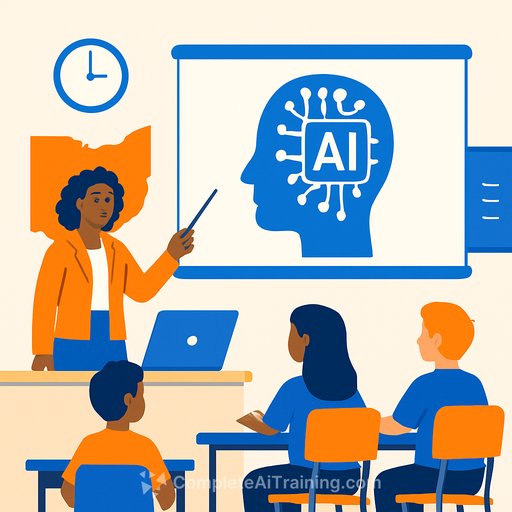
Ohio's Department of Education and Workforce (DEW) has published a model policy to guide how schools use artificial intelligence in teaching and operations. Districts must adopt an AI policy by July 1, 2026. You can adopt the state's model as-is or adapt it to fit local needs; see AI for Education for additional resources and examples.
What you need to know
- Ohio DEW released a model AI in education policy to support responsible, effective use.
- Every district needs a formal AI policy in place by July 1, 2026 (per Ohio law).
- Districts can adopt the model directly or modify it for local context.
"Ohio's AI in Education Model Policy demonstrates our commitment to preparing students to succeed in a technology-driven world that is increasingly being shaped by AI," Director Stephen Dackin said. "While we are supportive of schools using AI to strengthen instruction and expand learning opportunities, it is also incredibly important that these tools are used responsibly, and in a way that maintains academic integrity. This model policy provides school leaders and educators with clear, practical guidance to effectively and safely integrate AI into the classroom."
The policy was developed with Ohio's AI in Education Coalition and informed by feedback from educators, businesses, nonprofits, and government leaders. The aim: practical guidance you can put to work without guessing.
What's inside the model policy
- Curriculum integration: Where AI fits in instruction, assessment, and student projects; for specifics on large language models and generative tools, see Generative AI and LLM.
- Acceptable use: Clear guidelines for students and staff, including disclosure when AI is used.
- Academic integrity: Expectations for originality, citation, and consequences for misuse.
- Privacy and security: Guardrails aligned with FERPA and vendor data practices.
- Ethics and bias: Using AI responsibly, checking for errors, and addressing potential bias.
- Accessibility and equity: Ensuring AI tools support all learners.
- Procurement and approval: How tools are reviewed, approved, and monitored.
- Professional learning: Training for educators and support staff.
What district leaders should do now
- Form a cross-functional AI working group (curriculum, IT, legal, student services, union reps, building leaders).
- Map current use of AI tools across classrooms and operations; identify risks and quick wins.
- Customize the model policy to align with your AUP, academic integrity policy, data governance, and vendor processes.
- Define disclosure norms for when students and staff must state AI assistance in assignments or communications.
- Set an approval workflow for new AI tools and plug-ins; document criteria and who signs off.
- Pilot before scaling: run short, well-scoped pilots, collect evidence, and expand based on results.
- Plan professional learning: hands-on training for teachers, coaches, and administrators.
- Document parent communication about benefits, limits, privacy, and opt-out options where applicable.
- Schedule an annual review to update the policy as tools, laws, and classroom practices change.
Timeline and compliance
The legal deadline is July 1, 2026. Work backward: draft by spring 2026, board review and public comment in late spring, staff training in early summer, and classroom rollout by fall. Keep board adoption dates and implementation milestones visible to all stakeholders.
Practical tips for classrooms
- Start with low-risk tasks: idea generation, outlines, rubric-aligned feedback, and differentiation supports.
- Require students to note how AI was used and to verify facts with sources.
- Use AI detection tools carefully; pair them with teacher judgment and clear integrity policies.
- Co-create class norms about AI: what's encouraged, what's restricted, and how to cite assistance.
Resources
- Ohio Department of Education and Workforce - check for the full model policy, implementation guides, and updates.
- Student Privacy (FERPA) guidance - clarify privacy requirements for any AI tools used with students.
- Complete AI Training: courses by job - professional learning options for educators and school leaders.
The model policy gives you a solid baseline. Adapt it, train your people, start with focused pilots, and review annually. Clear guardrails now will save you rework later-and help teachers use AI where it actually improves learning.
Your membership also unlocks: