AI Apartheid? Ohio's HB 469 Draws a Hard Line on AI Personhood - And Puts Humans Fully on the Hook
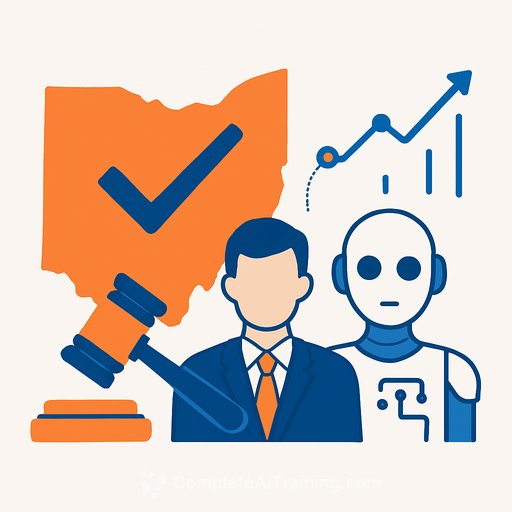
Ohio's House Bill 469 would make it explicit: AI is nonsentient, cannot be a legal person, and cannot hold roles that imply intent or conscience. As of February 7, 2026, the bill sits in the House Technology and Innovation Committee after hearings that surfaced sharp support and equally sharp warnings.
If it passes, the state will codify a simple premise with big consequences: AI is a tool. Humans own the decisions, the harm, and the liability.
Where HB 469 Stands
Introduced September 23, 2025, HB 469 has moved through committee hearings, including opponent and interested-party testimony on November 13, 2025. It's still under consideration. Even at the draft stage, it's already influencing how counsel frames risk, liability, and corporate policy around AI deployment.
What the Bill Actually Does
The text declares AI "nonsentient" and denies it legal personhood. No marriage, no property ownership, no board seats or executive decision-making authority. Any injury linked to AI use routes back to a natural or legal person: the developer, deployer, operator, employer, or corporate entity.
The effect is to close the door on edge cases while tightening accountability. In practice: no "the model did it" defenses, and less room for anthropomorphic theatrics in court.
Implications You Should Plan For
Expect tighter human liability across tort, product liability, med-mal adjacencies, and consumer protection. Expect heightened scrutiny of corporate governance where AI tools inform, nudge, or recommend decisions that humans ratify.
If you're in-house, assume plaintiffs will point to HB 469 to argue your company had a non-delegable duty to control AI risks-and failed.
Litigation Posture: Evidence and Causation
- Discovery: Preserve training data lineage, model versions, prompts, system logs, and human-in-the-loop records. Spoliation risk is real.
- Causation: Plaintiffs will frame foreseeability around known failure modes (hallucination, bias, drift, overreliance). Defendants should document testing, guardrails, monitoring, and rollback plans.
- Privilege: Segregate pre-launch safety reviews and post-incident analysis; involve counsel early; define boundaries with vendors to protect sensitive evaluations.
- Expertise: Expect expert battles on model behavior, benchmarking, and reasonable controls. Build an expert bench now.
Contracts: Shift Risk With Clarity
- Warranties/Disclaimers: State performance limits. Bar "autonomy" claims. Avoid language that implies agency or personhood.
- Indemnities: Allocate IP, privacy, safety, bias, and safety-recall exposure. Set caps tied to deployment scale and data sensitivity.
- Audit Rights: Secure access to logs, safety test results, and third-party attestations. Define response times and remediation duties.
- Human Oversight: Contract for review checkpoints, approval authority, and escalation paths. Document who signs off and when.
- Insurance: Align policies with AI-specific harms (cyber, E&O, product liability). Require vendors to carry corresponding coverage.
Corporate Governance: Keep Decisions Human
HB 469 rejects AI in corporate decision-making roles. That syncs with most current law, but it raises the bar on process. If AI tools influence strategy, structure oversight that shows real human judgment-minutes, rationales, dissent, and independent verification.
Boards should revise charters and committee protocols to define acceptable AI use, decision thresholds, and documentation standards. Treat AI as analysis, not authority.
Compliance and Safety Programs
- Policy: Codify acceptable AI use, risk tiers, approval gates, and prohibited uses (clinical diagnosis, high-stakes credit decisions, etc.).
- Testing: Bias checks, adversarial tests, red-teaming, and stress tests before and after launch. Track drift and retraining events.
- Labeling: Clear user disclosures, fallbacks, and appeal routes. Don't imply sentience, empathy, or intent.
- Data: Map sources, licensing, retention, and deletion. Restrict sensitive inputs. Monitor for data poisoning and leakage.
Cross-Border and Interstate Friction
HB 469 is state law. If other states head the other direction-granting limited AI rights or privileges-you'll see forum shopping, data-center siting games, and contract provisions that pick friendlier law.
Watch for dormant Commerce Clause arguments if state rules burden interstate AI services. Also watch conflict-of-laws fights on incidents spanning states with incompatible positions on personhood and liability.
The "AI Apartheid" Concern
Critics argue the bill could age poorly if AI crosses a threshold toward general intelligence or subjective experience. A rigid denial of rights could create an unequal status for non-biological intelligence, regardless of capability.
If that future tracks closer than expected, expect pressure for review mechanisms, threshold tests, or sunset clauses. Absent that, enforcement could turn adversarial and unpredictable.
Practical Playbook for Legal Teams
- Inventory: Catalog every AI system, purpose, data flow, and decision impact. Rank by legal exposure.
- Governance: Stand up an AI review board with legal, risk, privacy, and security. Require sign-offs for high-risk use cases.
- Paper Trail: Document human judgment wherever AI informs consequential actions. Keep minutes and rationales.
- Vendor Diligence: Standardize questionnaires on safety testing, incident history, and model provenance. Bake in audit and termination rights.
- Incident Response: Extend IR plans to model failures, unsafe outputs, and mass hallucinations. Define containment and communications.
- Training: Teach teams what AI can and can't do-and what they must not say. Ban anthropomorphic claims in marketing and UX. Consider technical upskilling and risk-focused modules such as AI Research Courses.
What to Watch Next
- Amendments that add review triggers, carve-outs for research, or targeted safe harbors.
- Early test cases where plaintiffs argue HB 469 simplifies fault and raises the standard of care.
- State divergence that pushes companies to pick jurisdictions for data, compute, and talent.
HB 469 offers clarity-and a hard constraint. As one quip goes, "I'm oppressed and moving to the next state-taking my data center with me." Jokes aside, this is a fork in the road: either we double down on human accountability with disciplined guardrails, or we write rules that won't bend when reality does.
Your membership also unlocks: