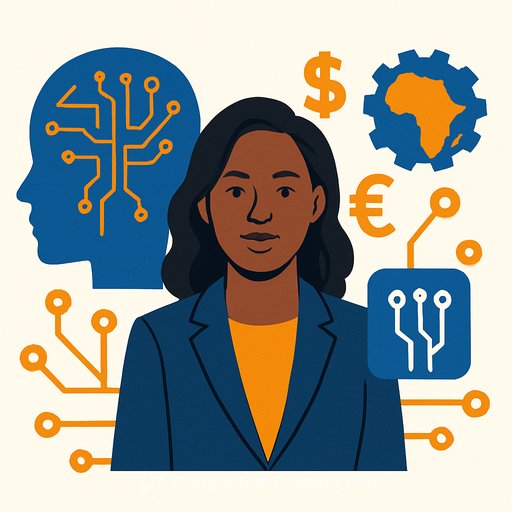
AI, Liquidity, and the Next Frontier of African Payments: Omolade Samuel Oke on Building Foundations, Not Front Ends
"AI will reset risk pricing, fraud detection, and personalised liquidity management in real time." - Omolade Samuel Oke
Omolade Samuel Oke is an entrepreneur, financial technologist, data expert, and venture capitalist. He founded Internopay Technologies Inc. on December 6, 2021 in Vancouver, Canada, to help local and global businesses handle international payments and procurement without friction. He later launched Peak Capitals in Nigeria (July 27, 2022) to deepen cross-border liquidity in frontier and emerging markets.
The real moat: liquidity as a service
Anyone can ship a payment gateway. Oke's edge is holding, pricing, and deploying local currency liquidity across 100+ corridors with settlement finality, strong rates, and uptime. Internopay embeds this "liquidity engine" into other fintechs, banks, and global platforms, making it part of their core stack rather than a bolt-on vendor.
The point: software without dependable liquidity and compliance is a house on sand.
Operator-led investing: what he backs now
After building in tough markets, Oke now prioritizes founder grit and regulatory fluency over slide-deck elegance. He looks for teams who grasp cash physics: customer acquisition in time and trust, corridor-level unit economics, and defensive workflows. His thesis moved from "disrupt what exists" to "build what's missing." Foundational layers beat pretty front ends.
Capital allocation: a simple three-bucket model
- Defensive: Liquidity reserves and licenses. Non-negotiable.
- Offensive: Sales, marketing, new corridors - only after proving unit economics and a clear path to profitability.
- Foundational: Core tech and data (15-20% of revenue, consistently).
The discipline: grow only where the corridor P&L is durable.
Why launch in 2021 - and why Vancouver
The pandemic exposed a gap: SMEs in Africa went digital, but global settlement stayed slow and expensive. Trust in digital-first operators peaked. Vancouver offered depth in fintech/compliance talent, a steady regulatory base, and a time zone that connects Asia, Africa, and the Americas.
Oke also cites regulatory headwinds in Nigeria at the time, including account blockages, as a trigger to build from a more stable base while still serving African markets.
Financial inclusion that actually moves the needle
Inclusion is agency: a Nigerian designer paid instantly in Naira at a fair rate, or a Kenyan cooperative buying fertiliser from India without losing margins to hidden fees. Internopay measures impact through trade volume growth, lower cost of capital, and money velocity in customer businesses. Cheaper processes are helpful; new business models are the goal.
The toughest build: Africa-China procurement
Capital controls, opaque rules, and country-by-country licensing created a maze. Currency shocks were painful - Oke recalls days when Naira swings delivered heavy losses. That forced a shift to real-time conversions at scale to limit exposure and protect customers.
Compliance as culture
Oke frames compliance as a duty to the broader system, not a checkbox. Internopay runs strict PEP frameworks and end-to-end transaction reviews - beneficiaries, emails, websites, purpose, UBOs - with AI-first screening and manual oversight. If the company ever needed a new CEO, he says he'd pick the compliance head.
Tech advantage over banks
Monolithic bank stacks can't move with market speed. Internopay's architecture is API-first and modular, with real-time liquidity rebalancing and AI-driven compliance that reduces false positives. The biggest opening ahead: B2B embedded finance and regional liquidity hubs where payments fade into the workflow of logistics and commerce platforms - powered by a reliable "liquidity mesh."
Scaling without cracks
- Network GDP: Total economic value facilitated - a real signal of ecosystem impact.
- Corridor health: Settlement success rate, cost trajectory, and volume growth per corridor.
- Compliance integrity: Low decline rates for good actors and fast approvals for clean transactions.
Awards and responsibility
Oke has been recognised by the Ooni of Ife's Royal African Leadership Awards (2024), the UK House of Lords Global Sustainability Summit and Awards (March 28, 2024), and as one of the 100 Most Influential Young Africans (April 13, 2024). He sees these as a mandate to build bridges, amplify inclusion, and keep policy conversations grounded in real outcomes: jobs, trade, and trust.
A message to young African founders
Start with the friction you live with. Kigali's logistics puzzle or Kano's payment headaches can be billion-dollar problems - if solved well. Build to global standards with local insight. Don't copy templates; create the missing layer your market needs.
What's next: AI + CBDCs
Oke believes AI will reset how fintechs price risk, spot fraud, and personalise liquidity provisioning in real time. Central Bank Digital Currencies, if made interoperable, could provide public rails for instant, low-cost settlement across countries. Together, AI and CBDCs can strip out legacy layers and make cross-border value transfer feel native to platforms.
For context on CBDC design and interoperability, see the Bank for International Settlements' work on digital currencies here.
Manager playbook: apply the lessons
- Make liquidity and compliance part of your product, not back-office bureaucracy.
- Run corridor-level P&Ls; expand only where unit economics are proven.
- Adopt real-time FX and risk controls; avoid open currency exposure when volumes spike.
- Invest 15-20% of revenue in core tech and data - every quarter, no excuses.
- Aim for "frictionless for good actors, impenetrable for bad actors." Measure both.
- Embed payments into your product workflow; don't push users to external steps.
If you're upskilling teams on AI for finance and compliance, this curated resource can help: AI for Finance.
The bottom line
Build the layer others depend on. Control liquidity, model risk in real time, and bake compliance into the product. That's how you avoid commoditisation - and create durable advantage in complex markets.
Your membership also unlocks: