Three Strategic Moves for Executives in the AI Era
Three years after ChatGPT's launch, the hype has cooled, but the stakes are higher. Markets swing on model releases, compute wars, and headline demos. Strategy can't depend on any single bet. It has to rest on what doesn't change: value creation, unique contribution, and durable moats.
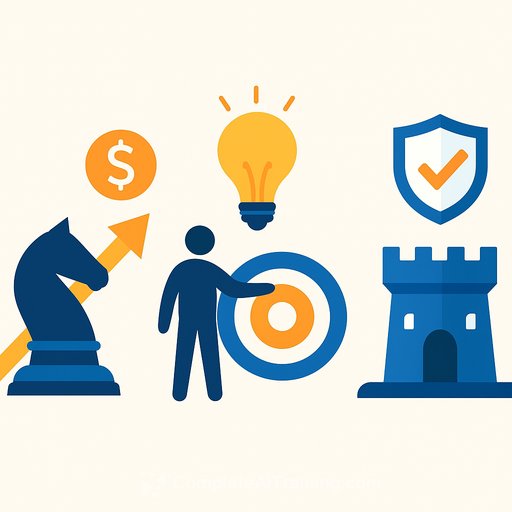
Here's the short version: build products people truly value, secure bargaining power by being uniquely necessary, and design your business so scale and network effects compound over time.
Why this AI wave hits differently
Generative AI pairs two forces that rarely show up together: near-zero marginal cost at scale and the ability to serve highly varied, personalized needs. In the language of Shapiro and Varian's technology lens-economies of scale vs. heterogeneity of demand-GenAI scores high on both. That's why it touches so many workflows and profit pools at once.
Previous waves (steam, electricity, computing/the Internet) delivered scale for largely uniform use cases. GenAI cracks open the long tail of needs that used to be uneconomical to serve. That's the structural shift executives should design around, not just the next model release.
Information Rules (Shapiro & Varian) offers a useful mental model for these dynamics.
1) Create user value beyond function
Most AI products today live at the base of the value pyramid: speed, cost, simplification. That's crowded, price sensitive, and easy to copy. Real defensibility emerges when you climb the pyramid-emotional value, life-changing value, and social impact.
We've seen early wins in chat, companionship, and games, but nothing with mass pull like WeChat. That's an opening. If your roadmap is all "faster, cheaper," you're fighting on a treadmill.
Moves to consider
- Map your value stack: what do you deliver functionally, emotionally, and aspirationally? Where can AI amplify the upper layers?
- Prototype "beyond function" features: identity, status, belonging, meaningful progress, or peace of mind. Test willingness to pay, not just usage.
- Package value, not features: tiers aligned to outcomes (time back, confidence, career upside), not just tokens and seats.
- Instrument WTP: track the delta between customer willingness to pay and price as a leading signal for pricing power.
For a quick primer on the value pyramid, see The Elements of Value (HBR).
2) Secure unique value contribution ("added value")
In value-based strategy, the slice you keep depends on your unique contribution: the total value created with you minus the value created without you. The larger that gap, the stronger your bargaining position with customers and suppliers.
This explains why core infrastructure players-NVIDIA, TSMC, ASML-have captured outsized gains. Their contribution is hard to substitute. It also explains market jitters when Google's Gemini 3 and TPU advances raised questions about how "indispensable" certain large-model and GPU providers remain.
Downstream, the absence of a true "mass-app" keeps most application players from claiming strong surplus. A few have momentum, but broad uniqueness is rare.
Moves to consider
- Write your "without us" memo: quantify what breaks or degrades if you're removed from the system. Be concrete.
- Concentrate on choke points: scarce data rights, distribution control, domain-specific evaluation frameworks, or compliance rails.
- Shift from services to assets: convert know-how into datasets, benchmarks, agent libraries, and integration standards customers depend on.
- Measure contribution, not activity: track "with-us uplift" in customer margin, speed to market, or risk reduction.
3) Build moats with scale and network effects
Brands, IP, and switching costs matter. But the compounding engines are scale economies and network effects. The gold standard is both.
Consider CUDA: over two decades it linked developers and enterprise buyers in a tight loop, making the platform more valuable as each side grew. That sort of flywheel is hard to dislodge once it spins.
Moves to consider
- Design for declining unit costs: shared inference, model reuse across verticals, and automated tooling that squeezes delivery cost per customer.
- Engineer network effects: models that improve with user data (with consent), marketplaces for extensions/agents, and APIs that attract complements.
- Own a standard: evaluation suites, schemas, or workflows others adopt. Standards anchor ecosystems.
- Lock in distribution, not just features: default placements, embedded partnerships, and data network agreements.
A 90-day operating plan
- Run a value audit: identify the top three emotional or life-changing outcomes your product could credibly deliver. Ship one experiment per outcome.
- Draft your added-value map: list stakeholders, quantify your "with-us vs. without-us" delta, and set targets to increase it.
- Write your moat hypothesis: which scale advantages and network effects you will pursue, what metrics prove they're forming, and what must be true to sustain them.
- Kill two initiatives that don't strengthen value, contribution, or moat. Reallocate to the three above.
Signals to watch
- Breakthroughs beyond probabilistic patterning toward causal reasoning.
- Physical AI progress that ties software to hardware (embodied intelligence).
- Data security and provenance solutions that restore trust at scale.
- Whether the last three years of chip and compute spend get validated by downstream revenue in the next 12-24 months.
The take
Cut through the noise by anchoring on what endures. Build products that matter to users beyond function. Become uniquely necessary in the value chain. Architect compounding moats through scale and network effects.
Do that, and short-term volatility becomes background. You'll have a strategy that earns its margins and lasts.
Further learning for executive teams
If you're aligning org skills to this strategy, explore curated programs by role here: AI courses by job. For a quick scan of new options, see latest AI courses.
Your membership also unlocks: