OpenAI Boosts Startup Growth with One-Day AI Development Cycles
Wednesday, 12 November 2025, 19:38
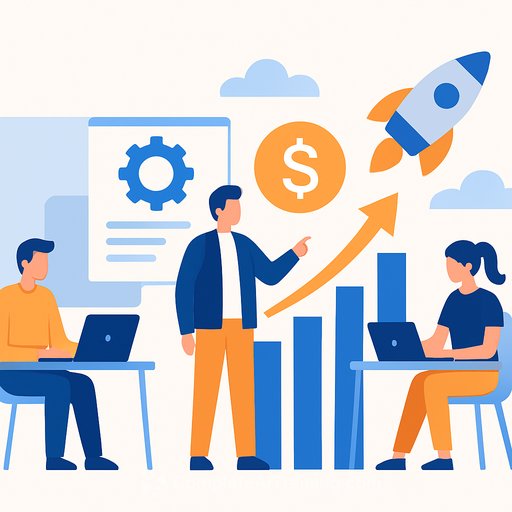
AI has moved past proof-of-concepts. According to Mark Manara, Head of OpenAI Startups, founders building on the platform are already showing around $200 million in annual recurring revenue, and the work cadence has compressed from two-week sprints to one-day iterations.
This pace isn't just about speed. It changes how engineering teams plan, ship, and measure product value. In TechCrunch's Equity podcast recorded at Disrupt 2025, Russell Brandom speaks with Manara about how OpenAI supports startups from first prototype to large-scale deployment.
Why one-day cycles are winning
- Focus on the smallest unit of shipped value: one prompt, one tool call, one workflow. Ship it, measure, repeat.
- Swap long PR queues for trunk-based development and feature flags to keep releases flowing without blocking QA.
- Automate evaluation: build a lightweight test set, run offline checks for quality, cost, and latency before every push.
- Keep a fast feedback loop: capture user traces, label failures daily, and fold them back into prompts, finetunes, or tools.
Vertical models are moving into healthcare, finance, and more
Teams are tuning models for narrow, high-value tasks that used to be off-limits due to risk or complexity. The path is pragmatic: specialized data, strict controls, and measurable outcomes.
- Choose the right approach: prompt engineering for speed, retrieval for factual grounding, finetuning for consistency, tools for determinism.
- Add data contracts and schema checks so outputs feed existing systems without breaking pipelines.
- Use human-in-the-loop checkpoints where stakes are high (PHI, payments, regulatory workflows).
- Log everything: inputs, outputs, model versions, prompts, and reviewers for auditability.
Where AI still isn't fully integrated
- Long-horizon autonomy (multi-step, multi-day tasks) remains fragile without strong planning, memory, and recovery.
- Unstructured enterprise knowledge is still messy. Without clean retrieval and governance, quality plateaus.
- Reliability under drift (data, policy, model updates) needs better monitoring and rollback strategies.
How OpenAI supports startups
- Help teams move from concept to scale: model selection, safety guardrails, and go-to-market guidance.
- Support for different business models, from SaaS workflows to API-first tools and internal automation.
- Clear sign that there's still room for innovation in evaluation, controls, and long-horizon agents.
A one-day iteration loop you can run now
- Define one task and one metric (e.g., accuracy at top-1, average handle time, cost per action).
- Build a 50-200 row eval set from real user traces; label expected outcomes.
- Prototype with prompt + retrieval or a minimal tool call. Keep it simple.
- Run offline evals for quality, latency, and cost. Tighten prompts or schemas.
- Ship behind a feature flag to 5-10% of traffic. Observe, don't guess.
- Tag failures by class (missing context, hallucination, tool error, policy hit) and fix the top two.
- Decide: stay with prompts, add retrieval, or spin a small finetune if variance stays high.
- Document what changed and why. Repeat tomorrow.
Metrics that matter
- Quality: task success rate, factuality, and regression rate by release.
- Speed: time-to-ship and p95 latency.
- Unit economics: cost per task, cache hit rate, tool call rate, and acceptance rate.
- Risk: policy violations per 1,000 calls and rollback frequency.
Risk and compliance highlights
- Strip or tokenize PII early; apply field-level redaction and encryption in logs.
- For healthcare and finance, keep clear review points and evidence trails.
- Red-team with realistic prompts; monitor for drift after model or data updates.
- Set rate limits and timeouts; implement circuit breakers on quality and cost.
Listen and go deeper
The full discussion is available on the Equity podcast from TechCrunch. You can find the show here: Equity by TechCrunch. For developers building on the platform, the docs are a useful starting point: OpenAI API docs.
If you want structured upskilling for engineering and product roles, explore curated learning paths by role: Complete AI Training: Courses by Job.
Who's in the episode
Russell Brandom hosts the conversation with Mark Manara during TechCrunch Disrupt 2025. Equity is produced by Teresa Loconsolo, who oversees writing, recording, editing, and live sessions for the show.
Bottom line
OpenAI is helping startups ship faster and scale with confidence, compressing dev cycles from weeks to days and turning AI from an experiment into running revenue.
Your membership also unlocks: