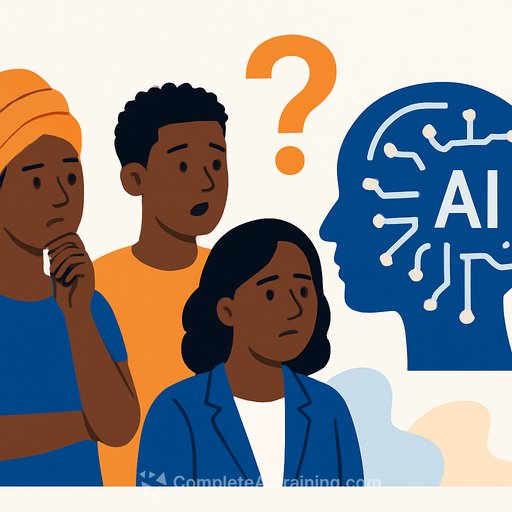
One in Three South Africans Unaware of AI: A Wake-Up Call for Policymakers
AI is changing how services run, how jobs look, and how money moves. Yet almost one in three South Africans have never even heard of it. For education leaders and policymakers, that's a red flag. If people don't know what AI is, they can't engage, upskill, or trust the systems built with it.
The Awareness Gap
This gap mirrors long-standing divides in access to devices, connectivity, and quality schooling. Urban professionals see AI daily in banking apps and social feeds. Many rural and low-income communities do not. The result: AI feels distant to the people who could benefit from it most.
Why Public Understanding Matters
Policy fails without public buy-in. If citizens don't know what AI is, consultation turns shallow, adoption stalls, and myths fill the space. Concerns about jobs, surveillance, and data misuse grow louder-often without facts. Building AI literacy is the fastest way to move from fear to informed participation.
What Low Awareness Means for Education and Skills
- Education: Fewer learners choose STEM and AI-adjacent pathways.
- Employment: Workers miss reskilling windows as tasks shift.
- Public Services: Digital tools see low uptake and weak feedback.
- Regulation: Public input lacks depth, weakening oversight.
- Economic Growth: Missed opportunities in local data and AI-driven industries.
What Educators Can Do Now
- Introduce AI basics across subjects, not just IT. Keep it practical: what it is, where it shows up, what it can and can't do.
- Use lightweight activities: prompt-writing, bias spotting in datasets, and simple no-code tools.
- Embed AI ethics early: privacy, consent, fairness, and responsible use of data.
- Run short AI awareness modules in TVET colleges and community centres for parents, teachers, and local businesses.
- Partner with local industry to co-create micro-internships and project briefs that mirror workplace tasks.
Policy Priorities That Enable Education
- Connectivity first: Fund school and TVET broadband, devices, and shared labs-especially in rural districts.
- Teacher upskilling: National CPD on AI literacy, assessment integrity, and classroom use cases.
- Curriculum updates: Short, modular AI units that fit CAPS and HEQSF without adding heavy admin.
- Safe infrastructure: Clear guidance on data privacy, model choices, and age-appropriate tools.
- Public campaigns: Plain-language explainer series via radio, TV, and WhatsApp to reach offline communities.
How to Measure Progress
- National AI awareness survey (annual), disaggregated by province, age, gender, and income.
- School and TVET dashboards: number of AI modules delivered, teacher training completed, and learner projects.
- Adoption metrics for digital public services, with user feedback loops.
- Workforce indicators: enrolment in AI-related short courses and placement outcomes.
This isn't just a data point-it's a warning sign. Without targeted awareness and education, AI policy will struggle, and inequality widens. Put learning first, communicate plainly, and involve communities from the start. That's how South Africa builds AI policies people trust and use.
Helpful Resources
- UNESCO: AI in Education - guidance on curriculum, ethics, and teacher development.
- Artificial Intelligence Institute of South Africa (AIISA) - local initiatives and partnerships.
For Educators Who Want Ready-to-Use Material
Explore curated micro-courses and pathways by role to speed up staff development and student projects. Primary school teachers can begin with a targeted learning path that provides classroom-ready modules and activities:
FAQs
1. Why is AI awareness important for South Africa?
It helps citizens engage with policy, trust public services, and access new learning and work opportunities.
2. Who is most affected by low AI awareness?
Rural communities, older citizens, and people with limited access to digital education and devices.
3. How does this impact government policy?
Consultation becomes harder, regulation loses relevance, and adoption of AI-enabled services slows.
4. What can government do to improve AI awareness?
Invest in connectivity, teacher training, public campaigns, and community-level programmes that use clear, local examples.
5. Does low awareness mean South Africa can't adopt AI?
No. It means adoption will be slower and less inclusive without focused efforts in awareness and education.
Your membership also unlocks: