Trump's AI "One Rulebook" Plan Is Headed for Court
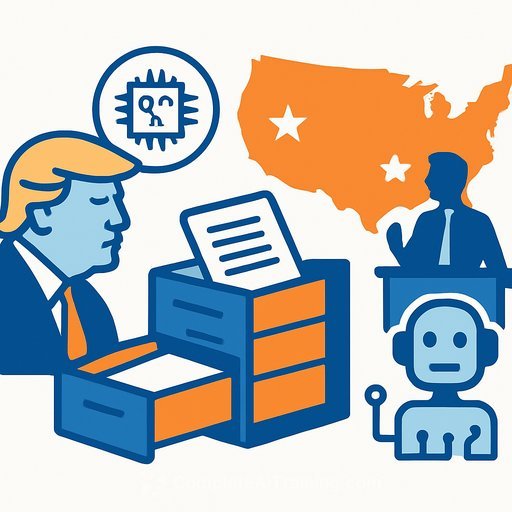
President Trump says he'll issue an executive order to create a single federal "rulebook" for AI - effectively overriding state AI laws. "We are beating ALL COUNTRIES," he wrote, warning that having 50 state rule sets would mean "AI WILL BE DESTROYED IN ITS INFANCY!"
The policy goal is simple; the legal path is not. Expect immediate suits from states, civil rights groups, and industry players who prefer existing state frameworks to a hazy federal directive.
Bottom line on preemption: an EO can't do what a statute does
Executive orders implement existing federal law; they don't create new law that preempts states on their own. Preemption requires a statute or a valid agency rule grounded in a statute. Without that, the Supremacy Clause isn't triggered.
That's why even major tech firms have acknowledged federal preemption of state AI laws "will require an act of Congress." Florida's governor echoed that point, arguing an EO "doesn't/can't preempt state legislative action." Courts will likely agree.
There's also the anti-commandeering line of cases. The federal government can't order states to legislate or enforce federal policy. See Murphy v. NCAA.
Using federal funds as leverage has limits
A draft concept reportedly floated would restrict certain broadband money from states with "overly burdensome" AI laws. That runs into Spending Clause guardrails.
Conditions on federal funds must be clear, related to the program, and not coercive. If the order threatens large, vital funding to force repeal or suspension of state AI protections, expect challenges under South Dakota v. Dole and its progeny (including the anti-coercion analysis from NFIB v. Sebelius).
Separation of powers and APA problems
To "create one rulebook," agencies would need to promulgate rules that preempt state standards. That means notice-and-comment and a statute to back it. If the EO pushes agencies to assert sweeping authority without clear congressional direction, challenges will invoke separation-of-powers principles and the major questions doctrine.
On day one, litigants will chase a preliminary injunction based on lack of statutory authority and irreparable harm to states forced to pause or unwind their AI safeguards.
States have already moved - and that matters in court
All 50 states (plus D.C., Puerto Rico, and the Virgin Islands) introduced AI bills this year; 38 adopted or enacted about 100 measures. Think consumer disclosures, impact assessments, hiring and housing bias checks, and model governance for sensitive uses.
An EO that tries to nullify this patchwork is a direct hit on traditional state police powers around privacy, discrimination, and public safety - the kind of space courts protect absent clear congressional preemption.
How this hits the justice system
"A great federal system could be better, in theory," said Nicholas E. Stewart of the Justice Education Project. "But in practice, without a system in place, states are only really the ones filling the gaps."
Stewart warns AI is already embedded in policing and prosecution. "Policing and prosecution are being quietly rewritten by systems that don't think, can't explain themselves and are not accountable to anyone," he said. "You don't get neutrality - you get automation of the same biases and power imbalances that already exist, except they're only faster, quieter and harder to challenge."
Columbia professor Daniel Richman adds a simple risk: invisible systems can harm "with fewer questions asked." Expanded data collection widens the net - often for communities already over-policed.
What to expect in litigation
- Standing: States asserting sovereign interests in enforcing their AI laws; companies harmed by funding or compliance whiplash; civil rights groups targeting discrimination risks.
- Claims: No statutory authority; Spending Clause violations; anti-commandeering; arbitrary and capricious agency action; procedural APA defects.
- Remedies: Early TROs/preliminary injunctions to block funding conditions or any federal directive that negates state AI statutes.
Practical steps for legal teams
- Map exposure: List your state AI obligations and where federal directives would force noncompliance or delay. Build a conflict matrix now.
- Funding audit: Identify broadband or tech-linked grants vulnerable to new conditions. Preserve communications and notices for a Spending Clause record.
- Preemption memos: Draft state-specific positions on police powers, consumer protection, and algorithmic accountability to support quick filings.
- Governance fallback: Maintain bias testing, documentation, and human-in-the-loop controls even if a federal pause is announced. Courts favor continuity that protects consumers and civil rights.
- Monitor Congress: The Artificial Intelligence (AI) Civil Rights Act was reintroduced. If it moves, the preemption analysis changes fast.
State of Play: U.S. Attorneys Turbulence
The push to install loyalist U.S. attorneys has run aground. After multiple rulings that certain acting appointments were unlawful, one high-profile U.S. attorney resigned, citing disruption across her district - trials stalled, sentences delayed, and docket confusion over the legality of her leadership.
Other districts are seeing similar friction. Judges have struck filings and questioned continued participation by officials already found disqualified.
DOJ leadership fired back, accusing some judges of bias against the disqualified U.S. attorney and her team while emphasizing they're following OLC guidance. At least one judge suggested resignation is the proper course if appellate courts have ruled the service unlawful.
The structural issue isn't new: prolonged Senate holds and the blue slip tradition have left interim tenures to expire, creating openings for these challenges. A lawsuit aimed at the blue slip practice was floated but hasn't materialized - and would be a tough climb.
Boasberg v. Noem: Contempt Risk in Alien Enemies Act Litigation
A federal judge is weighing criminal contempt referrals tied to flights deporting alleged Venezuelan gang members under the Alien Enemies Act. The court previously ordered planes turned around; the government later said they were already out of U.S. airspace when the order hit.
The Homeland Security Secretary submitted a declaration: "I made the decision to continue the transfer of custody of the Alien Enemies Act detainees." Senior DOJ officials described the legal analysis they performed that night, but the judge has not yet identified specific officials responsible for any violation.
Next phase: fact-finding on timing, command chains, and whether the directive was obeyed in full. If the judge finds willful defiance, referrals for prosecution are on the table.
The takeaway
Preempting state AI laws by executive order is a legal long shot. Expect courts to hold the line on federalism, Spending Clause limits, and statutory authority.
For now, states remain the active front for AI governance. Legal teams should keep their compliance programs intact and ready them for a fast, multi-front court fight if an EO lands.
Your membership also unlocks: