AI-powered open-source infrastructure for accelerating materials discovery and advanced manufacturing
Materials discovery is moving from trial-and-error to system-level design. Open-source tools, AI, and automated labs now connect data, models, and production in one loop that runs faster, costs less, and is easier to reproduce.
This article lays out a practical framework you can build today: how to collect and structure data, how to model it with physics and AI, and how to deploy results to the lab and the line-without sacrificing rigor, traceability, or sustainability.
Why open-source + AI matters now
- Speed: high-throughput experiments and simulations cut cycle time from months to days.
- Clarity: shared code, schemas, and model cards make results verifiable and reusable.
- Scalability: cloud-edge architectures support both benchtop robots and factory systems.
- Sustainability: carbon-aware compute, uncertainty-driven sampling, and fewer failed runs.
- Access: community datasets and tools lower barriers for teams and partners.
The shift: from empirical to generative platforms
Empirical discovery gave us progress; theory gave us direction; computation gave us reach. Big-data methods mined patterns, while generative models now propose candidates that meet target specs.
What works best is a hybrid: curated data pipelines, physics-grounded simulation, and ML for scale. Treat them as one system, not parts in isolation.
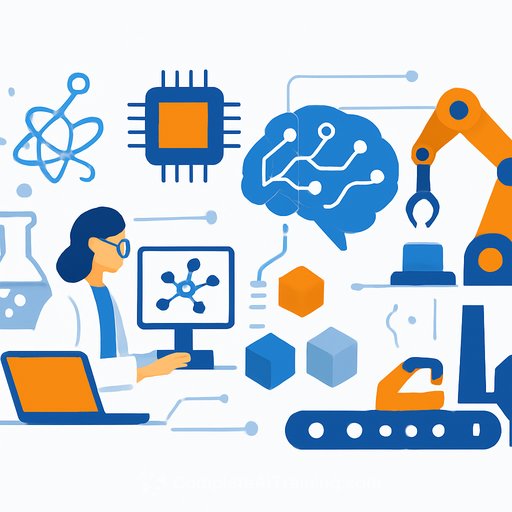
An end-to-end AI infrastructure (overview)
- Data sources: experiments, self-driving labs (SDLs), simulations, synthetic/LLM extraction, web scraping.
- Pipelines: cleaning, normalization, units, metadata, quality gates, PII/IP filters.
- Storage & lineage: object storage + DB, schemas/ontologies, versioning, provenance, access control.
- Modeling: physics-based (DFT/MD/FEM), surrogates, property predictors, generative design, active learning, uncertainty.
- Digital twins & SDLs: closed-loop design-make-test-analyze, physics-informed control.
- Deployment: cloud-edge services, MLOps, monitoring, safety interlocks, audit trails.
Data collection: from bench to bytes
Traditional experiments are slow and fragmented across labs. You need standard operating procedures, shared units, and consistent metadata to compare results and learn at scale.
Adopt FAIR principles so your data is findable, accessible, interoperable, and reusable. See the FAIR overview at GO FAIR.
Leverage open repositories for structure, thermodynamics, and electronic properties. The Materials Project and related databases provide high-value training and validation data.
Smart systems: self-driving labs and digital twins
SDLs close the loop: AI proposes an experiment, robots run it, instruments measure outcomes, and the model updates. The result is fewer dead ends and tighter feedback.
- Core pieces: experiment planner, optimizer, automated synthesis, in-line/at-line characterization, data broker, safety layer.
- Digital twins track process states and test "what if" scenarios before you spend time or material.
- Use physics-informed approaches to keep models stable under sparse or shifted data.
Physics-informed ML that respects constraints
Purely statistical models can drift. Physics-informed ML (including PINNs and constrained surrogates) keeps predictions consistent with conservation laws and thermodynamics.
- Encode constraints in losses, architectures, or priors.
- Apply to thermal transport, reaction kinetics, additive processes, structure-property links, and process control.
- Combine with uncertainty quantification to filter unsafe or low-value experiments.
Synthetic data without surprises
In silico methods (DFT, MD, quantum chemistry) expand your search space and guide experiments. Use community codes like LAMMPS, GROMACS, NAMD, and Quantum ESPRESSO for reproducible baselines.
ML interatomic potentials (e.g., HDNNP, GAP, equivariant GNNs) bring near ab initio accuracy to larger systems, but only within the domain of the training data. Plan for active learning and periodic re-anchoring to first-principles references.
Track compute cost and carbon use. Prefer mixed-precision, efficient kernels, and schedule heavy jobs during greener grid hours.
Web, literature, and LLM pipelines
Scrape public sources to fill gaps-within terms of use and IP rules. Tools like Beautiful Soup or Scrapy handle static pages; Selenium or Puppeteer deal with dynamic content.
For scientific literature, transformer-based extractors (e.g., domain models such as MaterialsBERT) outperform generic LLMs on terminology and units. Pair automated extraction with human-in-the-loop review, unit checks, and data cards that state sources, uncertainty, and license.
- Build canonical fields: material identity, composition, synthesis route, processing window, test conditions, property values, uncertainties.
- Flag ambiguous units, temperature/pressure assumptions, and sample history.
Data management, storage, and compute
- Schemas and ontologies: define entities (material, process, property, method) and relations; require units and methods per record.
- Storage: object store for raw/large files, relational or document DB for metadata, lakehouse pattern for analytics.
- Versioning and lineage: Git + data version control, immutable artifact stores, run registries, signed manifests.
- Access and governance: role-based access, dataset licenses, usage logs, retention policies.
- Edge-cloud split: run time-sensitive control at the edge; train and batch-score in the cloud; sync via message queues (e.g., MQTT) and APIs.
- Provenance and traceability: append-only ledgers or enterprise blockchain for experiment lineage, supplier data, and chain-of-custody when required.
Modeling stack: predict, design, and decide
- Property prediction: graph models and descriptors for modulus, band gap, ionic conductivity, stability, etc.
- Surrogates: replace expensive simulations; validate on holdout regimes, not just random splits.
- Generative design: VAEs/GANs/diffusion models propose compositions/structures under constraints.
- Active learning: close the loop with acquisition functions that target uncertainty, feasibility, and cost.
- Uncertainty and safety: conformal prediction, ensembles, and reject options to avoid unsafe runs.
- Causal checks: ablation with physics features, counterfactual tests, and dimensional analysis sanity checks.
Deployment to manufacturing
Use a service layer for models (REST/gRPC) with clear contracts, input validation, and unit enforcement. Keep latency-sensitive tasks on-prem or at the edge and batch work in the cloud.
- Integrate with LIMS/ELN, MES, and SCADA via adapters; log decisions and sensor streams for audits.
- Set guardrails: operating envelopes, SPC rules, automated rollbacks, and human approval for high-risk actions.
- Monitor real-time for drift, data quality, and energy use; retrain on scheduled and event triggers.
Sustainability, ethics, and techno-economics
Include lifecycle assessment (LCA) and techno-economic analysis (TEA) from day one. Optimize for performance, cost, safety, recyclability, and embodied carbon as co-equal objectives.
- Carbon-aware scheduling, hardware-efficient kernels, and small-but-accurate models where possible.
- Model/data cards, bias checks, and dataset licenses that respect IP and privacy.
- Supplier traceability and provenance for compliance and recalls.
Starter open-source stack (practical picks)
- Acquisition and control: PyVISA, OPC UA, MQTT, Bluesky for experiment orchestration.
- Pipelines: Prefect or Airflow; DVC for data versioning; Great Expectations for data QA.
- Storage: MinIO/S3 for objects; PostgreSQL or MongoDB for metadata; DuckDB/Parquet for analytics.
- Simulation: LAMMPS, GROMACS, NAMD, Quantum ESPRESSO, OpenFOAM.
- ML: PyTorch/JAX, scikit-learn, PyTorch Geometric, PyG/Deep Graph Library.
- SDL & scheduling: lab automation interfaces (e.g., vendor APIs), ChemOS-style planners, Bayesian optimization (Ax, BoTorch, SMAC).
- Provenance: MLflow for runs/models, OpenLineage, and optional Hyperledger Fabric for immutable records.
- Visualization: Plotly/Dash or Grafana for live dashboards.
Implementation roadmap (first 90 days)
- Weeks 0-4: Define use case and KPIs; lock units and metadata schema; stand up storage; baseline DFT/MD workflows; set energy and cost tracking.
- Weeks 5-8: Build ETL from instruments and simulations; deploy first predictors with uncertainty; add active learning; connect to a robot or semi-automated station.
- Weeks 9-12: Close the loop on a narrow target; add drift monitoring; run a multi-objective campaign (performance, cost, carbon); publish docs and model/data cards.
Common failure modes and guardrails
- Unit and condition mismatches; fix with validators and canonical fields.
- Data leakage and overfit; use time- and regime-aware splits.
- Distribution shift; monitor, detect, and schedule refresh or active learning.
- Ignoring uncertainty; require confidence thresholds for autonomous actions.
- Physics violations; add constraints or hybrid models, and reject out-of-domain inputs.
- Opaque provenance; sign artifacts and keep immutable logs.
Where to go next
If you want a structured path to implement SDLs, data lifecycles, and AI modeling in your lab, see the AI Learning Path for Research Scientists.
Your membership also unlocks: