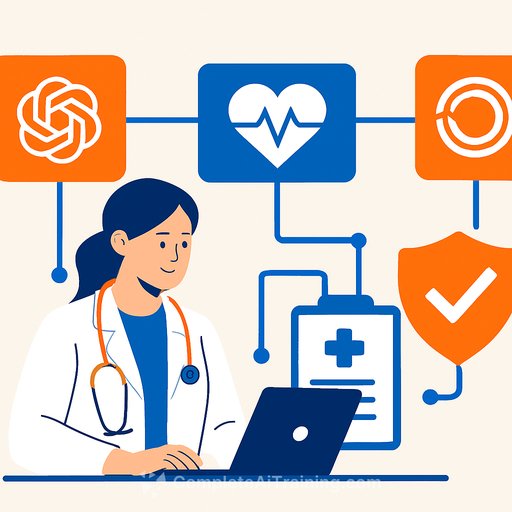
Healthcare AI Is Moving From Chat to Infrastructure
OpenAI and Anthropic just pushed healthcare AI past general chat and into your actual systems. The headline isn't model size. It's integration, governance, and how quickly you can plug this into clinical, administrative, and research workflows without breaking compliance.
Anthropic: Claude for Healthcare and Life Sciences
Anthropic introduced Claude for Healthcare and expanded Claude for Life Sciences. The key is a growing set of connectors that bring authoritative data into the conversation at query time.
- Coverage and coding: CMS Coverage Database, ICD-10
- Provider verification: National Provider Identifier Registry
- Life sciences: integrations across clinical trial operations and research platforms
They also added agent skills: FHIR-based data exchange, prior authorization review templates, clinical trial protocol drafting, and bioinformatics tooling. The message is clear: this isn't a single-turn assistant-it's built to run workflows.
OpenAI: OpenAI for Healthcare
OpenAI launched a package that combines ChatGPT for Healthcare with a HIPAA-configured OpenAI API. The focus is enterprise controls and compliance so IT, security, and compliance teams can say yes. See ChatGPT Training for practical guidance on deploying ChatGPT in regulated settings.
- Role-based access, SAML/SCIM, audit logging
- Customer-managed encryption keys and optional BAAs
- PHI remains under customer control and is excluded from model training in these configurations
ChatGPT for Healthcare supports retrieval over curated medical sources and your internal documents. Vendors are already embedding models for ambient clinical documentation, chart summarization, and discharge workflows-inside existing systems, not as another interface to manage.
Personal Health Data: Opt-In, With Real Concerns
Both companies are offering optional integrations for personal health data. They're opt-in with granular permissions and revocation controls.
That said, trust needs proof. As one user put it: "Handing over personal health data to a for-profit company should not rely solely on a blog post promise. Without independent audits and clear regulatory oversight, claims about data exclusion and non-training are hard to trust."
What This Means for Healthcare Teams
The shift is from generic assistants to embedded infrastructure. Expect tighter standards alignment, traceability by default, and controlled access to structured data-built to fit into your current workflow.
- Start where friction is high and outcomes are measurable: documentation support, prior authorization, care coordination, discharge planning, trial screening.
- Map your stack: EHR integration points, FHIR server availability, terminology services, identity (SAML/SCIM), key management.
- Decide your integration path: connectors to authoritative sources, retrieval over internal content, and agent skills for repeatable workflows.
- Governance checklist: BAA, data-use policy, PHI redaction where possible, role-based access, periodic access reviews, audit-log monitoring, retention limits, customer-managed keys.
- Validation: SME reviews, prompt/policy templates, test sets for quality and safety, bias and drift checks, rollback plan.
- Change management: quick training for clinicians and admins, clear support path, feedback loops into prompts and policies.
Questions to Ask Vendors Before You Pilot
- Show the data flow: what leaves our network, where PHI is stored, and for how long.
- Confirm that PHI is excluded from training and fine-tuning unless explicitly agreed.
- Provide audit logging and event export. Can we prove who accessed what, when?
- Keys: can we manage our own encryption keys and rotate them on our schedule?
- Standards: Do you support FHIR for data exchange? See HL7 FHIR.
- Compliance: BAA terms, data residency, and HIPAA guidance. Reference: HHS HIPAA.
Quick Pilot Plan (60-90 Days)
- Weeks 1-3: Security review, sandbox access, wire up SSO, define a narrow use case (e.g., prior auth packet prep or discharge summaries).
- Weeks 4-6: Connect to internal documents and codesets, build prompts and policies, run SME review, measure accuracy and time saved.
- Weeks 7-12: Expand to a second workflow, enable audit exports, finalize BAA and retention settings, train end users.
Bottom Line
This isn't about flashy demos. It's about integrating AI into your existing rails-standards, identity, logging, and data controls-so clinicians and ops teams get real time back without adding risk.
Upskilling Your Team
If you need practical training on platforms from leading AI companies, explore curated learning paths by role here: AI courses by job. For healthcare-specific resources and role-based tracks, see AI for Healthcare.
Your membership also unlocks: