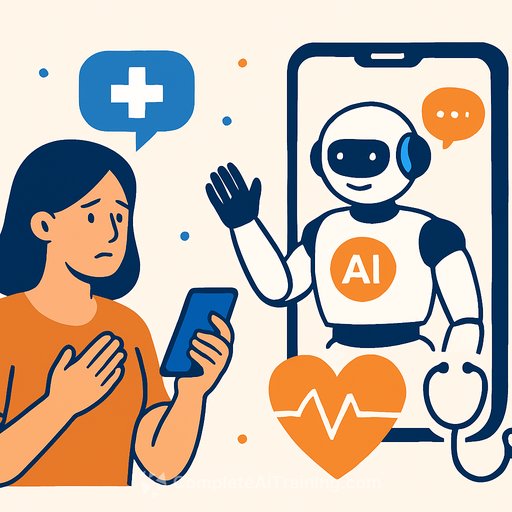
AI Companies Accelerate Healthcare Innovations Amid Rising Concerns
Friday, 16 January 2026, 19:58
Big tech isn't tiptoeing into healthcare anymore. According to TechCrunch, OpenAI acquired medical startup Torch, Anthropic launched Claude for Health, and MergeLabs-backed by Seth Altman-closed a $250 million seed round at an $850 million+ valuation. Money and product launches are stacking up fast in healthcare and voice AI. The upside is obvious; the risk is real.
What this means for healthcare leaders
Expect a flood of AI tools targeting documentation, triage, coding, prior auth, and patient communications. Voice AI will compete to become the default "ambient scribe" across clinics and hospitals. The winners will be the systems that are accurate enough, compliant by design, and easy to roll out across service lines.
Where AI can add value right now
- Ambient clinical documentation that reduces after-hours notes and burnout.
- Front-door triage and patient messaging with clear escalation rules.
- Revenue cycle support: Coding suggestions, denial analysis, and prior auth drafts.
- Clinical summarization for chart review, handoffs, and discharge notes (with clinician oversight).
- Ops automation: referral management, appointment reminders, and intake QA.
The risks to manage from day one
- Hallucinations and inaccuracies: Ground models in your EHR and clinical guidelines; require human review for clinical outputs.
- Data exposure: Enforce tight PHI controls, encryption in transit and at rest, and strict data retention. Sign BAAs and verify where data is stored and processed.
- Model drift and bias: Monitor performance by population, specialty, and workflow. Retrain or reconfigure when quality drops.
- Security gaps: Pentest vendors, check SOC 2/ISO 27001, review audit logs, and test incident response.
A practical rollout playbook
- Start with one high-friction workflow (e.g., outpatient notes) and one willing clinical champion.
- Define pass/fail criteria: accuracy thresholds, time saved per note, clinician satisfaction, and audit results.
- Rigor first: human-in-the-loop review, clinical governance sign-off, and clear "do not use for" rules.
- Integrate with the EHR to reduce copy/paste and version control errors.
- Scale only after two consecutive cohorts meet safety and ROI targets.
Security and compliance checklist
- Business Associate Agreement (BAA) with clear data-use limits.
- Role-based access, SSO, and PHI minimization by default.
- Encryption at rest and in transit; data residency documented.
- Comprehensive logging and audit trails; admin controls for data deletion.
- Independent security reports (SOC 2 Type II, ISO 27001) and recent pentest results.
- Clear process for incident reporting and model updates.
If you need a quick refresher on the basics, review the HIPAA Security Rule summary from HHS for controls that still apply to AI vendors today: HHS HIPAA Security Rule.
Clinical safety guardrails
- Use retrieval-augmented generation (RAG) to cite sources from trusted guidelines and your own policies.
- Require visible citations and versioning for every AI-generated clinical statement.
- Set hard stops for high-risk content (diagnoses, medication changes) unless explicitly approved workflows exist.
- Run periodic blinded reviews by clinicians to catch drift and edge cases.
Vendor questions worth asking
- What data is stored, for how long, and where? Is any of it used to train models?
- Can we opt out of data retention and still maintain performance?
- How do you measure accuracy by specialty, and can we see raw evaluation sets?
- What happens when the model is wrong? Show us your escalation and correction loop.
- Can you integrate into our EHR and respect our audit and role permissions?
Metrics to track from week one
- Time saved per note and per encounter.
- Clinician acceptance rate and edit distance on AI drafts.
- Denied claims rate and days in A/R (for RCM workflows).
- Patient safety signals: near-miss reports, overrides, and manual escalations.
Why this surge is happening
Healthcare has clear pain points, repeatable workflows, and budgets tied to measurable outcomes. Voice AI is now good enough for ambient notes and call centers. And big players see a window to become the default operating layer in clinics before standards harden.
Podcast highlights: broader tech moves to watch
TechCrunch's Equity podcast digs into what's behind the push into medicine and adjacent shifts across software and hardware. Topics include:
- How Anthropic's collaboration tool could pressure Salesforce and other enterprise vendors.
- Bandcamp banning AI-generated music on the platform.
- Fusion energy gaining traction, with startups like Type One Energy drawing large checks.
- Updates on Luminar's bankruptcy and a potential trade conflict tied to its LiDAR assets.
Listen here: TechCrunch Equity.
Bottom line
Adopt AI where the risk is controlled and the ROI is provable. Treat safety, privacy, and clinical governance as the product-not an afterthought. Move fast on pilots, but keep the guardrails tight.
If you're building internal capability and need structured upskilling for clinical, ops, and data teams, explore curated options by role: Complete AI Training - Courses by Job.
Your membership also unlocks: